Sermon for December 21, 2014 (Advent 4)

Text Luke 1:26-38 (The Annunciation); Preached at St Andrew Memorial, London Ontario

Middle of the night phone calls or knocks on the door are always unsettling. First there is that sudden ascent into consciousness. Then there is the noise. Loud and shrill: the ring of a phone. Strong thuds: the pounding on the door in the wee hours of the morning. Noises that are destined to set the heart racing.

Blood pounds through the veins, each beat of the heart a prayer on behalf of the one who has no words.

Hello?

An unfamiliar voice, a uniformed person, “I am just calling with a message…”

***

She knows it’s a tough place to raise a kid. Especially one who can be opinionated and outspoken like this one. It just isn’t safe to stick your neck out like that here, and she has told him that more times than she can count. Last week, the priest’s dog disappeared … and everyone knows it is because the priest was too outspoken against the government, but no one has any hard evidence.

That is always the way it is. Things happen but there is never any way to assign blame.

It is just a matter of time.

She lifts her eyes up, sighing out her frequent prayer, “How long, O Lord, must your people wait in suffering and in silence.”

As if to prove her fears true, she sees a familiar figure limping down the long dirt road that runs through the village. Soon, his swollen and bloodied face comes into focus through her tears: “They said they were sending a message, mom.”

***

That time lag between the doctor’s call and the doctor appointment is always nerve-wracking. Every single scenario known to humankind – or the Internet – has flashed before the eyes and given that sinking feeling inside, all before a foot is even set inside the doctor’s door. And then you wait – wait with little to cling onto save that reassurance of “I will never leave you or forsake you” that is both comforting and hollow at a time like this.

Finally the impassive doctor comes into the room wearing a sterile white coat, clipboard in hand. You’ve never seen this doctor before and it is a little intimidating. The doctor clears his throat, pauses, and then opens his mouth to deliver the message.

***

She is probably minding her own business, going about her day as usual. She lives in a small, out of the way, unimportant village in a small, out of the way province, in a big empire. In this village over 2000 miles away from the centre of the empire, there aren’t many strangers that wander through town save maybe the odd soldier stationed at the garrison 30 miles down the road.

And it is probably a good thing that there aren’t many strangers. Those that run the empire aren’t always friendly to the locals. If a solider tells you to pick up and carry his gear for a mile, there really isn’t any safe way of refusing. The political government and the religious leadership don’t always get along. When they do, it is often to unite against young, vocal activists – anarchists you might call them – or martyrs – or zealots – activists who are disrupting the uneasy peace that the community has settled into.

Mind your own business, keep your head down; don’t look for trouble and trouble likely won’t look for you. That is the best way to live when it seems like God has forgotten you and your country.

***

Imagine if you will – or maybe you don’t have to imagine because it is all too real – the idea of God being silent. God hasn’t spoken to you or noticeably acted around you for years.

Decades.

Generations.

You don’t hear from God. You as a people thought you were “the chosen ones” – the ones upon whom God’s favour rested, and you had God’s king whose kingdom was going to last forever. You had God’s temple, where God lived and where you could worship God freely.

And then it all fell apart – literally. The kings were killed or deported and that line ended, the temple was destroyed and it seemed that God left the land, the people were exiled and you did not know if or where God is anymore.

Life goes on, but it is certainly not the same life that you knew before, when you had tangible evidence that you were God’s chosen people.

Songs of Lament are a regular prayer, “How long, O Lord? Will you forget me forever? How long will you hide your face from me? How long must I bear pain in my soul, and have sorrow in my heart all day long? How long shall my enemy be exalted over me? Consider and answer me, O Lord my God!” (Ps. 13)

***

And so we return to the young woman in the small, unimportant village, in the out of the way province, in the big empire. She is going about her day as a normal day. Yes, the Temple has been rebuilt in Jerusalem, but God still seems absent. There haven’t been prophets speaking God’s message the way her ancestors would have heard it. Foreigners occupy and rule the land. The wealthy landowners have gotten their wealth off of the backs of the regular person who is often forced into working as a tenant farmer while the owners head off to live the good life in the city.

Then the stranger appears in town – a stranger that the woman has never seen the like of before – not even in her dreams. Or nightmares.

“Greetings, favoured one! The Lord is with you.”

The Lord is with you.

With five simple words everything changes.

The Lord is with you.

What sort of greeting is this?

The Lord is with you:

“You, Mary, will conceive in your womb and bear a son, and you will name him Jesus. He will be great, and will be called the Son of the Most High, and the Lord God will give to him the throne of his ancestor David.”

Mary pauses: I’m from a small town – I know how babies are made. I’ve got to tell you – that’s not happening here!

The Lord is with you, the messenger said.

The Lord is with you:

With five simple words the Word that once hovered over the waters when darkness covered the face of the deep broke its silence and announced its intention to become flesh and dwell among us.

The Lord is with you: nothing will be impossible with God.

The Lord is with me: Here I am, the servant of the Lord; Let it be with me according to your word.

The Lord is with you.

These five simple words we say each week as we gather together around the table: The Lord be with you.

Maybe they are not so simple words, after all.

What does it mean, what does it look like to say that the Lord is with us?

The Lord who was born in a manger in Bethlehem, who walked on dusty roads, who healed the sick, and fed the hungry, The Lord who walked on water and died on a cross. The Lord who, on the third day, rose from the dead: The Lord is with you.

The Lord who holds your beating heart in love when your phone rings in the middle of the night or when you awake to pounding on the door: The Lord is with you.

The Lord who is there when you wipe away tears and wash bruised and bloodied faces of those persecuted for standing up for justice – or when you simply stand in solidarity with them: The Lord is with you.

The Lord who is there, laughing when you laugh and crying when you cry: The Lord is with you.

The Lord who, as Mary sang in her joy, brings down the powerful from their thrones and lifts the lowly; who fills the hungry with good things and has sent the rich away empty: The Lord is with you.

The Lord who sits with you in those times of uncertainty, who accompanies you when there is news from the doctor: The Lord is with you.

The Lord who welcomes children, who calls rough-around-the-edges working class folks, and who breaks bread with outcasts and sinners: The Lord is with you.

The Lord who walks beside you as you feed the hungry, give clothing to the naked, sit with the hurting: The Lord is with you.

The Lord who journeys beside you in the joys or in the mundane of daily life: The Lord is with you.

The Lord is with you: Not only is this our anticipation in Advent, this is our Reality every day.

The Lord is with us.

Amen.

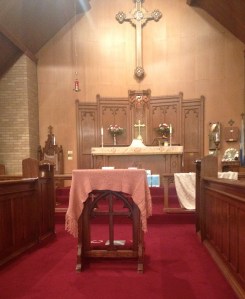
/home/wpcom/public_html/wp-content/blogs.dir/66c/8056372/files/2014/12/img_0527.jpg
Photo from Christ Church Cathedral, Victoria. Taken from their Facebook page.
Halfway

The end of term one year two: I am now officially halfway through seminary! It is hard to believe that 17 months ago I was getting on a plane to leave BC and move to Ontario. It feels a lot longer…

The weather in this corner of Ontario has felt a lot like Vancouver Island weather over the last few weeks (*touch wood*). While some have been lamenting the lack of snow and the above zero temperatures, I have been enjoying mist, fog, and mild days reminiscent of home.

All of that being said, I won’t be sad if and when we get snow – I have some ice skates, snowshoes, and cross country skis to put to use! Not to mention the winter jacket that I bought new this year.

Christmas break for me this year will involve working some extra shifts and reading lots of good fiction. Fiction: it is like a breath of fresh air after three and a half months of dense theology texts. Work: it grounds me and is a wonderful community to be a part of that is completely removed from my school and church communities. There is something very real and immanent about working shoulder to shoulder with those living with severe mental illness; there is no BS with them, no politics, and no illusions.

And then January will happen and it will be back to school for term two year two (or term four of six, depending on your preferred method of counting!).

Until then, Happy Christmas.

Praying Communities

I’ve been in a placement all term and I love it.

My parish is a warm and welcoming place – much like a big family. They have embraced me (and Matthew whenever he can be spared from his placement) and already made me feel a part of the community in the three short months I’ve been there.

Part of it being a wonderful place is the love and care that they give to everyone in the congregation. Earlier this fall, a long-time central member of the church was diagnosed with cancer. Immediately we went to work, knitting. Around the table at parish council a prayer shawl was passed. Each of us with any skill with knitting needles knit a few rows, then passed it along to the next person. The love and the care of the congregation was knit into that shawl along with their prayers. Each section slightly different, all of the unique gifts of the congregation coming together to make one beautiful garment.

I was blessed, as a relative newcomer to the parish, to be able to add a few rows myself. I know the legacy this woman has had on the church and I have heard stories of how central she is to the community and I was honoured to be able to add my own part to our shared gift.

When it was finally completed, we brought the shawIMG_0464l into church and laid it on the prayer desk in the centre of the choir. As each person came up for communion they paused, laid hands on the shawl, and prayed – some just for a moment and others lingered. Sitting at the front, I was moved to tears by the love, care, and faith shown by everyone.

We blessed the shawl at the end of the service and then it went off to bring our prayers and blessings to our family member in hospital.

This is the body of Christ at work.

Making Space

A beautiful thing happened last Sunday morning.

Our server was sick and opted out of serving for fear of infecting everyone. As he was telling the priest, his six-year-old son piped up, “Can I?!?”

Without missing a beat the priest accepted his offer and my newest assistant was created.

Come communion, I invited him up to help me set the table. As I readied the table, he waited patiently. Then we painstakingly counted out the host together, lapsing into his mother tongue as he counted: “five. ten. fifteen. vente. vente cinqo. thirty. …”

Then the wine. I brought the chalices down from the table, crouched down on the step beside him, and asked him if he thought he could pour the wine in. “Which one is the wine?” “The red one” Slowly, painstakingly, ever so carefully, he poured the wine into one chalice, then the other. The hymn ended. We were still pouring. Then, while all looked on in silence, we added the water – slightly more than our usual splash.

The table was set. We passed it over to the priest who continued the service. Our newest server sat and squirmed for a minute, all the solemnity of setting the table for Eucharist gone, then bounced back down to sit beside his dad, running shoe heels lighting up as he went.

Come to the table, where space is made for all.

Sermon for November 9, 2014

Text: Matthew 25:1-13; Preached at St Andrew Memorial Church, London Ontario

When you are offshore sailing, the 4 to 8 watch is possibly the worst shift to have.

Four hours. Twice a day.

It doesn’t seem like much when it is 4-8 in the afternoon: there are people milling around on deck, the sun is out and there are things to look at. The shift is broken up by the appearance of the evening meal on deck for you to eat.

But the hours from 4 to 8 in the wee hours of the morning: that is the hard part.

You are dragged from your nice warm bunk in the middle of a wonderfully deep sleep. Up onto the cold, probably wet, deck. No cover. No protection from the elements. Just you and two others responsible for steering the ship through the night until morning comes. Those hours until dawn can seem like an eternity.

And the sky is black – as far as you can see.

If it is a clear night, the only light is the millions of pinpricks of stars that cover the sky from horizon to horizon to horizon. And it is those stars that let you know when you have dozed off at the wheel and gone off course.

All are sleeping.

All is silent except for the rhythmic slap

Slap

                                                                                 Slap

                           Of the waves against the hull of the boat.

And you wait

You wait.

You wait some more.

Shift partners sometimes talk to try and keep each other awake. But in the dark of early morning, it is far too easy to be silent, lost in your own inner world, dozing off while on watch.

You wait for the sun to finally peek over the horizon – because you know it is going to eventually come – and offer some light to the brand new day.

Waiting is hard work.

It is hard to remain alert and expectant when it is dark or when there does not seem to be much hope for that which is expected.

It is even harder when you do not know the day or the hour when that for which you wait will come to pass.

The sunrise is expected: it happens every day whether we are waiting for it or not.

The Lord’s coming? Who knows?!

This is what we have in our readings this morning: We have people who have grown tired in waiting. Who could blame them?

The kingdom of heaven is like this, Jesus says:

It is like ten bridesmaids who are waiting for the bridegroom to appear.

They wait, and they wait, and they wait some more.

They wait so long that the oil in their lamps runs out.

Some – they are called the wise – are prepared to wait for a long time and have more oil. Others – they are called the foolish – are not prepared to wait that long and their lamps go out.

Then the bridegroom comes. Those who have thought to bring extra oil go with him; those who have run out of oil are left out.

What are we to make of this?

I must admit to being a little uncomfortable with the idea that being unprepared can result in getting shut out of the bridegroom’s wedding banquet. There are times in life where I have felt more than a little unprepared or ill-equipped for the task at hand and have had to rely on collaboration or cooperation with others. I am sure that you have experienced those moments as well. We all have.

The reverse is equally discomforting. The idea of being like one of the wise bridesmaids who refused to share or cooperate is also an uncomfortable one.

And then there is the bridegroom who says that he does not even know the foolish bridesmaids and shuts them out. How do we understand THAT?

What if the more important part of this parable is something else entirely?

What if it is about that one little line in the middle of the parable: “As the bridegroom was delayed, all of them became drowsy and slept.”

Perhaps the point of this parable is actually about trying to remain alert in the moment – awake, aware, and keeping watch. If we keep our eyes open, keep looking around us at the community we journey with, what will we see?

If we are intentional about our relationships then we will see who amongst us might be running out of oil. What if, right from the beginning, the wise bridesmaids had said to their foolish sisters, “Hey – did you think to bring extra oil? We might be here awhile, maybe you should go and get some more so that you can be ready.” Instead of cultivating relationships with their companions, helping each other out, they all fell asleep waiting.

Life doesn’t always go as planned. The folks in the first century after Jesus’ resurrection were pretty sure that Jesus was going to come back any minute. They were so sure of this that they did not think they would die before Jesus returned.

Two thousand years later, we are still waiting. But that doesn’t mean that we can fall asleep, saying, “We’ve got all the oil we need. We are all prepared.”

Waiting for Jesus’ imminent return is difficult for many of us to understand or entertain. Life happens and we can’t just put that on hold.

But opportunities for waiting on Jesus’ presence are all around us every day if we keep watch:

Each time we work for justice, we reveal the presence of Jesus.

Each time we bear each other’s burdens, we reveal the presence of Jesus.

Each time we advocate for the poor, or reach out to the friendless, or work to make this world a better place, we reveal the presence of Jesus.

This is hard work, and we can admit that this kind of waiting, this kind of alertness, this kind of preparation can be hard to sustain. We can grow tired in our work. We can get frustrated by not seeing any outcomes or distracted by all of the obligations that fill up our days. On any given day, we can be the foolish bridesmaid who feels ill-prepared or unequipped. Or we can be either of the bridesmaids who fall asleep.

But this is why we have each other. That is why we have this community where we can find help and support in all the different kinds of waiting that we face each day.

More important than who has the oil is that we as a community have oil. We are those who wait with each other – the wise and the foolish together, helping, encouraging, and sustaining.

We are those who sit awake with and for each other at times of pain, loss or bereavement.

We are those who celebrate achievements and console after disappointment.

We are those who give hope when hope is scarce, comfort when it is needed, and courage when we are afraid.

We are those who help each other to wait, prepare, and keep the faith.

In all these ways, we encourage each other with the promises of Christ. That’s what it means to be in the wedding party – then and now.

With much appreciation for the many online commentators who helped me put this together and whose ideas I shamelessly borrowed in a few places.
Karoline LewisMatthew L. Skinner, Sharon L. Blezard, and David Lose,

Niagara Falls

This past week was Faculty of Theology reading break here at Huron.

Matthew and I took the opportunity to take two days away and go to Niagara Falls and Niagara-on-the-Lake – time with each other, time to explore nature, and time without having to think about school or school work for a couple of days.

It was a lovely getaway to a place I have not been since I was 11 or 12.

Sermon for October 19, 2014

Text: Matthew 22:15-22; Preached at St Andrew Memorial Anglican, London, Ontario.

I wonder when the disciples of the Pharisees and the Herodians in today’s gospel reading began to realize that their question was not going to yield their desired outcome. Here they are, with Jesus cornered in the Temple, days after his Triumphal Entry into Jerusalem with all of the fanfare – and then his subsequent clearing of all of the money changers and vendors in the Temple. After a scene like that, no one is going to forget this man very quickly.

So they have Jesus pinned, hemmed in by questioners in the Temple – much like reporters at a press conference – and they ask him a question – one they have cleverly designed with the specific purpose of trapping him by what he said and getting him in trouble with either the Political Leadership or the Religious Leadership.

“Teacher, we know that you are sincere, and teach the way of God in accordance with truth, and show deference to no one; for you do not regard people with partiality. Tell us, then, what you think. Is it lawful to pay taxes to the emperor, or not?”  (vs 16&17)

A well-crafted question that can only leave Jesus in a predicament.

Or so they thought…

The disciples of the Pharisees and the Herodians must have known that something was up when Jesus accused them of putting him to the test and called them hypocrites. Surely they must have felt a note of concern when he asked them to bring him the coin used for the tax. All bets should have been off when he started asking the questions – “Whose head is this? And whose title?” After all, as we have seen in the gospel readings over the last few weeks, Jesus has been specializing in making the Religious Establishment look pretty foolish.

Image is an interesting thing. It used to annoy me to no end when complete strangers would come up to me and tell me how much I resembled my mother. I knew it was a tight resemblance when a friend of the family asked why there was a portrait of me up at my mother’s memorial service: it was actually a picture of mum in her early twenties. Even a few weeks ago when we visited the parish I grew up in for the first time in over ten years, half of the church came up to say hi to me, knowing instantly to which family I belonged because of the closeness of my image to my mother’s.

Image.

Whose image?

Jesus’ answer is so simple – so simple that the religious folk trying to trap him probably wish they’d thought through all possible scenarios before asking their initial question.

Jesus holds up the coin and asks, “Whose head is this? Whose title?” Whose name and whose image is on this coin that you carry?

Then he answers – “Give to the emperor those things that are the emperor’s and to God the things that are God’s.” Jesus doesn’t say what belongs to God but leaves that wide open for us to realize the gift that we are handed.

In leaving it wide open, Jesus is making no demands upon us. It would have been really easy for him to launch into a long and detailed explanation of what is and what is not God’s. But he doesn’t do that. He merely says, “Give to God the things that are God’s.”

The things that are God’s.

The things that belong to God?

Despite the close resemblance between my mother and I, it isn’t as easy to see that family resemblance between me and others in my family. Unlike a coin, I haven’t got a family name or a family image stamped onto me. It just isn’t that obvious.

But I, like each one of us, am a child of God. Made with love and care, in God’s image. And each day has been left wide open for us to decide how each one of us will show the world whose image we bear. Not our earthly family, though that can be a lovely thing. But that we bear God’s image. That we are a part of God’s family, carrying God’s name.

It is a question to ask, maybe while lying in bed before feet hit the floor, maybe while getting dressed and ready for the day each morning: how close of a family resemblance do I have? Do you have? What can I, what can you, do to give to God that which is God’s? How will anyone know?

Because in making no demands but simply stating, “Give to God that which is God’s,” Jesus is allowing us the choice to decide for ourselves. And I, like each one of us, get to respond each and every day and decide what to do with that which bears God’s image.

Amen.

End of an Era

Four years ago, in May of 2011, I went to my first PWRDF Youth Council meeting in Vancouver. Four years later, only three of twelve of that Vancouver crew are still on the council. And now it is two only.

After four years – two as representative for BC/Yukon and two as Member at Large – my time has ended. Through the Youth Council I learned a great deal about the workings of PWRDF. I became more involved in international social justice issues, more informed about international relief and development work, and more vocal at home about issues which affect us all. I have had numerous opportunities to write about my experiences for the Youth Council website and had the opportunity to speak about PWRDF in nearly a dozen churches in at least five diocese in Canada. It has been a good journey.

Last weekend was my last meeting with Youth Council. It is bittersweet. I aged out of Youth Council 18 months ago and somehow they kept me around and doing work on council. It is an amazing group of young people doing incredible work and I have been proud to have been involved with them.

We’ve come a long way. I’ve been involved in a complete rewrite of our Terms of Reference and governing Manual. I helped create worship resources for youth groups to use. We have created amazing promotional materials that have been adopted by PWRDF as a whole. And I worked with PWRDF staff to create an international internship program for Canadian youth.

I’ve learned a lot, I’ve grown a lot, I’ve had some amazing opportunities, and made some incredible friends. Youth Council friends, I’m looking forward to seeing where you go from here! PWRDF, I’m looking forward to changing our relationship. Because one is never too old to care about the needs of others, to respond in love, and to seek to transform unjust societal structures.

Sermon for October 5th, 2014

Readings: Isaiah 5, Matthew 21:33-45; Preached at St Andrew Memorial, London Ontario.

You have maybe had that moment where someone starts to tell a story and you realize you’ve heard it before – so you know that it is a good one… there is that eager expectation for the highlights of the story – you might even prompt the story teller if you think they’ve forgotten one of the key lines.

I kind of think that is how the listeners must have felt when Jesus started to tell the parable in today’s Gospel reading: They know the story about the vineyard. They’ve heard it before from Isaiah and they are pretty sure that they know exactly what is going on:

Israel the unfaithful.

Israel the untrue.

God’s unrequited love for Israel.

Unrequited love that results in Israel being cast away – exiled, and her temple destroyed because of her bad behaviour.

So when Jesus started to tell the story about the vineyard with wicked tenants, I picture some of those listening taking a step back, maybe folding their arms or raising an eyebrow and saying, ”I know how this one goes! Lets see how he does”

Jesus describes the care the landowner goes to in order to set up his vineyard. He describes the way the landowner leaves the vineyard with tenants to tend it and harvest its produce.

Then Jesus describes the cycle of violence that ensues when the landowner seeks to recover the crop from the vineyard:

The tenants kill the first set of slaves sent to collect the fruits of the vineyard.

Then the tenants kills the second set of slaves sent to collect the fruits of the vineyard.

The landowner, perhaps in a temporary loss of sanity, thinks they won’t dare do anything to his son and his heir. So the son is sent to collect the fruits of the vineyard and the tenants seize him, toss him out, and kill him too.

So it isn’t really too surprising that when Jesus finally asks the question: “When the owner of the vineyard comes, what will he do to those tenants?” that everyone listening is like “Oh, I’ve got this one, I know the answer”: after all, in the vineyard story from Isaiah that they all know, God destroys the vineyard entirely, trampling down its walls, lets it become overgrown, casts out the people, and speaks of bloodshed from the pruning that Israel will experience.

So the listeners answer, kindly sparing the vineyard itself, but damning the tenants: “He will put those wretches to a miserable death, and lease the vineyard to other tenants who will give him the produce at harvest time.”

If they won’t comply, kill them and get new people who will do a better job.

I find myself asking “Why” when I read this gospel parable. Why are the tenants killing the slaves and trying to keep the harvest and the land? I wonder what drove them to do that?

Are they really wicked?

What if they are desperate?

The landowner, we are told, lives at a distance. An absentee landowner. He bought the property and probably invested a lot of money into setting up this vineyard, came to some sort of arrangement with his tenants, and then took off to live in another land. So this guy probably has some money. Judging from the way he takes such time and care to set up his vineyard, we can guess that this was a brand new vineyard: a brand new vineyard carved out from land that may once have been common land for the peasants to harvest crops for their food on. This was a common practice in Palestine in Jesus’ day.

It is also, unfortunately, a common practice today.

Canada is home to 75 per cent of the world’s mining companies and mineral exploration companies. The Canadian stock exchange raises 40% of all mineral exploration capital worldwide. (Statistics from Kairos)

Canadian mining companies have been known for taking advantage of, worsening, or even provoking conflict in countries with weak democracies. Exploiting the conflict to their own financial and material gain.

I travelled to El Salvador at the beginning of this year. In El Salvador we sat with and listened to the stories of people affected by Canadian mining operations in that country. We heard about agreements made to deliver the resources from the land at the expense of the workers and those trying to live on the land. Wealthy company executives who live in another country who pressure – and even trick – those working the land to sign away the rights for and turn over a product beyond what they and what their land can sustainably produce. To give up a return that will not enrich the workers and will not provide for their livelihood – instead it will kill their livelihoods and poison their water. A return that will only line the pocket of the mining company executives and shareholders. And when the people of the country put their foot down and say “No more exploitation,” violence – intimidation and death – against those who protest, follows.

Would we blame these workers if they decided to revolt? Wanted to seek better working conditions? Wanted to protect their children and livelihoods?

I’m all for justice in the world, and I’m all about fairness – and killing messengers sent to collect produce probably needs to be dealt with, but all of this – the destruction of the land, the exploitation of vulnerable workers and retribution for non-compliance – this just seems like a lot of violence that needs to be stopped. The people listening to Jesus’ story, however seem to encourage it to continue: “put those miserable wretches to death and find someone else to do the dirty work.”

I don’t know about you, but that kind of response doesn’t seem like the Jesus that speaks elsewhere in the gospels – the Jesus who challenges the status quo and asks us to stand up for the poor and the vulnerable. Not with violence, but with love.

Jesus, shocking his listeners, and perhaps challenging us, doesn’t agree with that response either. Jesus flips it around. “Haven’t you read the scriptures?” he asks. As if to say – is this really what you think God is like? Do you really want a violent God? A God who is represented by the landowner that goes in and kills everyone – a God who is just going to be violent in response to any violence that happens?

No, says Jesus, “the stone that has been rejected will be the cornerstone.” Instead of telling a story of a violent and retributive landowner, I am telling the story of what could be: Those who you reject I have lifted up. The least among you is the greatest. The voiceless will be listened to. Those who exploit will be overturned and we will have grace and justice.

We believe in a God who asks us to feed the hungry, clothe the poor, visit those in prison, shelter those who are homeless. A God whose son Jesus Christ said, “whatever you did to one of the least of these, you did to me.”

I am challenged to ask, what I, what we, have done and what I, what we, have left undone to the least of these.

Amen.