Tag Archives: faith
For Your Viewing Pleasure
Brilliant. H/T
Loving Others
When Jesus said to love others, what did he mean?
If the measure of love I have for those around me is the indication of the measure of love I have for God, how do I know if I am loving those around me?
As a person who gets along with nearly everyone, there is not really anyone I actively dislike. Does that somehow make me super-person who must love God a lot? I’m not sure. Not actively disliking someone does not necessarily mean I love them.
If I walk by a homeless person and ignore them, am I not-loving them?
If I write off a person in my social circle, am I not-loving them as well?
Just some things I was thinking about today with the young peoples group at church.
‘The Bible is no longer considered part of the conversation’
This is an interesting article.
Community
I’ve been doing a lot of thinking on the subject of community lately. The thoughts have been stimulated by life decisions I’ve had as of late, by conversations overheard and conversations with friends, books I’ve been reading, and observations of the world around me. Now that I have begun to think about it, I see references to community everywhere.
As some are aware, I had the opportunity to volunteer in Kenya for three months this summer. One of the (many) reasons for deciding against going was because of the community I am finally feeling a part of here and my reluctance to break away from that right now. After a number of years of transient life, I seem to be craving an integral part in a healthy land-based community.
What is it about community that compels us and draws us in? Over and over when I was living and working on the Pacific Grace we were confronted with trainees returning year after year to the program. One of the interesting things we found is that it was the community which drew them: crew changes on a regular basis, the boat itself isn’t enough of a draw (it is a hard life on the boat for many trainees – up early in the morning, doing dishes, no showers, no [shock, horror] Facebook…), but the consistent thread is the welcoming community rooted firmly in God. It is this community which draws trainees back year after year and gives then a sense of being loved and known.
This type of community, that which welcomes everyone regardless of physical or mental weakness and ascribes worth and value to each human, is the premise of Jean Vanier’s book Becoming Human which I just finished re-reading. If you haven’t gone out and read it yet, you should. [Aside: There have been two great posts on the blog Faith and Theology in the last week or so involving Vanier’s L’Arche communities here and here.]
Two weekends ago, I visited a good friend in Vancouver. We first met ten years ago in high school when her family moved to town for her mother to take up a teaching position at our school. As principal, Dad invited their family over for a bbq one evening and, as the daughter the same age as the new family’s daughter, I took her on a long bike ride through the coulees. She likes to relate this story and tell everyone that I tried to kill her. Not so. We have kept in touch, some times better than others, over the last decade. When she was tree planting up in northern BC, she would stay with us on days off. When I moved to Victoria I became friends with her best friend, not knowing they were friends. Somehow (and, I think, for good reason), life has kept us connected. Both of us have had a number of major life experiences in the last few years. Mine involved living in intense community on the boat for a period of time and then finding myself on shore without it and craving it. Hers involved a campervan pilgrimage around the east coast seeking to understand how others do community and interact with society around them. In the end we have both settled in BC in various types of communities. I had the privilege to step into hers for 24hrs.
The HOB is a house of five girls living in East Vancouver. They have a fantastic community house in which the care they have for each other is genuinely evident. I began to journal my thoughts on community while I was with them. They have community meals weekly and spend time praying with and for each other as well as holding each other accountable. Entering their community house, I immediately felt relaxed and welcomed, as though I had known all of the girls for years. (And they put me to work in the morning making pancakes as though I had known them for years…) It was a refreshing feeling and the resulting 24hrs was the precise downtime and recharge that I needed. All of our living spaces should be like that.
On a long public transit ride home two weeks ago, I was reading Jean Vanier while eavesdropping on a conversation going on between two people on the other side of the bus. The conversation began with them finding out why the other was on the long bus ride from downtown Vancouver out to the ferry. The guy was describing to the girl that he had come over to Vancouver for the weekend to meet with a Swami who was in town. He continued to tell the girl about some of his experiences with the Swami and yoga and life pertaining to the two. One thing they discussed was a farm he had spent time at where 18-30 year olds can go to spend time within an ” intentional community” – his phrase. After my weekend in Vancouver, this phrase made me perk up and listen all the more intently. This community he was so enthusiastic about was a Buddhist community but the phrasing he used and the ideas he was sharing about could have come out of the mouth of any Christian. It struck me, listening to them talk and get excited about that kind of lifestyle, that yearning for community is not restricted to any one faith or national group. Christians do not have a corner on the community market. After all, isn’t it this community aspect that draws people towards cults in the first place?
It seems that this desire for community is hardwired into us. It is, after all, how we have lived for thousands of years. It is the model we see in the life of Jesus and that of the early church (see, for example, Acts where the believes all live together and take care of each other). It strikes me, therefore, that this is an opportunity for us as Christians to excel and meet a real and expressed need in the world around us. People desire community. We have in our possession the ultimate model of what healthy community looks like so why are we not more front-and-centre in providing it? What an opportunity it could be to show the world that the teachings of Jesus actually work.
It also leads me to wonder at why, if so many seem so hungry for genuine, intentional community, are we not living like that? Are we so caught up in our Western way of life that we cannot break out of it into something we all yearn for? Have we suppressed our desire for so long that we no longer recognize it? It is entrenched; we are trapped in a cycle we cannot get out of and everyone is so caught that no one wants to make the first move. Or, we are so individualistic that we don’t even know anymore if anyone else thinks like us.
As usual, I have more thoughts and questions than answers on the subject. However, I do believe that Christians and the church can and should lead the way in the example of what real community looks like. By creating places of community that are open and welcoming to all, we not only provide the solution to a need the world has expressed, but we follow the life and model of Jesus, the one we are called to exemplify.
Power and Authority
Today was good. I accomplished things: 4 chapters of anatomy, 2.5 hours studying chemistry, and 1 chapter of philosophy. I made Pad Thai for dinner and proceeded to eat far too much of it at dinner and just ate most of the leftovers when I got home half an hour ago. I have no self-control. I also listened to a cd I just got over and over and over again. It is by a former offshore trainee who sailed with us on leg 1. She would sing both the hold and foc’s’le to sleep every night with her songs and listening to it brought back great memories of her singing.
I also got to meet up with some friends I haven’t seen in ages tonight. The IVCF group on campus shifted their weekly meeting from Friday night to Thursday night (which meant I couldn’t go, not that I’ve been going to the Friday meetings either) and a good friend was speaking about her experiences in China. We first went to China together three years ago on the Global Partnership and she has been back twice, most recently for nearly a year. I couldn’t go to the meeting for reasons I’ll explain in a minute, but I met up with some of them at Tim Horton’s afterwards. Now that I’ve reconnected, hopefully I’ll be able to see some more of these girls again. We did Bible Study together during my two years at UVic and were on the IVCF leadership team together, and…
The reason I couldn’t go to the IVCF meeting tonight was that Tony Campolo was in town tonight and speaking at a church downtown. I believe he will be at Missionsfest in Vancouver this weekend. He was here on behalf of World Vision Canada so there was the usual push to sponsor a child, however what he had to say went much deeper than that. He started off talking about our inner spirituality (for lack of a better term or Campolo’s eloquence) and the importance of taking time to just be in God. That resonated because that is what I’ve been trying to accomplish over the last couple weeks. He talked about prayer and sitting in prayer, free of distractions and, again being.
He went on to bring things to a larger scale and challenged us that real change does not happen by us electing a “Christian” political party or having the right lobby groups or anything that we may be able to accomplish politically. Jesus didn’t chose to work that way, he was offered political power and rejected it. He was offered economic power and he rejected that too. (See Matthew 4.) What he did do was bring about a radical change through living sacrificially. And he had authority as a result. Power and authority: two very different things. One is commanded, the other is out of respect.
Where are we as the church? Do we try and command power by having people high up in the political proceedings or is our authority respected because of our track record for feeding the hungry, clothing the poor, giving shelter to those who need it, and visiting the sick. I don’t think that many churches could claim to have the kind of authority and respect that we should. We should be at the forefront of social justice but often we are too concerned with maintaining our building and declining memberships. What would it take for us to get back to a place of living sacrificially? I suppose, it is done as Mother Teresa said when asked how she was going to save the tens of thousands of kids on the streets of Calcutta: one person at a time.
The Secret Message of Jesus [Book Review]
I posted here awhile back that I got a [free] book in the mail from a publisher to review and post my review on here and a few other places. Well, the great unveiling has come (for those who I have a) not already excitedly told about it or b) not figured it out by the cover being conspicuously posted in the side index) and I am now writing my review. In typical Gillian fashion, it is being posted 2 days before it is due. Come to think of it, that is actually record earliness for me. Well done Gillian!
Anyway, enjoy! And then go read the book… there is a link below to the Amazon site for the book, but support your local Christian book store and get it from them instead (or be cheap and read my copy – it is the “Advance Reader’s Copy” after all, which makes it automatically cool!).
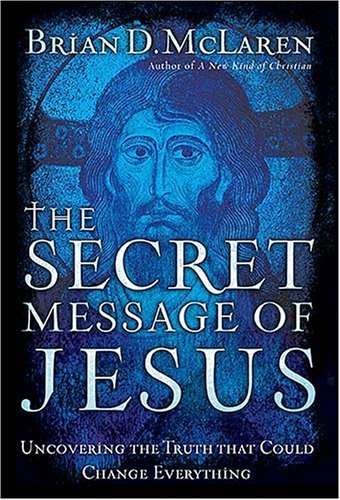 The first time I read one of Brian McLaren‘s books, it was like I was reading a more eloquent and better thought-out version of my own thoughts. McLaren has, since the first one of his books I read (3 or 4 of his books ago…), consistently challenged my thinking with his fresh insights into the Christian way of life. This book is no different. In The Secret Message of Jesus (subtitled “Uncovering the Truth that could Change Everything), McLaren deals with the person and, primarily the message of Jesus. Much like Phil Yancey did with the person and character of Jesus in his book The Jesus I Never Knew, McLaren steps back from the common images and perceptions we (both Christians and not Christians) have about Jesus and his message to take a long, hard look at the New Testament to see what the message really was.
The book is divided into three sections. The first deals with the context of the message. McLaren places Jesus and his teaching in a political and cultural context as well as looking at the impact the message would have had on contemporaries and how it turned their world upside down. He also spends time assessing the “hidden” aspect of Jesus’s message – how it seems so obscure and, well, hidden at times, questioning why Jesus would need to do such a thing. If Jesus’s message truly is as important as Christians seem to think it is, why did Jesus speak so obscurely at times, never giving a straight answer?
The second section deals with the meaning of the message: how Jesus presented the message impacted its effectiveness (for lack of a better word) and influenced how it was received then and how it is still received today. It impacts how we take that message and incorporate it into our lives, living it in daily life.
This leads to the third section which is, perhaps, the crux of the whole book. The section is entitled “Imagination: Exploring How Jesus’ Secret Message Could Change Everything” and proceeds to do just that. Chapter after chapter in this section looks at different situations and what it could/would/should be like if we lived according to Jesus’s “secret message.” What if the message weren’t a secret anymore? What if Christians started to actually live it? If McLaren’s ideas as written here were actually lived out in the world, what would the world be like? It is the kind of thing that gives both hope and despair simultaneously: hope that we could actually achieve this and despair that we have gone so far from this ideal, both Christians and not Christians.
As I said at the outset, I have enjoyed all of Brian McLaren’s books thus far. They have been both challenging, stimulating, and refreshing all in one. This one was no exception. It was really good to read and especially thought-provoking at times. It made me think about how I live my life in response to “the secret message” and what I should be doing in my life. I’d definitely recommend it, and I’m looking forward to re-reading it when I’m not in school so I can fully digest what McLaren has to say and spend more time in study with my Bible beside me.
Note: Brian includes three appendices in the book, one of which discusses “The Prayer of the Kingdom.” It is quite good but, apparently, has been left out of the final copy of the book that went to the publishers (I have a pre-publication version, so its in there). Anyway, if you want to read it, the chapter has been posted on McLaren’s website here.
If you end up reading the book, drop me a line and let me know what you thought. We can have a little debate, I’m always open to those, especially with classes almost over (3 days left baby!) and not too many finals on the horizon.
 gillian's island