Young and Old in Church

I had a letter read on CBC radio last week. It was a bit of an event for me… nearly everyone else in the family has managed to get on CBC (well, my sister has anyway), so now it was my turn. The letter was in response to a short documentary aired on the Vancouver Island morning show on Radio 1.

In this program, the interviewer was looking at spirituality amongst younger people in Victoria. Apparently only about 2-5% of the population of Victoria attends church on a regular basis (compare that to about 20% nationally and closer to 45-50% in the United States). However, we are one in one of the most spiritually rich places in North America. They then investigated some churches that are working to reach out to the “20 & 30-something” demographic (of which I am a part). One of the church leaders interviewed is the leader of a church-plant by one of the break-away Anglican groups in North America. In the course of the interview, it was revealed that this church, as well as the other featured church, aim their services exclusively at the 20-30’s in Victoria. I say exclusively because the interviewer could not attend a service because he was “too old”.

Too old?! Since when is anyone too old for church? One of the techniques (if you can call it that) is the cafe-style of church where participants sit around in groups and each, in turn, expound on the topic of the day. Call me crazy, but I am sure that there are some in the older generations to whom this would appeal and there are as many in the target generation who would benefit from the wisdom of their elders.

With that in mind, I sat down and wrote a letter.

“Maybe I am an abnormal 20-something, but I know I am not alone amongst 20-somethings in these sentiments: I go to church on a near-weekly basis and, even more shocking, go to a church with a number of people who could be my parents and grandparents. And I love it. Excluding older generations from church is not only presumptuous but a little short-sighted. One of the things I value about my “church experience” is the opportunity to interact with multiple generations. Where else can people interact with kids, teens, young adults, middle aged and elderly adults all at once? I have learnt many, many things from these older generations both about life and faith. By preventing that interaction, young adults leave themselves without mentor-ship and close themselves off to a world of experience and growth. Maybe they’ve forgotten, but those 80-year-old’s were 20-somethings like us once and a lot of them were trying to push the boundaries of church then the way we are today.”

They read it on air.

Thoughts? Do you like going to church with multiple generations? Or would you rather spend your Sunday morning/evening with people solely your own age? Have you gained anything from worshipping with older folk or does it detract from your experience?


Advent 4


We believe that God is present in the darkness before dawn;
in the waiting and uncertainty where fear and courage join hands,
conflict and caring link arms, and the sun rises over barbed wire.


We believe in a with-us God who sits down in our midst to share our humanity.
We affirm a faith that takes us beyond a safe place:
into action, into vulnerability and onto the streets.

We commit ourselves to work for change and put ourselves on the line;
to bear responsibility, takes risks, live powerfully and face humiliation;
to stand with those on the edge;
to choose life and be used by the Spirit
for God’s new community of hope. Amen.

from our Affirmation of Faith this Sunday

Advent

Breathe out empty yourself: of hate, of fear, of anxiety
Breathe in fill yourself with love, with life, with mercy
Breathe out empty yourself of busyness, of selfishness of greed
Breathe in fill yourself with peace, with joy, with hope
Breathe out empty yourself of idolatry, of self worship, of false gods
Breathe in fill yourself with God, with Christ, with the Holy Spirit

from jonny baker.

Back to Community

Back on the subject of community… I think I first broached here in March 2009 and it has not been far from my thoughts since then.

A friend made an interesting comment the other week. This friend is most assuredly not connected in anyway to a Christian or religious community and would likely run the other way if I were to suggest a visit to a church or meeting with too many religious folk. I, on the other hand, have never been shy to mention in my friend’s presence the fact that I have received great benefit from church communities and love being a part of one.

I tagged along to a 100-mile dinner party last weekend. It was a birthday celebration (a celebration where I did not know the birthday boy) and potluck where people were invited to bring dishes made from ingredients produced within 100 miles. It was a veritable feast and some wonderful experimentation happened. During the evening, we ate a lot of food, some excellent conversations happened and I met some very interesting people, some games were played, and then I needed to go home (1:00am is quite late when you have to be at church at 8:30am). As we were cycling away from the home where the dinner took place, my friend said something like, “Environmental people are a pretty good and responsible group to spend time with. It is the best community to be a part of.” I know I am off on the wording, but the gist of what I took from the statement was a gybe directed at religious groups (a fairly common occurrence in our discussions) and a statement advocating community and belonging.

Here we had, on a Saturday night, a group of about 20 young adults, in the 24-30 range, gathering together to share around something they are passionate about. There was good and engaging discussion. There was food. There was a common purpose. It was fun.

But it also felt like it was lacking. Yes, I can get behind no-waste initiatives. I can agree with a moratorium on offshore drilling on our coastline. I am all for urban sustainability projects and food security. However for me it goes deeper than that. At the heart of all of these discussions, I always come back to Christ. Why do I care for people and for the environment? Because of my faith in God.

If I didn’t have that hope and that knowledge of my future, I am not sure that I would see the purpose of environmentalism. I would have loved for discussions at the 100-mile dinner to go beyond the surface to more fundamental questions of life and belonging. These questions need to include discussing how we relate to and deal with the environment, however they cannot be isolated to them. These are questions that are best answered in community because community can be the core force needed to jump-start any initiatives. Community strengthens, supports, challenges, and encourages. We need more of these types of communities – with Christ at the centre – that are unafraid to challenge the status quo on all issues. That is a community I would be a part of.

How do we get more young people in church?

I am kind of, it feels like, the token “under-30” at church at times. Not that I am the only under-30, I am just one of the more involved under-30s who appears at church on a fairly regular basis. By and large, however, my generation is dramatically under-represented in church, at least many of the ones I frequent. Many of our churches, especially in the mainline denominations, are struggling with numbers; churches are slowly (or not-so slowly) getting smaller and smaller as parishioners die with no one to replace them.

It is a sad state of affairs and it leads to the above question often being asked. As the apparent spokes-person for the “young people” at church, I often get asked variations of that question. My favourite version so far went something like this:

The Christmas bazaar is coming up in a few weekends, Gillian, I’d love to have you and some of your young friends help out at it. It would be a great way to get them to come to church.

I’m sorry, in what universe would I invite my friends to church to volunteer at a Christmas bazaar that amounts to little more than a giant rummage sale that serves lunch? I’m sure that is the best way to get more young people in church. If you can’t hear the sarcasm dripping off of my words, please reread that paragraph and insert sarcasm.

What, then, do we do? I have lots of unformulated and inarticulate ideas, but most of them revolve around one simple premise: stop trying. Stop trying to get young people into church. Instead, start going outside of church and hanging out with young people and start enjoying life with them. If they decide to come and check out your church, cool. If they haven’t, you’ve still made a new friend and you can both be blessed by your friendship.

If, however, you are like some people and like lists, I highly recommend this post by an American university chaplain. It was recommended to me by the blog of an English priest. It is worth the few minutes to click over and read, and I think that many churches need to implement it least some of her suggestions.

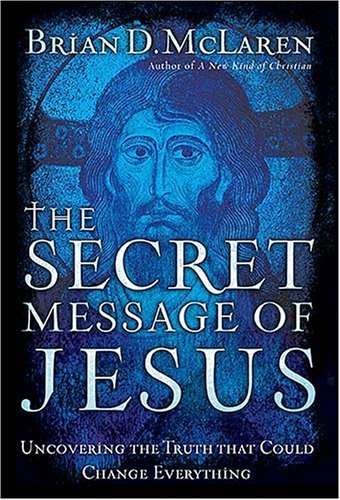
The Secret Message of Jesus [Book Review]

I posted here awhile back that I got a [free] book in the mail from a publisher to review and post my review on here and a few other places. Well, the great unveiling has come (for those who I have a) not already excitedly told about it or b) not figured it out by the cover being conspicuously posted in the side index) and I am now writing my review. In typical Gillian fashion, it is being posted 2 days before it is due. Come to think of it, that is actually record earliness for me. Well done Gillian!
Anyway, enjoy! And then go read the book… there is a link below to the Amazon site for the book, but support your local Christian book store and get it from them instead (or be cheap and read my copy – it is the “Advance Reader’s Copy” after all, which makes it automatically cool!).

The first time I read one of Brian McLaren‘s books, it was like I was reading a more eloquent and better thought-out version of my own thoughts. McLaren has, since the first one of his books I read (3 or 4 of his books ago…), consistently challenged my thinking with his fresh insights into the Christian way of life. This book is no different. In The Secret Message of Jesus (subtitled “Uncovering the Truth that could Change Everything), McLaren deals with the person and, primarily the message of Jesus. Much like Phil Yancey did with the person and character of Jesus in his book The Jesus I Never Knew, McLaren steps back from the common images and perceptions we (both Christians and not Christians) have about Jesus and his message to take a long, hard look at the New Testament to see what the message really was.

The book is divided into three sections. The first deals with the context of the message. McLaren places Jesus and his teaching in a political and cultural context as well as looking at the impact the message would have had on contemporaries and how it turned their world upside down. He also spends time assessing the “hidden” aspect of Jesus’s message – how it seems so obscure and, well, hidden at times, questioning why Jesus would need to do such a thing. If Jesus’s message truly is as important as Christians seem to think it is, why did Jesus speak so obscurely at times, never giving a straight answer?

The second section deals with the meaning of the message: how Jesus presented the message impacted its effectiveness (for lack of a better word) and influenced how it was received then and how it is still received today. It impacts how we take that message and incorporate it into our lives, living it in daily life.

This leads to the third section which is, perhaps, the crux of the whole book. The section is entitled “Imagination: Exploring How Jesus’ Secret Message Could Change Everything” and proceeds to do just that. Chapter after chapter in this section looks at different situations and what it could/would/should be like if we lived according to Jesus’s “secret message.” What if the message weren’t a secret anymore? What if Christians started to actually live it? If McLaren’s ideas as written here were actually lived out in the world, what would the world be like? It is the kind of thing that gives both hope and despair simultaneously: hope that we could actually achieve this and despair that we have gone so far from this ideal, both Christians and not Christians.

As I said at the outset, I have enjoyed all of Brian McLaren’s books thus far. They have been both challenging, stimulating, and refreshing all in one. This one was no exception. It was really good to read and especially thought-provoking at times. It made me think about how I live my life in response to “the secret message” and what I should be doing in my life. I’d definitely recommend it, and I’m looking forward to re-reading it when I’m not in school so I can fully digest what McLaren has to say and spend more time in study with my Bible beside me.

Note: Brian includes three appendices in the book, one of which discusses “The Prayer of the Kingdom.” It is quite good but, apparently, has been left out of the final copy of the book that went to the publishers (I have a pre-publication version, so its in there). Anyway, if you want to read it, the chapter has been posted on McLaren’s website here.

If you end up reading the book, drop me a line and let me know what you thought. We can have a little debate, I’m always open to those, especially with classes almost over (3 days left baby!) and not too many finals on the horizon.

A New Kind of Christian…?!?

For some “light” reading over the break, I borrowed, from a friend of my dad’s (and have subsequently gone and bought for myself), a trilogy of books by Brian McLaren – A New Kind of Christian, The Story we Find Ourselves in, and The Last Word and the Word After That. Fascinating. Very thought provoking. They have stimulated some interesting thought directions in my brain over the last 10 days or so. If you haven’t read them, you should at least take a peek at them (even if it is just the first one). I think that I have found some expression to nebulous ideas that have been bouncing around in my head for the last little while.

The challenge of the first one is being a Christian in a postmodern world. The church, despite its desire to be relevant, is still quite modern. However people are not, especially not my generation. How can I expect them to engage in a faith, religion, worldview (whatever your prefered term is) if it is not available in their “language”? We go to great lengths to translate the Bible into other languages so that people will be able to hear the gospel, but so many people who speak our own language miss out because we aren’t presenting Christ in a way they can understand. I mean, if I hadn’t been raised a Christian, I’m not sure I would be seeking out the church and Christianity the way it is now. So then what can I/we do? How can I/we become relevant? Well, thats one of the questions that’s been bouncing around lately.

Maybe we should lose the lable “Christian” and all the baggage that comes with it and focus on Jesus Christ. Isn’t that what Christianity is supposed to be about in the first place?

Another book I read over the holidays (I know, I was busy) was Blue Like Jazz by Donald Miller. Another excellent book. A story he tells in it really caught my attention: in the midst of a huge drunk-fest on his campus, he and the 7 or so other Christians on campus got together and made a confessional booth. They spent the day walking around in monk’s clothing, then went and sat in the booth. Students would come in and jokingly ask if they were supposed to “confess” everything they had done over the course of the drunk-fest. Instead, the group of Christians confessed to the students of their campus – confessed that Christians in general, and they themselves, hadn’t really been living up to what they should be. They hadn’t loved the people on their campus as much as they would have liked to, they had been judgemental… they went on and on. In the end, the Christian students had a profound impact on other students at their very secular American college. That really impacted me. How many times have I had the same attitudes to people on my own campus. Smug superiority, judgement… I’m not sure I want to think about that. What would the world look like if we dropped the lables and just tried to follow Christ? I mean really follow Him…