Author Archives: Gillian
Friday Photo
Oh hey! It is Friday!
Who has time to take photos when you work all night and sleep all day? I’ve worked one evening (shelter), one day (optometry), and two overnights (shelter) so far this week… and am about to head off to overnight number three (though at a different shelter than the other shifts this week). This hasn’t left me much time for wandering around town or for taking pictures this week. Instead, today we’re flashing back to 2007 because of the opera that I went to last night before work: The Flying Dutchman. While I’m sure that the tropical seas of the Pacific near Hawaii are a slightly different hue than the North Atlantic of Wagner’s opera, this production opened with some footage of rolling swells and breaking seas that brought me right back to many times on Offshore.

Only those people who are capable of being alone are capable of love, of sharing, of going into the deepest core into the other person without possessing the other, without becoming dependent on the other, without creating “the other,” reducing the other into a thing, and without becoming addicted with the other. They allow the other absolute freedom, because they know if the other leaves, they will be as happy as they are now. Their happiness cannot be taken by the other, because it is not given by the other.
Osho
Sunday Evening
I was walking through downtown after dropping someone off at the ferry terminal. I decided I needed a coffee, and so hit up a favourite place on the edge of Chinatown. From there, it is only a couple blocks to a bus stop where the bus that drops me practically at my front door stops.
As I walked through the square, I noticed a crowd of people gathering under an overhang. Not yet close enough to see what it was, I initially thought it was the Sunday market gone into overtime. As I drew closer, I saw that it was something else entirely. I began to suspect it was CARTS as I started to recognize some of the individuals standing around. It was interesting to see clients I am used to seeing at the Shelters in another context entirely.
I continued on to the bus stop, wondering if I should say hi. Obviously that would be weird and a complete breach of confidentiality, so I did not. Some of the individuals drifted over to the bus stop and loitered for a while before crossing Douglas St to another part of town. Others I have seen since, wandering around town. Many do not recognize me from shift to shift at the shelter, so I am not sure why I think they might recognize me outside of the shelter. If they did recognize me, I don’t think that would make any difference to how I reacted. Once again, however, I am struck by how thin the line is that separates me from them.
Friday Photo
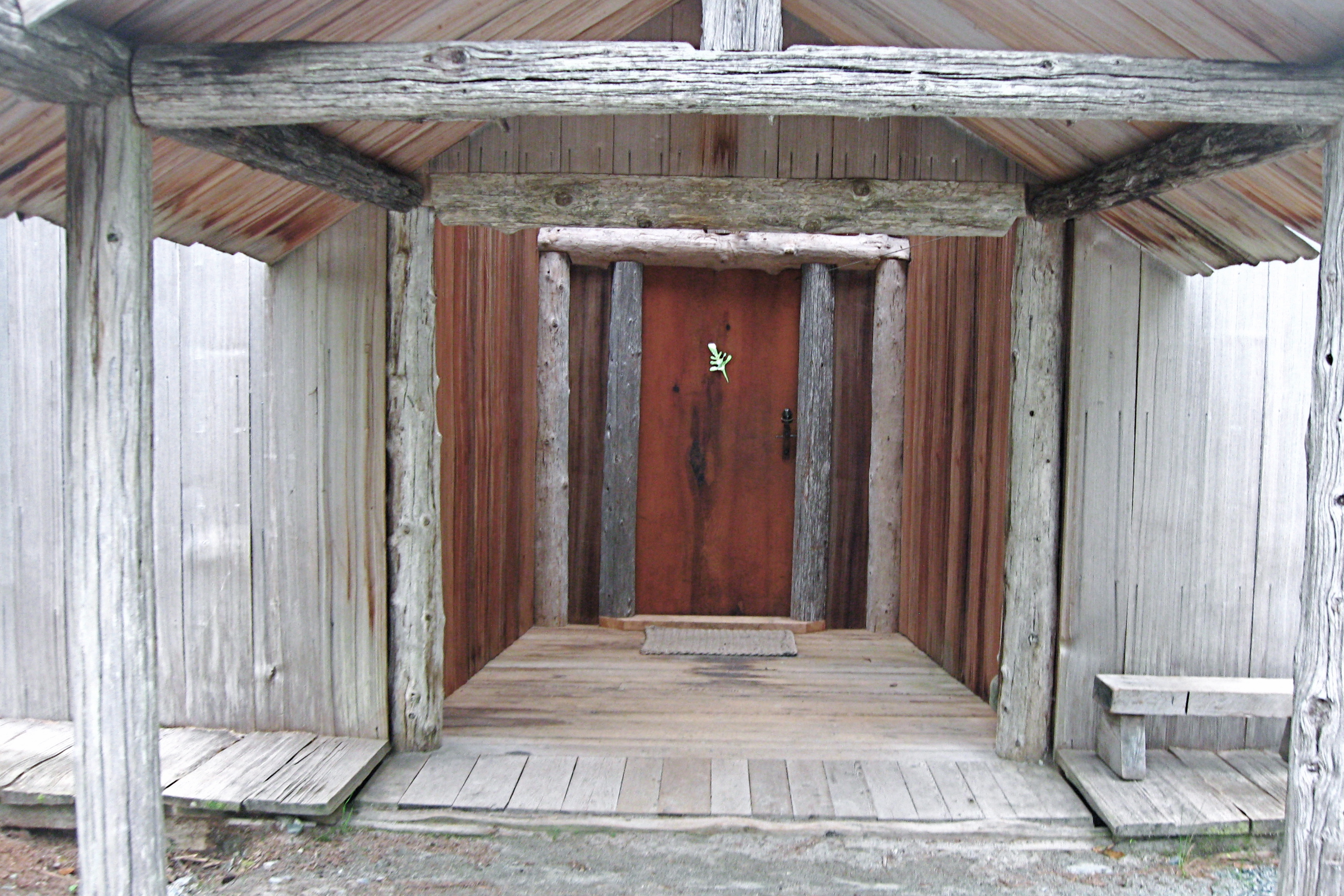 Sometimes I think it would be nice to just go and find a log cabin to live in and forget the world.
Wait! There is More!
Now that I have the attention of the government…
I received an emailed letter from the Minister of the Environment, The Honourable Peter Kent today. I’m hoping for a letter from the Minister of Health next, and, since Kent forwarded my letter to them, I’m also anticipating hearing from the Ministries of Foreign Affairs, International Trade, and Labour. I should start a scrap book.
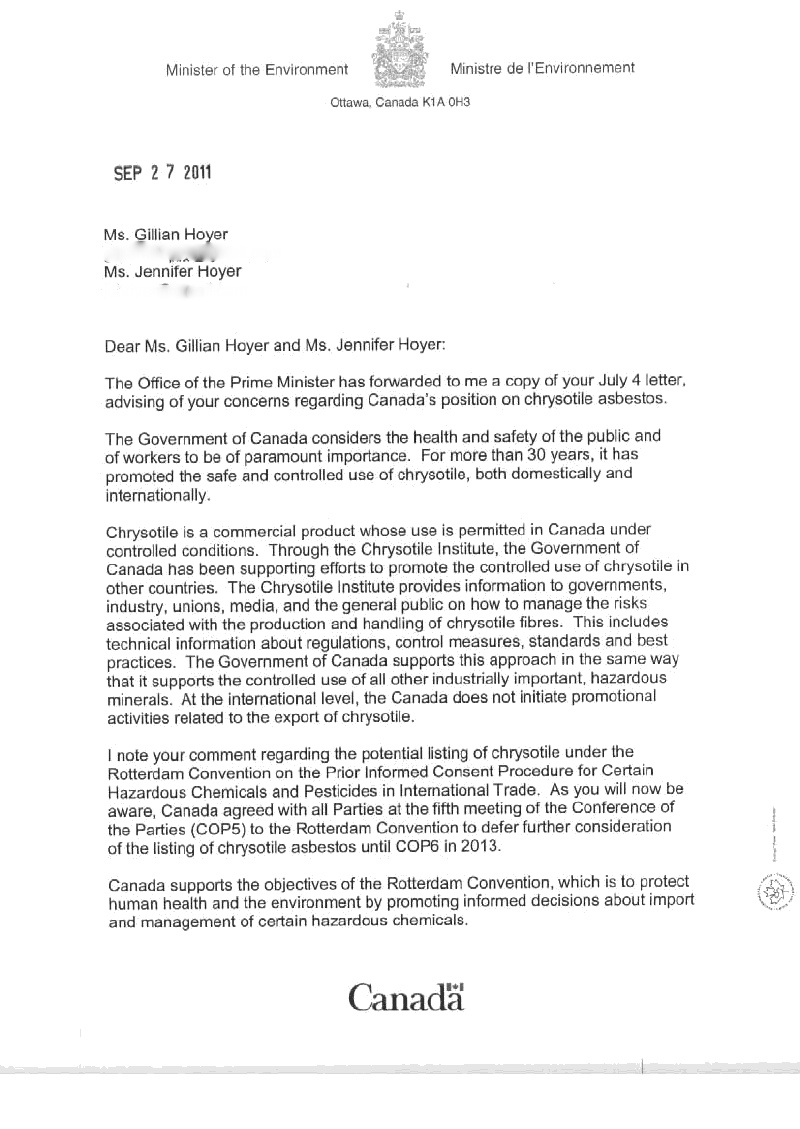
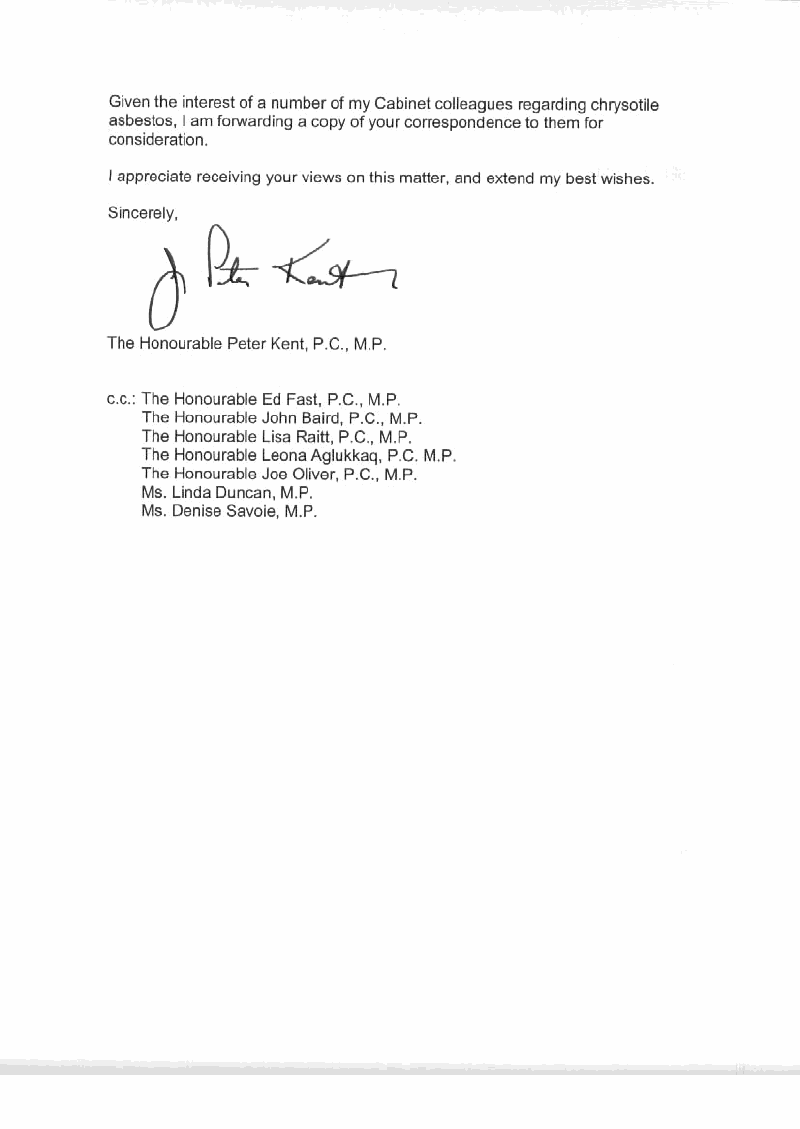 Does it sound like he agrees with us but isn’t allowed to outright say so?
In which I discover that the government does read mail. And then they respond with a lecture.
UPDATE 09/27: A second letter from the Minister of the Environment!
This is a long one… if you don’t read everything in the Government’s letter (and it is all a load of crap), at least scan to the end for my editorializing…!
Back in July, asbestos was in the news a lot. Canada, a leading exporter of the stuff, was getting in hot water internationally for exporting it and not ensuring it was used safely overseas when it is something banned in this country. I got a little miffed about that, given my family history with asbestos, and made some comments on Facebook. Those comments turned into a series of long debates with friends which my sister, Jen, proposed that we incorporate into a letter to the Prime Minister. Since I had just done something similar a couple months earlier, I was definitely game to hate mail our government once again.
July 4, 2011
Dear Mr. Prime Minister,
As you may have noticed, your efforts at the recent Rotterdam Convention to keep chrysotile asbestos off the Annex 3 list of hazardous chemicals have garnered some attention. We are writing you to voice our own concerns about Canada’s continuing role in exporting asbestos. We are sisters; Gillian is 29 and Jennifer is 26.
Our relationship with asbestos began fairly personally. Our grandfather worked for an oil company at their refineries for his entire career. As a manager, he brought his family to live in onsite housing when his children were young. This is likely how the family received most of their exposure to asbestos. When our grandfather died of cancer in 2003 he was also suffering from asbestosis. When our mother was diagnosed with mesothelioma in the fall of 2000, doctors were shocked to see the disease in a patient so young. She fought it for three long years, far beyond the maximum 8 months she was originally given, and died a few months shy of her 50th birthday. Jennifer was 18 and Gillian was 21. Asbestos touches real people.
We are also concerned about Canada’s place in the global village. If we ban a substance in our own country but continue to sell it to others, what does that make us? Profiteers at the expense and certain harm to others? Would we expect the federal government to prop up the manufacture of drugs so that we can ship them to other countries? Opiates have a use in the health care industry, as does marijuana, but in reality we get upset at countries that don’t crack down on the manufacture and export of drugs that are illegal in Canada.
Canada should agree to let chrysotile asbestos be listed as a hazardous material and also provide the training necessary for its proper use. Unfortunately, developed countries have a tendency to sell resources to developing countries with no regard for safety, often exposing them to risks that would never be acceptable here. If we are a global village, we need to act like neighbours who actually care about each other more than making a dollar.
We worry about possibly watching our mother’s three siblings deal with asbestos-related diseases. We worry about other children losing their parents. We worry about Canada’s tarnished reputation on the world stage because of the government’s stance on this issue, and we are ashamed.
Sincerely,
Gillian and Jennifer
I didn’t receive a response to the first letter that I sent (though, unlike this one, I only sent it to the PM and not my MP) and so, that was the last I thought of it. Until today. I arrived home this afternoon to a letter in my mailbox from the Ministry of Natural Resources. Ministry of Natural Resources? It wasn’t until I was halfway down the driveway with the closed letter in my hand that I realized what it must be. Inside, I received a two-page lecture from the Hon. Minister Joe Oliver… (text follows) (Sorry for the bad lighting in the first image. Not sure what happened. It was the same time/place… I should get a scanner.)
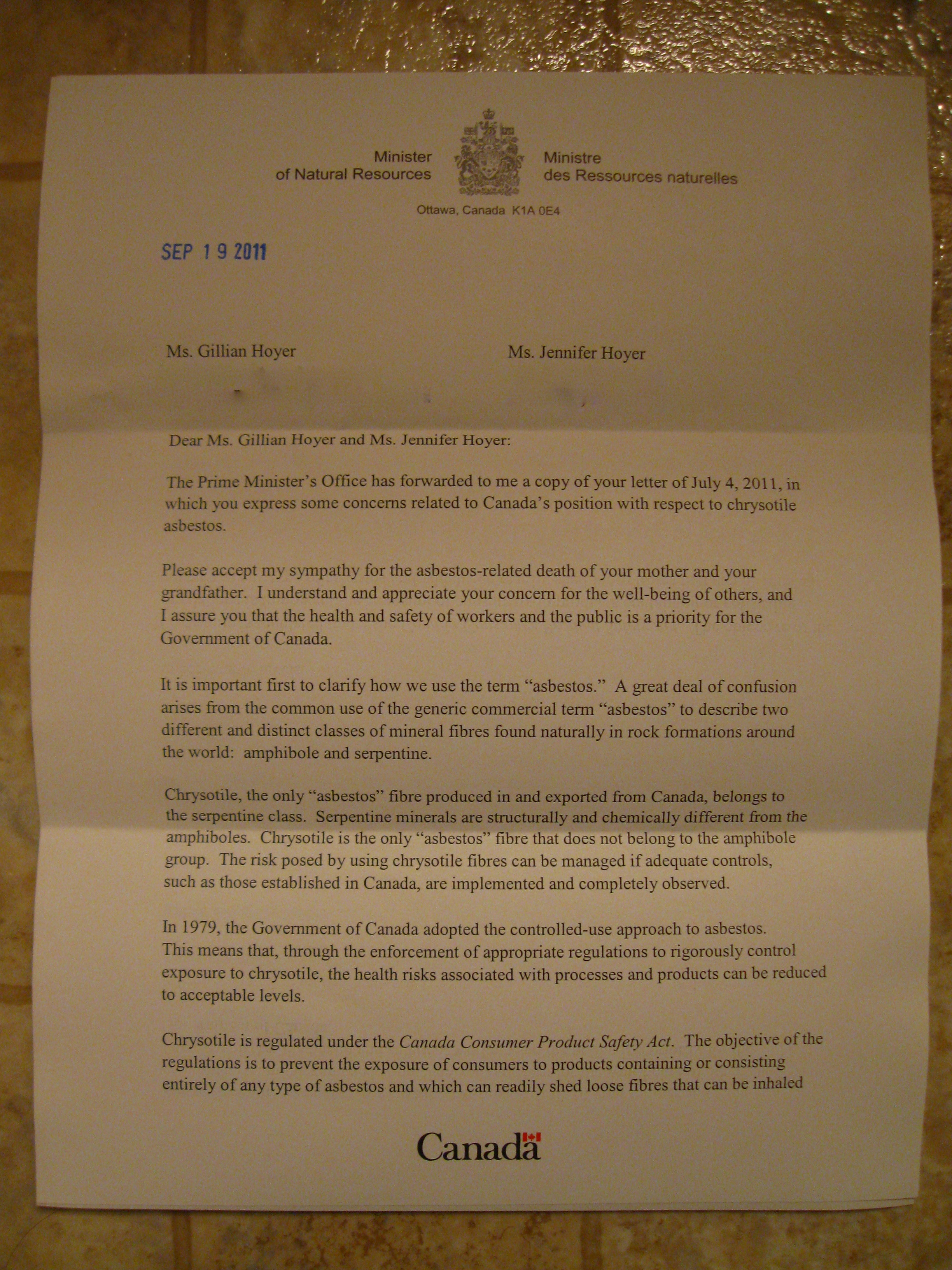

Dear Ms Gillian and Ms Jennifer:
The Prime Minister’s Office has forwarded to me a copy of your letter of July, 4, 2011, in which you express some concerns related to Canada’s position with respect to chrysotile asbestos.
Please accept my sympathy for the asbestos-related death of your mother and your grandfather. I understand and appreciate your concern for the well-being of others, and assure you that the health and safety of workers and the public is a priority for the Government of Canada.
It is important first to clarify how we use the term “asbestos.” A great deal of confusion arises from the common use of the generic commercial term “asbestos” to describe two different and distinct classes of mineral fibres found naturally in rock formations around the world: amphibole and serpentine.
Chrysotile, the only “asbestos” fibre produced in and exported from Canada, belongs to the serpentine class. Serpentine minerals are structurally and chemically different from the amphiboles. Chrysotile is the only “asbestos” fibre that does not belong to the amphibole group. The risk posed by using chrysotile fibres can be managed if adequate controls, such as those established in Canada, are implemented and completely observed.
In 1979, the Government of Canada adopted the controlled-use approach to asbestos. This means that, through the enforcement of appropriate regulations to rigorously control exposure to chrysotile, the health risks associated with processes and products can be reduced to acceptable levels.
Chrysotile is regulated under the Canada Consumer Product Safety Act. The objective of the regulations is to prevent the exposure of consumers to products containing or consisting entirely of any type of asbestos and which can readily shed loose fibres that can be inhaled and cause adverse health effects. Canada does not ban naturally-occurring substances. Canada manages the risks of products and practices derived from these substances where and when required and applicable.
The illnesses we are currently seeing in countries that have intensively used “asbestos” fibres are linked to past high-level exposures and inappropriate uses. These uses have been prohibited or discontinued in Canada since the late 1970s. A total ban on chrysotile is neither necessary nor appropriate. Implementing a ban would not protect workers or the public against past uses that have been prohibited for many years.
More than 93 percent of the world production of chrysotile is used in chryso-cement-manufactured products in the form of pipes, sheets and shingles. Five percent is used for friction materials such as brake pads and linings. Canadian-manufactured products include brake pads, gaskets and specialty products. Fibres are encapsulated in a matrix in those products, thus preventing the release of fibres and allowing their use.
We all share the objective of protecting human health. Since 1979, Canada has promoted the controlled-use approach, both domestically and internationally. Canada continues to work with other countries on matters related to the safe use of chrysotile through the Chrysotile Institute.
The Chrysotile Institute, a not-for-profit organization established in 1984 by the governments of Canada and Quebec, labour and industry, has the mandate to promote the controlled use of chrysotile both domestically and internationally. The Chrysotile Institute provides information to governments, industry, unions, media and the general public on how to safely manage the risks associated with the handling of chrysotile fibres. This information includes technical regulations, control measures, standards and best practices. Over the years, the Chrysotile Institute has assisted knowledge and technology transfer in more than 60 countries.
Thank you for writing.
Yours sincerely,
The Honourable Joe Oliver, P.C., M.P.
Did anyone else notice the excessive use of quotation marks around “asbestos”?
I find it interesting how, in the same breath, asbestos use in Canada is both condoned as safe and labelled as risky. Please, make up your mind. And then instead of giving me a history lesson and lecture, trying to placate me with lots of information and overwhelm me to silence, actually address my concerns. While I appreciate that the government actually replied to my letter (First time that the Conservatives have ever replied to anything I have written. Though I would also like to take this opportunity to state that my wonderful NDP MP has responded to every letter I have ever written her.), I feel a little patronized and completely unsatisfied by this response. Basically, it is another rehashing of this government’s position: “I am right, you are wrong. Shut up, get out of our way while we screw this country over.”
Friday Photo

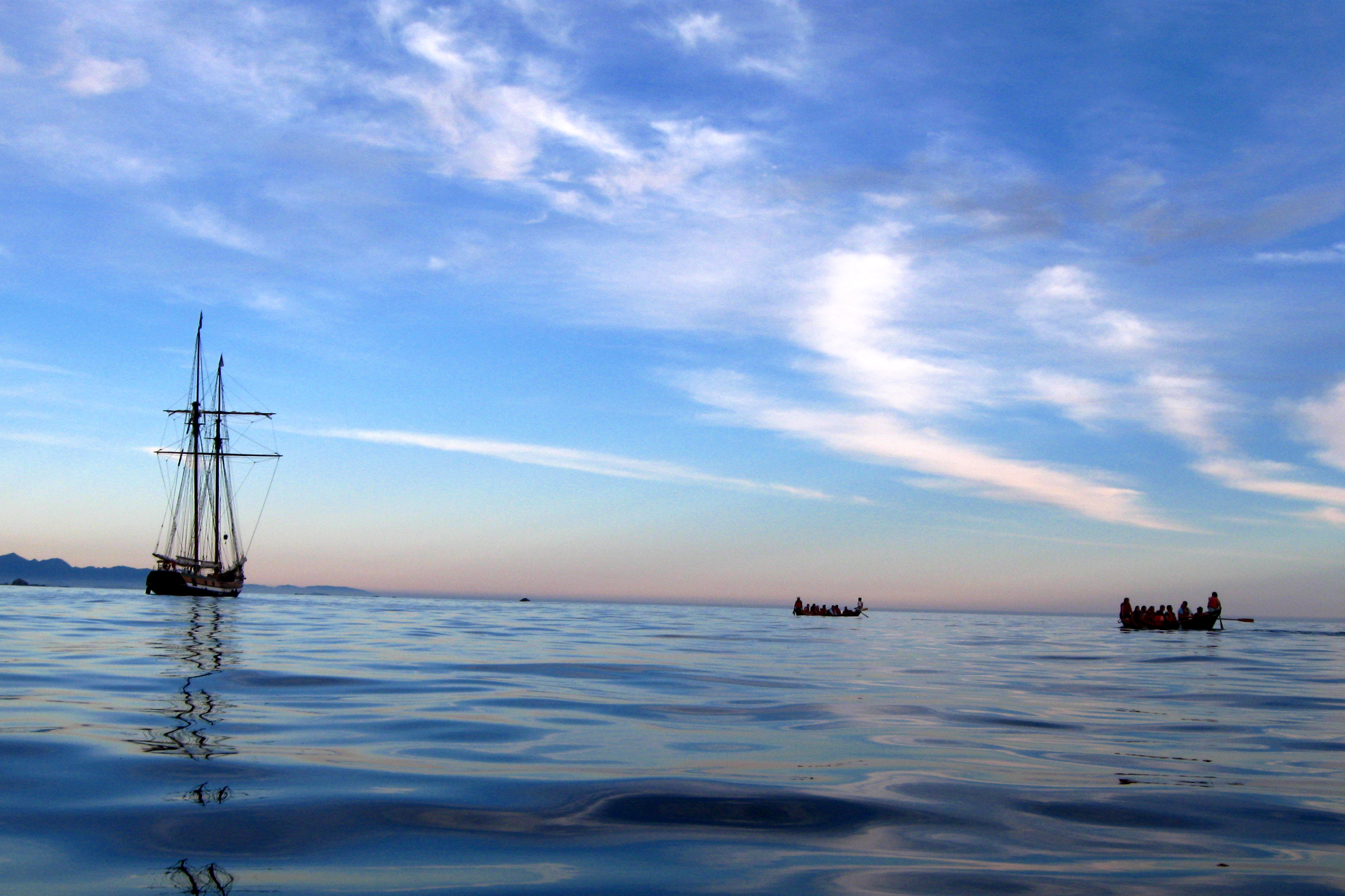
I was so busy last week that I forgot to put up a photo so this week we get two! I haven’t put any of my photos from sailing up here yet (though you can find them all here) and those are the most recent photos I’ve actually had a chance to upload and edit. These are the two I submitted to the SALTS photo contest – it was a tough decision, I had about 6 that made the short list – so you may see them on a SALTS calendar or website in the future… if they like them, that is!
These photos are from the West Coast of Vancouver Island: Hesquiat Harbour and Brooks Peninsula. I love the West Coast. I know I have said it before, but I will continue to say it over and over again: I am convinced that the West Coast of Vancouver Island is one of the most beautiful stretches of coastline in the world. Or at least in the Pacific, it is the only coastline that I have any real authority to speak to.
New Jobs New Outlooks
I started a new job. To date, I am just casual/on call (which means that my phone is always on and by my side so that I can pick up shifts), but I have begun a new job. I am working in an emergency shelter.
To be honest, it isn’t the job I thought I would have when I finished my Masters in Counselling. I had all sorts of grand ideas about setting up private practice somewhere and settling in to that working world. Now that this has happened and I am getting into the rhythm of working here, I am enjoying it and right now I would rather be doing this then establishing a practice. Not to downplay the important work that is done in private practice – work that I have participated in myself in my sessions with individuals dealing with marital conflict, anger and alcohol use, mild depression, identity questions, and grief – but there is something quite satisfying in working with people on a more base level of survival: providing food and shelter and basic human contact.
The kicker is that some of the individuals I see regularly at the shelter are not individuals I would have placed in that arbitrary category of “homeless” or “needing shelter housing”. They look just like me. They don’t all have that glaze of addiction over their eyes. Some are quite well-dressed and well-groomed. They are intelligent. In other words, they don’t, at least not obviously, all belong in that ‘other’ category of “mentally ill” or “addicted”.
Others do, and I have already had my share of entertaining encounters with those who are high, drunk, or experiencing delusions and/or psychosis. We’ve had to call the paramedics but, thankfully, not the police (yet). All in a day’s – or night’s – work as they say.
While I make it a practice to not talk about work on my personal blog, sharing my responses and reactions to working in this field is something I feel okay about doing because it is about my own personal growth and will hopefully be able to continue as I spend more time with a segment of society we often ignore and overlook. I’m looking forward to getting to know people and sharing parts of life with them.
[As I was writing this, I checked my rss feed and read this post by Tall Skinny Kiwi on choosing to be homeless and thought it an interesting comparison/compliment to the individuals I work with and challenge for our spiritual life.]
Friday Photo
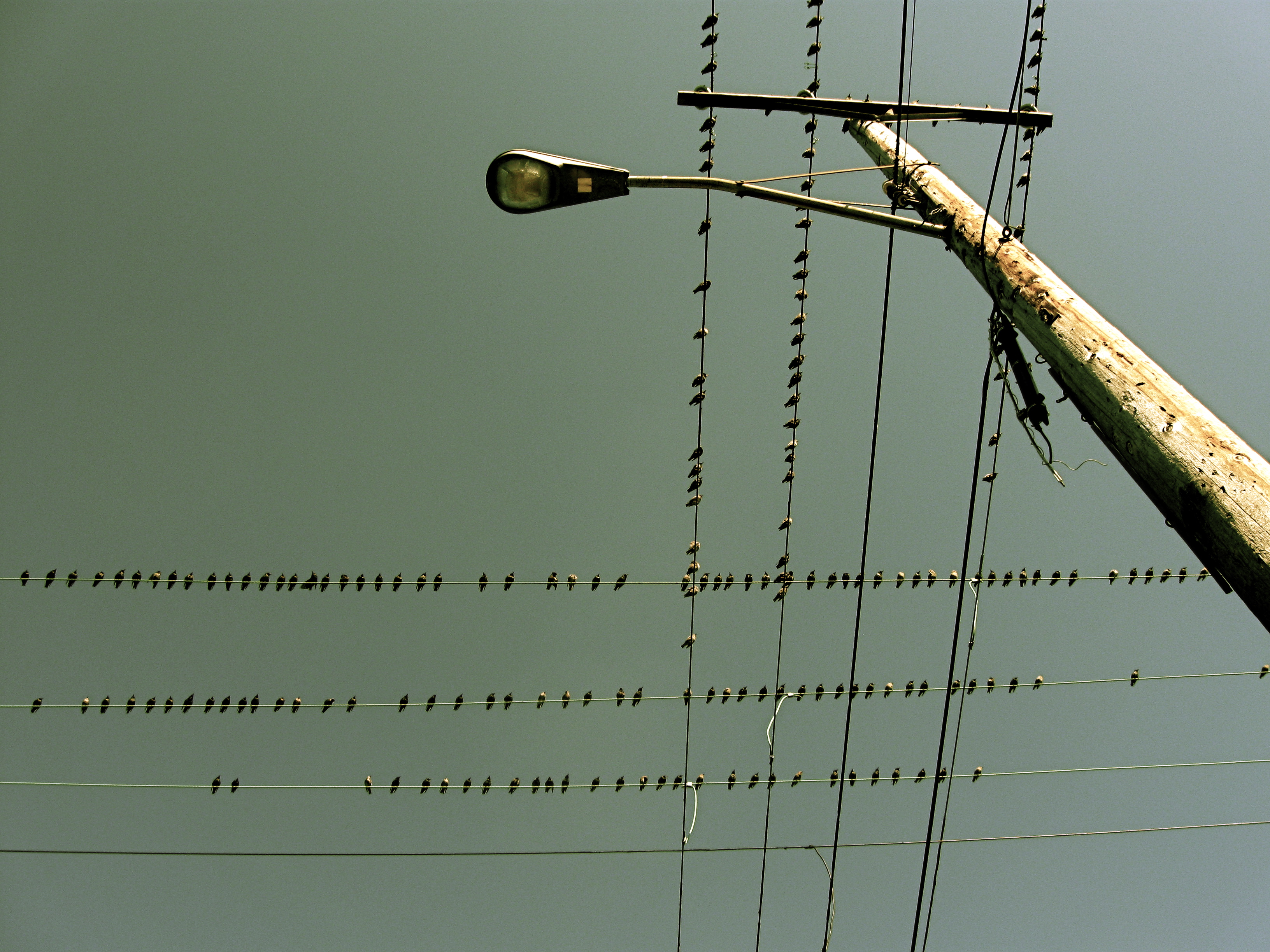 Four-and-twenty blackbirds…
 gillian's island