Back to Community

Back on the subject of community… I think I first broached here in March 2009 and it has not been far from my thoughts since then.

A friend made an interesting comment the other week. This friend is most assuredly not connected in anyway to a Christian or religious community and would likely run the other way if I were to suggest a visit to a church or meeting with too many religious folk. I, on the other hand, have never been shy to mention in my friend’s presence the fact that I have received great benefit from church communities and love being a part of one.

I tagged along to a 100-mile dinner party last weekend. It was a birthday celebration (a celebration where I did not know the birthday boy) and potluck where people were invited to bring dishes made from ingredients produced within 100 miles. It was a veritable feast and some wonderful experimentation happened. During the evening, we ate a lot of food, some excellent conversations happened and I met some very interesting people, some games were played, and then I needed to go home (1:00am is quite late when you have to be at church at 8:30am). As we were cycling away from the home where the dinner took place, my friend said something like, “Environmental people are a pretty good and responsible group to spend time with. It is the best community to be a part of.” I know I am off on the wording, but the gist of what I took from the statement was a gybe directed at religious groups (a fairly common occurrence in our discussions) and a statement advocating community and belonging.

Here we had, on a Saturday night, a group of about 20 young adults, in the 24-30 range, gathering together to share around something they are passionate about. There was good and engaging discussion. There was food. There was a common purpose. It was fun.

But it also felt like it was lacking. Yes, I can get behind no-waste initiatives. I can agree with a moratorium on offshore drilling on our coastline. I am all for urban sustainability projects and food security. However for me it goes deeper than that. At the heart of all of these discussions, I always come back to Christ. Why do I care for people and for the environment? Because of my faith in God.

If I didn’t have that hope and that knowledge of my future, I am not sure that I would see the purpose of environmentalism. I would have loved for discussions at the 100-mile dinner to go beyond the surface to more fundamental questions of life and belonging. These questions need to include discussing how we relate to and deal with the environment, however they cannot be isolated to them. These are questions that are best answered in community because community can be the core force needed to jump-start any initiatives. Community strengthens, supports, challenges, and encourages. We need more of these types of communities – with Christ at the centre – that are unafraid to challenge the status quo on all issues. That is a community I would be a part of.

Lottery of Life

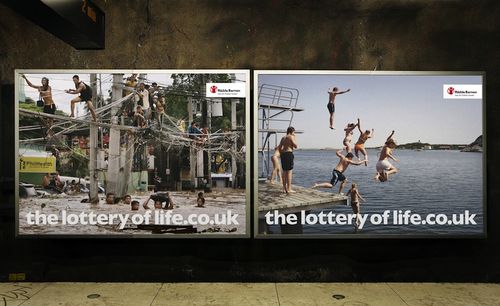
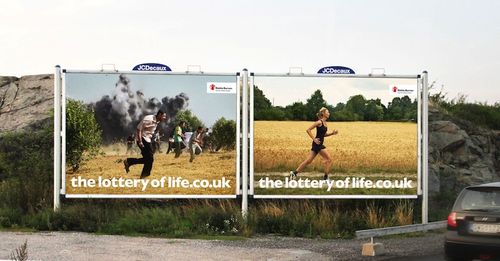
Some hard-hitting images from Save the Children UK this year. They were brought to my attention by Mike at Waving or Drowning.

He writes about blessing and cursing. Namely, how we talk about how “blessed” we are to live in the place where we do. The converse of this is that we somehow say that those who live in less wonderful places are somehow cursed. While I hadn’t thought about this dichotomy before, at least not the way Mike describes it, I have definitely experienced a bad taste in my mouth when we talk about how blessed we are and how much God has blessed us to live where we do…

Check out their campaign at The Lottery of Life. If I were born today, I would have a minuscule chance of being born as a Canadian: I can’t even see Canada on the wheel as a percentage of world population. Today, I’d have a much better chance of of being born in China, India, Nigeria, or Mexico. The interesting thing is, regardless of which country you end up in, there are issues that need to be dealt with in each place. While we might be “blessed” in Canada, there are still issues that need to be dealt with. We are amongst the worst in the developed world at dealing with our environmental issues. Our First Peoples are routinely marginalized. I walk downtown and see dozens of people asking for money, for food, offering work for food, desiring a place to live. The cold snap of a few weeks ago brought to the forefront our inability to house everyone in this city. Our foodbanks cannot keep up with demand and the foodbank at the university is the emptiest it has ever been. We have kids killing themselves because of bullying… or kids being killed by bullies.

No, we do not have land mines to be wary of when we go for a walk in the meadow or down by the ocean. No, we do not have armed rebel groups or rioting after electoral fraud (we just have two leader-less political parties and plenty of in-fighting). But we are not all there and there is a lot of work to be done. Are we blessed? Yes… but not to the exclusion of everyone else.

Disillusionment pt 2

Back in the spring, I wrote about my problems with big pharmaceuticals. I had just come off of a course where pharmaceutical interventions for mental illnesses seemed to be disproportionately pushed. It may stem from my own discomfort with my family doctor seemingly being in the hand of pharmaceutical companies, it may stem from the fact that I live in one of the hippie capitals of Canada, or it may be the fact that I have always tried other options before resorting to popping a pill. Any way you look at it, I think there is a problem with the way North Americans relate to medications. That is why this post on The Ethics of Western Pharmaceutical Companies caught my eye. It is from jordoncooper.com, a blog I read from time to time. He shares some chilling quotes that are worth a read.

SALTS

I have been associated with SALTS, the Sail and Life Training Society, for over ten years now. My first trip was a three-day coastal voyage in high school. I’ve been on board nearly every year since then. For two years, I worked for SALTS in the position of cook. Coastally, I’ve sailed all around the Gulf Islands and Sunshine Coast/Desolation Sound as well as circumnavigating Vancouver Island at least once. Offshore, we circumnavigated the Pacific Ocean: Hawaii, French Polynesia, the Cook Islands, Samoa, Tonga, Fiji, Vanuatu, Papua New Guinea, Micronesia, China, Japan… I lived and breathed SALTS for those two years – at times literally never leaving the boat for weeks on end (the longest passage we had was 30+ days without sighting land). I had to miss sailing with them this summer because of school, but I am looking forward to getting back on the water next season. It is hard work, but it is some of the most rewarding work one can ever do. Enjoy the short video. If you watch closely, you might pick me out once or twice in the offshore footage at the end.

Because it never just rains

… it floods.

I’m flooding the world with postings all of a sudden. I finally got around to updating my photo site. In the Daily Life album, you can find a half-dozen or so new photos at the end, including the one and only photo from my time in France this summer that I saw fit to add. There is a limited-time San Francisco album with about 20 photos from our trip earlier this month. It will stay up there for an undetermined time and, when I get around to it, my favourites will be shifted to other albums and I’ll delete the rest to clear up space. Enjoy!

How do we get more young people in church?

I am kind of, it feels like, the token “under-30” at church at times. Not that I am the only under-30, I am just one of the more involved under-30s who appears at church on a fairly regular basis. By and large, however, my generation is dramatically under-represented in church, at least many of the ones I frequent. Many of our churches, especially in the mainline denominations, are struggling with numbers; churches are slowly (or not-so slowly) getting smaller and smaller as parishioners die with no one to replace them.

It is a sad state of affairs and it leads to the above question often being asked. As the apparent spokes-person for the “young people” at church, I often get asked variations of that question. My favourite version so far went something like this:

The Christmas bazaar is coming up in a few weekends, Gillian, I’d love to have you and some of your young friends help out at it. It would be a great way to get them to come to church.

I’m sorry, in what universe would I invite my friends to church to volunteer at a Christmas bazaar that amounts to little more than a giant rummage sale that serves lunch? I’m sure that is the best way to get more young people in church. If you can’t hear the sarcasm dripping off of my words, please reread that paragraph and insert sarcasm.

What, then, do we do? I have lots of unformulated and inarticulate ideas, but most of them revolve around one simple premise: stop trying. Stop trying to get young people into church. Instead, start going outside of church and hanging out with young people and start enjoying life with them. If they decide to come and check out your church, cool. If they haven’t, you’ve still made a new friend and you can both be blessed by your friendship.

If, however, you are like some people and like lists, I highly recommend this post by an American university chaplain. It was recommended to me by the blog of an English priest. It is worth the few minutes to click over and read, and I think that many churches need to implement it least some of her suggestions.

Anything and Nothing

I am reveling in the fact that I am all done my coursework until the New Year! It is an incredible feeling, after 14 months of more-or-less non-stop school, to have time to do anything or nothing. I am enjoying being able to come home from work and read a book or knit, guilt free. I can go to bed at 9pm without feeling that I’ve missed out on school work. Or I can stay up until midnight reading a book “for fun”. It really is a wonderful thing. Whole days have gone by without me turning on my computer. The computer may feel left out, but I love leaving it off! The downside is that I am getting out of practice writing and my journaling and blogging suffers.

I’m also beginning to prepare myself for a busy January. I’ll be doing my practicum (here and here) four days a week as well as hopefully working two days a week. That will give me approximately only Sunday, and the odd Thursday afternoon, to sleep, read, and catch up with people. As a result, I’ve started to let go of other commitments. The major weight lifted is that I’ve resigned from the committee at church that was sucking up my time (and my soul…).

Until then, I’ll be reading up a storm and working on some knitting projects. I sewed a skirt on Saturday and started a new knitting project on Sunday. I’m ambitiously reading a 700+ page non-fiction book “for fun” and have four more on the floor to get through between now and Christmas. I have a good supply of chocolate and tea, not to mention the leftover mulled wine and spiced apple cider left from my party on the weekend. I could get used to this.

#yyjsnowapocalypse

For those of you not in the Twittersphere, the title of this entry is a Twitter hashtag. What is a hashtag, you may ask? It is a way to create groupings on Twitter. For example, people “tweeting” in Victoria often use #yyj to signify that the content of that tweet relates to the city of Victoria. YYJ is our airport code.

Monday, the Victoria hashtag of choice, however, was “yyjsnowapocalypse”. Plain and simple, this means that when it snows, we freak out while the rest of the country enjoys a good laugh at our expense. What constitutes a snowstorm in Victoria has the rest of the country merely increasing the speed of their windshield wipers. Jack Knox, of the Times-Colonist, wrote a wonderfully tongue-in-cheek piece about this in his article last week.

Consequently, I’ve devised a step-by-step guide to Victoria’s snow weather:

  1. Environment Canada issues “Heavy Snowfall Warning” for the region.
  2. Mass hysteria and panic ensues: salt and snowshovels sell out, stores close early, people leave work early, a run on tire shops occurs as people rush to get tires installed.
  3. The first few snowflakes fall.
  4. Hysteria continues and the weather is now all that we can talk about.
  5. It continues to snow. Perhaps a collected accumulation of 4-6 cm.
  6. Public transit is running 1 hour behind on the routes which are still open. Many routes are suspended or have altered routes.
  7. CRD Police forces close down certain roads, specifically anything with a slight incline or decline.
  8. Anyone who did not  already leave work early, does. Shops close, meetings are cancelled. Taxis make do a roaring business driving everyone who was too afraid to drive their own car home.
  9. Three days later, the city is still reeling and Gillian is still riding her bicycle.