Green

This Sunday is Palm Sunday. We read through and studied the gospel reading for this Sunday in class this week. From the gospel of Luke (19:28-40), we read the story of the procession into Jerusalem:

After Jesus had said this, he went on ahead, going up to Jerusalem. When he had come near Bethphage and Bethany, at the place called the Mount of Olives, he sent two of the disciples, saying, “Go into the village ahead of you, and as you enter it you will find tied there a colt that has never been ridden. Untie it and bring it here. If anyone asks you, ‘Why are you untying it?’ just say this, ‘The Lord needs it.’” So those who were sent departed and found it as he had told them. As they were untying the colt, its owners asked them, “Why are you untying the colt?” They said, “The Lord needs it.” Then they brought it to Jesus; and after throwing their cloaks on the colt, they set Jesus on it. As he rode along, people kept spreading their cloaks on the road. As he was now approaching the path down from the Mount of Olives, the whole multitude of the disciples began to praise God joyfully with a loud voice for all the deeds of power that they had seen, saying, “Blessed is the king who comes in the name of the Lord! Peace in heaven, and glory in the highest heaven!” Some of the Pharisees in the crowd said to him, “Teacher, order your disciples to stop.” he answered, “I tell you, if these were silent, the stones would shout out.”

One of my classmates asked us to draw an image that came to us from this passage, one that speaks to where this passage is going. I have always been captivated by the closing line spoken by Jesus, “I tell you, if these [people] were silent, the stones would shout out.” It is such a powerful image of creation crying out praises to God even if we human fail to keep it up all the time. So I drew a pile of rocks with a speech bubble and the word LIFE! proclaimed loudly in the speech bubble. Because ultimately that is where the procession of palms ends a week later: rock tombs opening up and shouting life as Jesus is risen.

I don’t know about where you are, but in this little corner of the world we are starting to see spring. It has been raining and the smells of spring are in the air. Green is beginning to sprout and I will not be surprised if trees start to bud soon. Seeing green pop everywhere always brings to mind the song “The Color Green” by Rich Mullins.

And the moon is a sliver of silver
Like a shaving that fell on the floor of a Carpenter’s shop
And every house must have it’s builder
And I awoke in the house of God
Where the windows are mornings and evenings
Stretched from the sun
Across the sky north to south
And on my way to early meeting
I heard the rocks crying out

Be praised for all Your tenderness by these works of Your hands
Suns that rise and rains that fall to bless and bring to life Your land
Look down upon this winter wheat and be glad that You have made
Blue for the sky and the color green that fills these fields with praise

The rocks cry out, the colour green cries out, sun rise and rain fall bless the name of God.

We’re headed to the celebration of Palm Sunday and then on to Holy Week and the great Tridiuum services. But at the end of the day, the rocks cry out along with us: Blessed is the king who comes in the name of the Lord! Life!
diakonos – Some Huron University College History

Sometimes in my role as Co-President and Secretary for the Bishop Hallam Theological Society Council at Huron I get to do some really neat things.

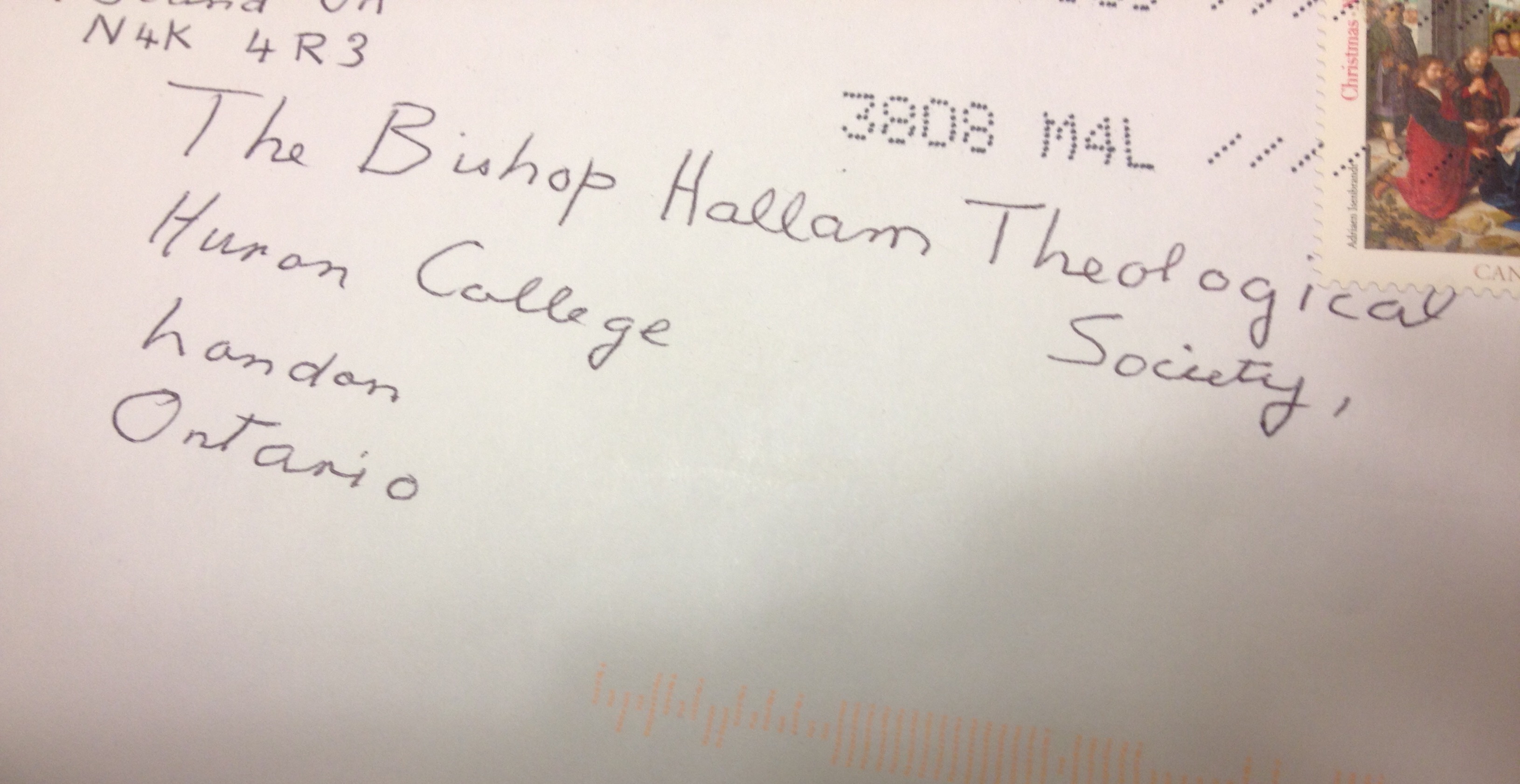
envelopeOne of my tasks is checking the Society’s mail. I usually check every few days, more or less frequently if there are things I am expecting or if school is not in session. Last week, a small envelope appeared in our mailbox. The address was written with shaky-looking writing and there was no street address or postal code: just “The Bishop Hallam Theological Society, Huron College, London Ontario. The postmark suggested that it had been mailed in December meaning it took two months to find us – but that Canada Post still managed to get it to the right building! (Small miracles!)

Two small pieces of paper torn from a spiral ring notebook were inside, with a return address from a retirement home in Owen Sound, Ontario. It read:

To the Bishop Hallam Theological Society Huron College London Ontario.

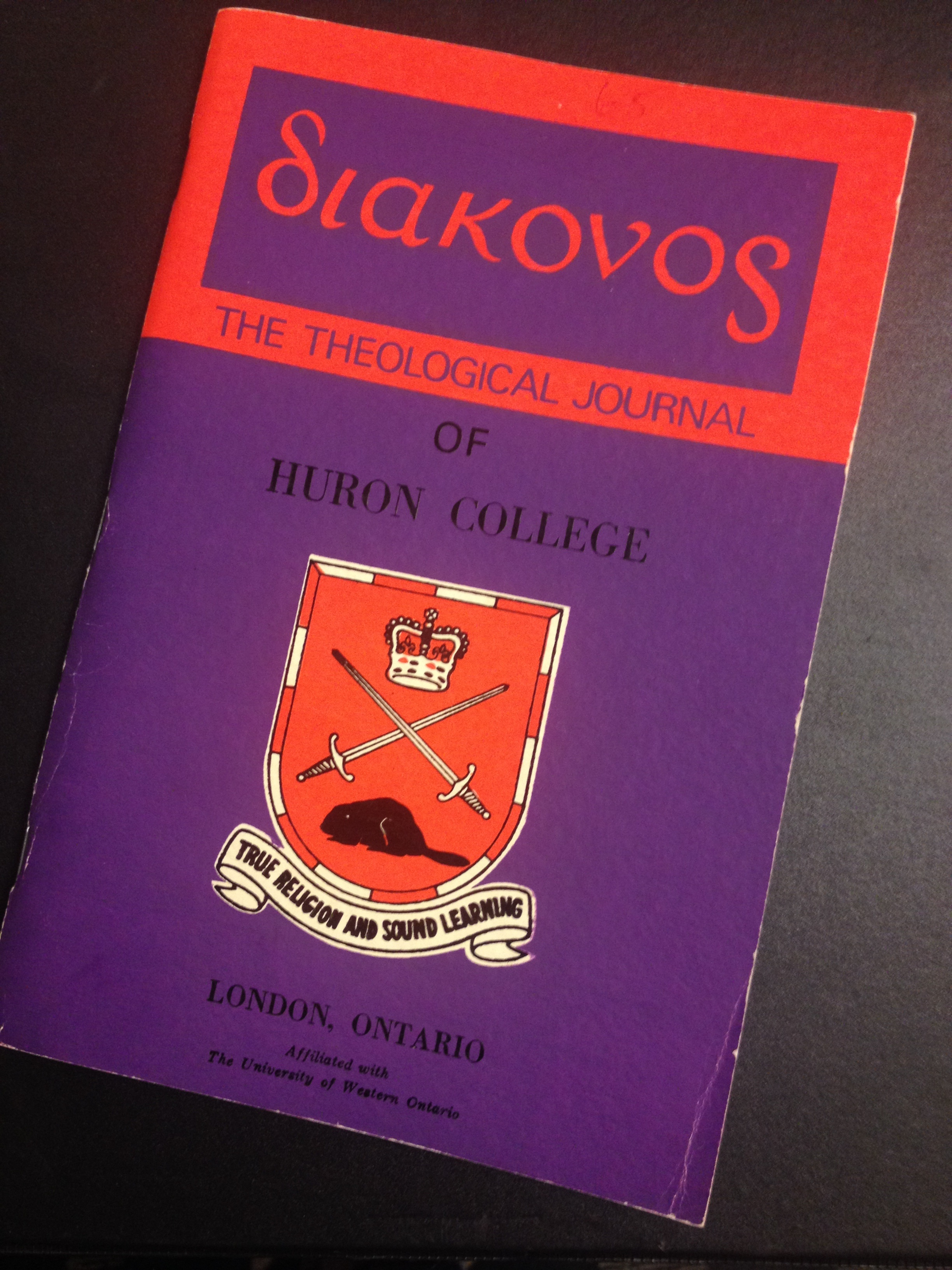
Is it possible to obtain copies of diakonos, the theological journal of Huron College London Ontario published by the Bishop Hallam Theological Society Huron College London 1965? My husband was the editor of this journal and we lived in a cottage next door to Huron College.

Would it be possible to obtain copies of this Journal? as I would very much like to be able to give a copy to each of my 3 children.

Your sincerely,

———-

I had no idea what she was talking about. The BHTS no longer publishes a journal – in fact I hadn’t even known we had in the past! Fortunately I happened to be near the Dean’s office when I opened and read the envelope and he and the Assistant to the Dean, both of whom have a long memory of things at the school, were in their offices. When I inquired about the journal, they both knew exactly what our letter writer was talking about!

It turns out that the BHTS did publish a journal, roughly from 1964 to 1967 or 68 from diakonoswhat I can tell. Copies are hard to come by now, for obvious reasons. There is a copy of each issue in the archives and the Dean has a copy of each issue in his office. Coincidentally, fortuitously, or providentially, he had a second copy of the 1965 edition which he was happy to give me. Yes, the surname of the editor is the same as the surname of our letter-writer.

Happily, I have been able to respond to our letter-writer with a note, thanking her for writing and for allowing us to reconnect with a piece of our history and to reconnect with the hundreds of faithful people educated at this seminary before us. I was sorry that I did not have three to send to her, one for each of her children, but so thankful that there “just happened” to be an extra copy of the one her husband was the editor of. I hope that she enjoys reading it as much as we have enjoyed being reconnected with a piece of our history that we had lost.


The Holy Innocents

Now after the wise men had left, an angel of the Lord appeared to Joseph in a dream and said, “Get up, take the child and his mother, and flee to Egypt, and remain there until I tell you; for Herod is about to search for the child, to destroy him.”

Then Joseph got up, took the child and his mother by night, and went to Egypt, and remained there until the death of Herod. This was to fulfil what had been spoken by the Lord through the prophet, “Out of Egypt I have called my son.”

When Herod saw that he had been tricked by the wise men, he was infuriated, and he sent and killed all the children in and around Bethlehem who were two years old or under, according to the time that he had learned from the wise men. Then was fulfilled what had been spoken through the prophet Jeremiah:

“A voice was heard in Ramah,
wailing and loud lamentation,

 Rachel weeping for her children; she refused to be consoled, because they are no more.”

Matthew 2:13-18


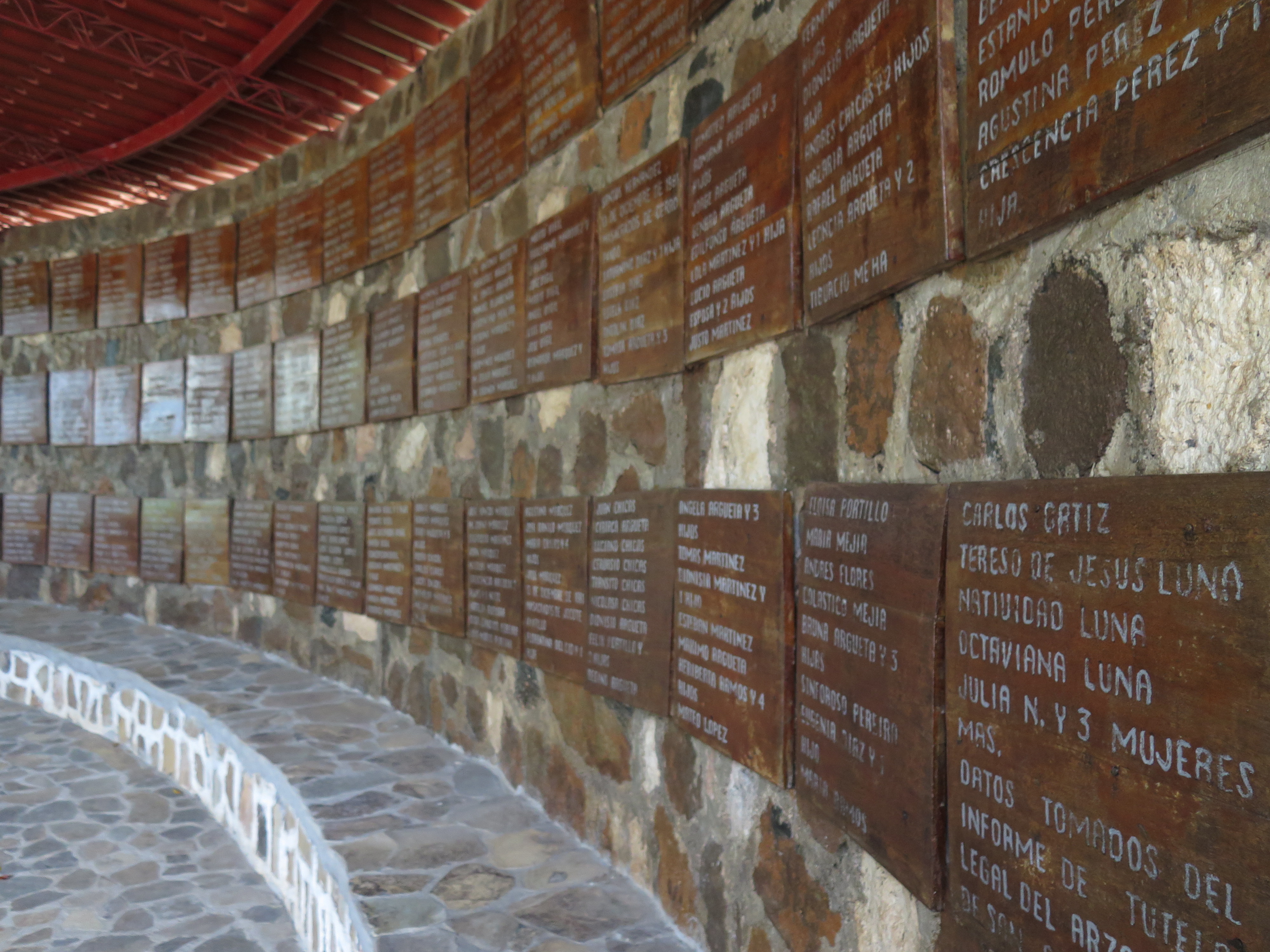
The largest massacre of the conflict in El Salvador happened in El Mozote on December 11, 1981. Reports vary, but anywhere from 750-1000 civilians were killed by the Salvadoran army that day.

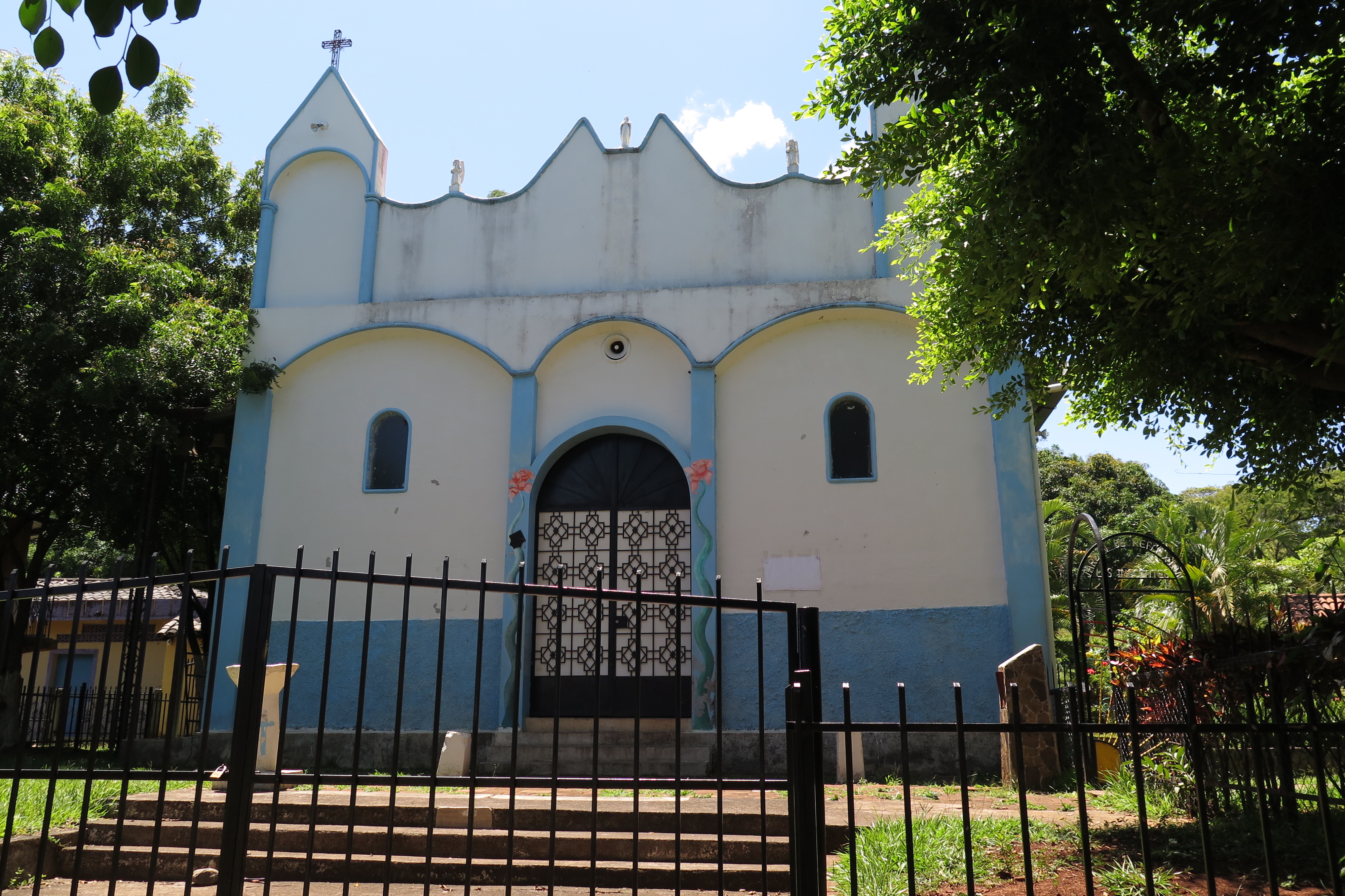
IMG_2676El Mozote is a small town near the border with Honduras. There are a few homes around a square, a small store, a big tree with the open-air market, and a church on a small rise at the base of one of the surrounding hills. The church is simple – whitewashed with blue trim. There is no steeple or tower, just two small crosses on the outside corners. Whether or not the church looked like this 35 years ago, I do not know. But there has always been a church.

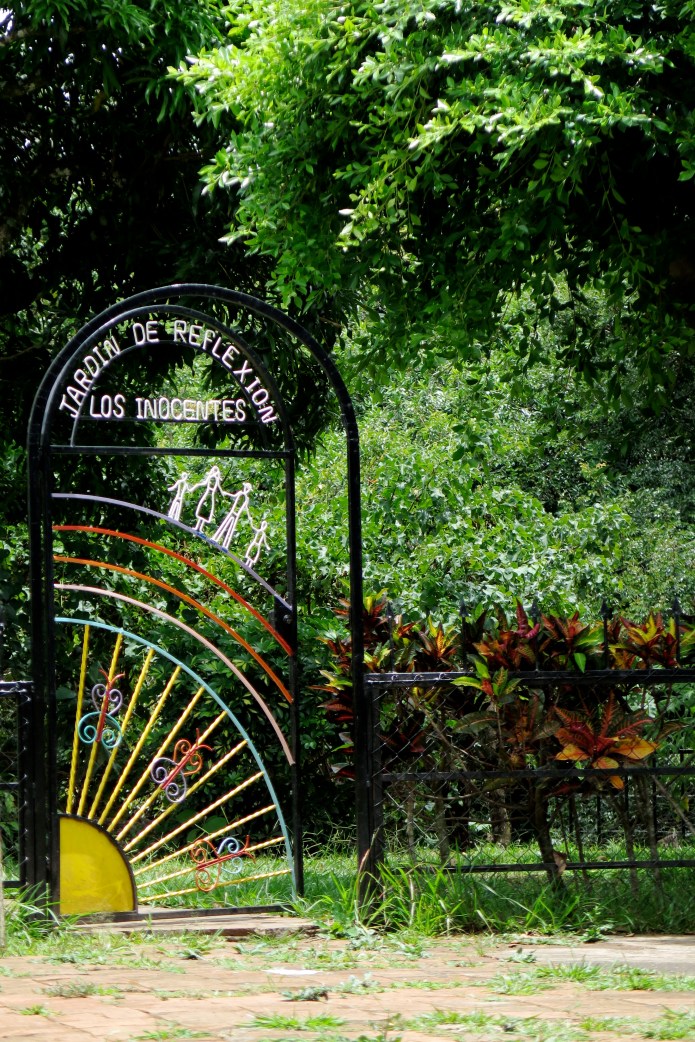
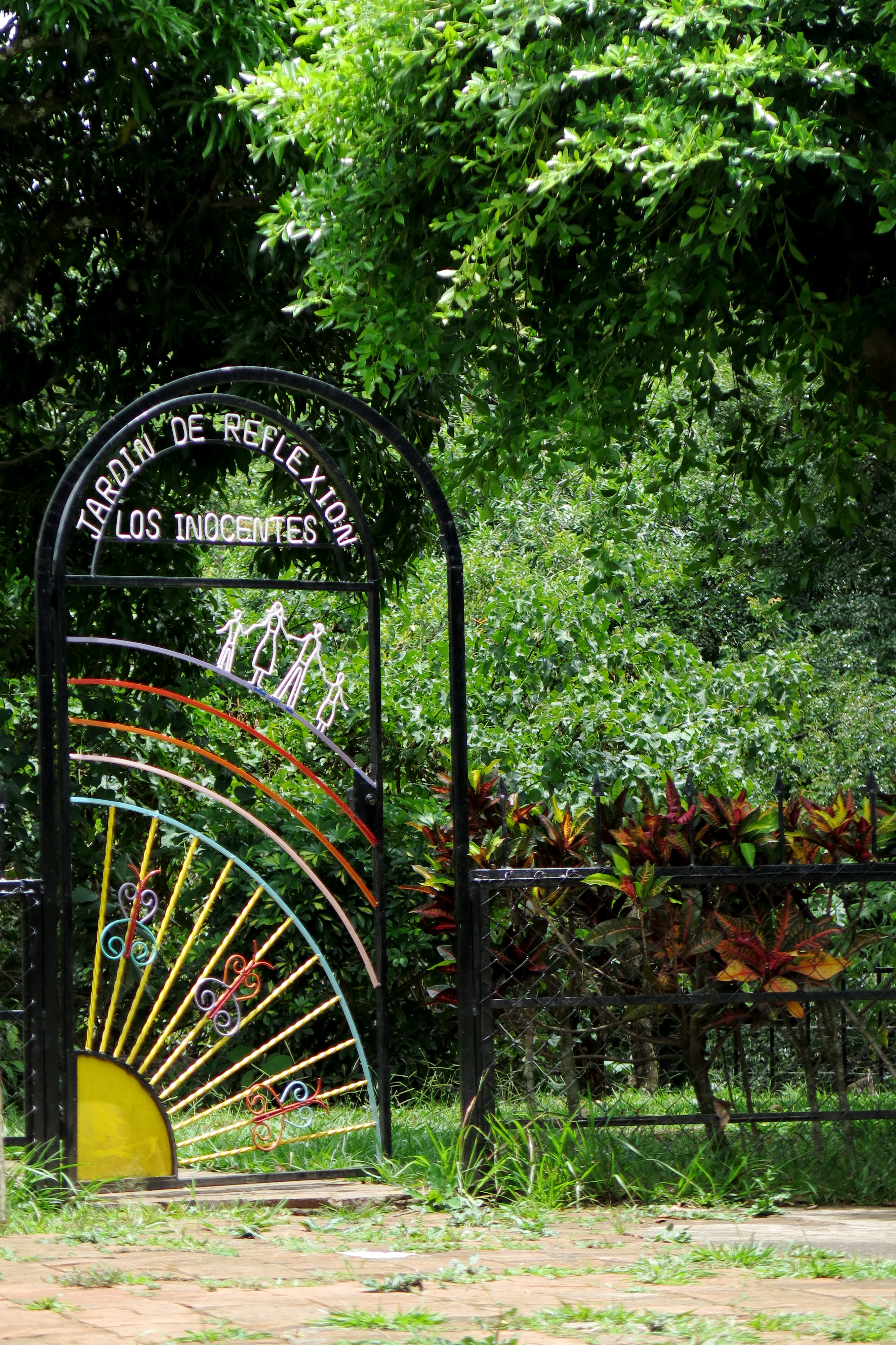
The church is surrounded by a concrete retaining wall and a short iron fence. While the gate is closed today, I can see another gate, made of iron in the shape and colour of a sun with rays and rainbow, leading into the garden beside the church. Over this image is the words, “Jardin de reflexion los inocentes” – The Garden of Reflection of the Innocents.

IMG_2691

Immediately what springs to mind is the Feast of the Holy Innocents, which we are commemorating today in the chapel at Huron. This is the feast where we remember those children massacred by King Herod when he was hoping to kill the child Jesus. But that isn’t entirely what this garden is commemorating, though it may be a reference. This garden is commemorating the massacre in El Mozote.

No one outside of the immediate department in El Salvador really believed that there had been a massacre of civilians of this scope in El Mozote. The army took great pains to hide it from everyone. Yet years later when they finally began to excavate the site, they found the bones of approximately 150 children buried in this space beside the church. One hundred and fifty innocent children massacred in one place.

IMG_2686With tears in his eyes, the brother of the lone survivor, Tomas, told us of how his sister Rufina was carrying her eight-month old baby and had her other children by her side that morning when the army rounded everyone into the square. First the men were brought into the church, interrogated, and killed. Then the young girls were taken into the hills, raped, and buried. Rufina’s baby was knocked from her hands by the soldiers who then picked it up, tossed it into the air, and “caught” it on the end of their bayonets.
Slaughter of the innocents.

Entire families were wiped out in this massacre. Lives changed – and taken – in an instant. Soldiers set fire to all of the buildings in the village, with the bodies piled inside, hoping to remove all evidence of what they had done.

IMG_2678

IMG_2688

I asked if justice had ever been served. They said no: those who ordered the massacres are still serving in the Legislative Assembly and until they are no longer around to block the process, they cannot seek justice.

[For an extensive report of El Mozote: here.]

It is hard to have hope, witnessing something like that. These massacres seem to have been going on for far too long. Who knows what will someday be uncovered about our history? Perhaps the only hope we can offer is that in the second reading for today:

Then I saw a new heaven and a new earth; for the first heaven and the first earth had passed away, and the sea was no more. And I saw the holy city, the new Jerusalem, coming down out of heaven from God, prepared as a bride adorned for her husband. And I heard a loud voice from the throne saying,

“See, the home of God is among mortals.
He will dwell with them;
they will be his peoples,
and God himself will be with them;
he will wipe every tear from their eyes.
Death will be no more;
mourning and crying and pain will be no more,
for the first things have passed away.”

Revelation 21:1-4

God is here and is making all things new. We are participating in that renewal of the earth. Awful things are still going to happen, unfortunately, until the new heaven and new earth becomes reality. Until then, we continue to hope and pray and work to make it our reality.

Cricket

IMG_2174

Hello world! I’m Cricket!

Meet Cricket!

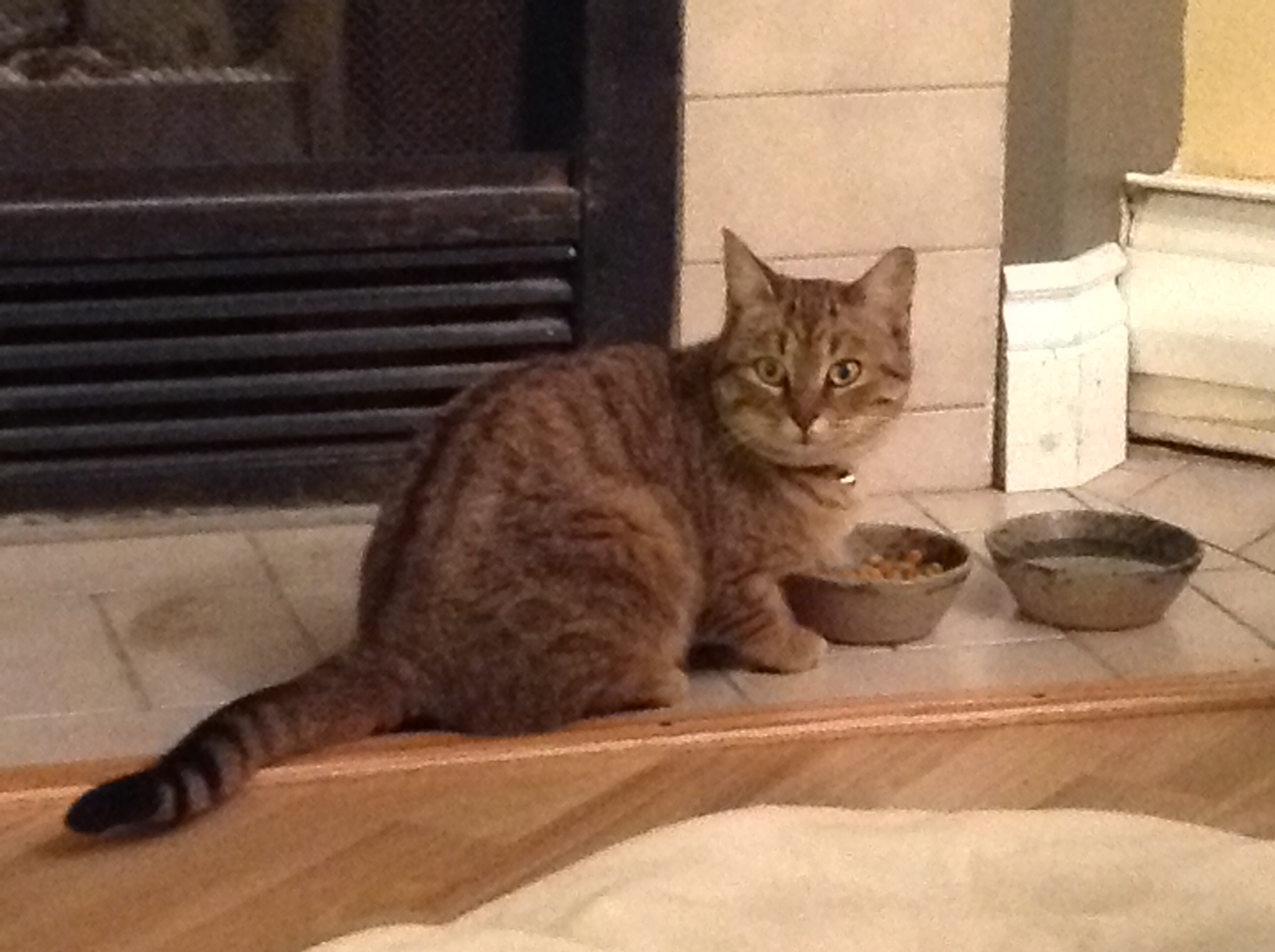
Matthew and I adopted an 8-9 month old kitten on Friday. She is a rescue cat who came to us by way of the parents of a friend.

She is still getting used to us, and is a little skittish, but is quickly warming up. After spending her first day entirely under our bed, she is gradually taking over the house. This morning I woke up and discovered her on the kitchen counter. She then discovered the gap between the fridge and wall and proceeded to fight with my apron which hangs there. While still easily startled by quick movements, she has just started to climb over me to get places, pausing for a chin rub on the way. Her meow is not much more than a little squeak but she has a loud purr box! She is quickly becoming a big part of our little family!


Twelve

IMG_2103I am currently in Toronto for the board meeting of the Primate’s World Relief and Development Fund. This morning our Executive Director led us in a theological reflection that included, in part, a reflection on the life that can come out of death.

Twelve years ago this morning we lost mum. One month ago this weekend, I was given her wedding band and a promise. Out of death has come new life. Amen.

Global Citizen Youth Leadership

I have very briefly mentioned that I spent a few weeks in El Salvador this summer. My time there was through the work I do with PWRDF. One of our partners, the Committee against AIDS (CoCoSI), was chosen to host a delegation of young people from Saskatchewan. The trip was designed and run by the Saskatchewan Council for International Cooperation. Its purpose was, as the title “Global Citizen Youth Leadership Program” suggests, designed to promote being a global citizen amongst young people.

What does it mean to be a global citizen, you might ask. This was explored through discussions of international development – good and bad, through understanding privilege and oppression, through living and interacting with people with a different history, culture, and worldview to the ones we may have grown up with, and through being open to being changed and willing to ask tough questions to ourselves and our society.

The eight teenagers from all across Saskatchewan who joined in on this journey are amazing young people. They rose to the challenge and let their hearts be broken time and time again by shattered worldviews, poverty, pain, and love. Their experiences, and the stories of some of the people we met have been captured in a 30 minute video by a Regina filmaker.

For those of you who have not yet had the opportunity to see the video, take 30 minutes and be challenged by some amazing young people.

Passing Peace

Each time we, as a Christian community, gather to celebrate the Eucharist, we have a tradition of passing the peace. How we pass that peace can be summed up in a thread started by a friend of mine of Facebook: “Informal poll for Episcopalians (or anyone who worships in a “liturgical church”): When passing the peace, are you a hand shaker or a hugger?”

With over fifty comments on the post, it is safe to say that we are all a little divided on it and many have strong opinions. I know people who will only attend services using the Book of Common Prayer, the older prayer book, so that they do not have to even think about touching anyone. I know people who have it as their mission to hug every single person in the building before they will conclude that they have sufficiently passed peace. My own response? Well, if I know you well, I’ll give you a hug. If I’ve only just met you or I don’t know you very well, it is a hand shake.

But what about if that has to change and you can’t shake hands for some reason and you do not want to hug? Then what?

I spent July and August in El Salvador with a group of youth leaders from Saskatchewan. We were visiting a PWRDF partner there, and spent the majority of our time in a small, isolated, rural community in the highlands close to the border with Honduras. While I am always really careful about ensuring I have all of my travel vaccinations before I go anywhere, there are some things you cannot plan for and cannot do anything to prevent.

Shortly before leaving to return home, I had a bit of a fever and felt achy all over. The local doctor looked me over and decided that I didn’t need to worry about anything with regards to flying, and to visit a doctor at home if anything changed after I arrived home. For some time, nothing changed. However a few weeks after returning home I started to get really achy joints: toes, ankles, knees, hips, elbows, and fingers. Not all at once, but definitely a lot of them for a lot of the time.

After a series of blood tests (and a whole lot of blood removed from my body), we have determined that I got the chikungunya virus when I was in El Salvador. It is transmitted by mosquitoes, which is interesting since I rarely get bitten by mosquitoes. It won’t cause any permanent damage and the joint pain will subside over time – and indeed it already has a lot: walking is no longer extremely painful and I have been able to type these words – but I will be dealing with joint pain off and on for a while longer still.

What does this have to do with passing the peace, you might ask? Simply this: my hands and feet remain the most affected parts of my body. I have difficulty holding our heavy hymn books some mornings in chapel. It also means that when well-meaning people give me a nice, firm handshake of peace, my hand aches for hours afterwards.

How does one pass peace when a handshake isn’t a viable option? I have tried a number of different things, most recently putting my hands together in prayer position and slightly bowing to people when I pass the peace of God. More often than not, however, this becomes awkward for both myself and the other person. So what is one to do? While for me, the pain will soon go away, I am mindful that is not the reality for many.

Countdown

The countdown is on. In 16 days, I’m getting married!

KAM_3897

(Our engagement photos and wedding photos by Blue Iris Photography: http://www.blueirisphoto.com)

We are getting married Thanksgiving weekend (Canadian Thanksgiving) in our adopted home of London, Ontario with our families, friends, and classmates around us. While stressful at times, it has been a lot of fun to plan out our liturgy and ask friends and classmates to play meaningful roles in the ceremony. Now, a little over 2 weeks out, all of the details are nearly sorted out and we’re just waiting to have fun celebrating with everyone.

While Thanksgiving weekend is smack in the middle of our penultimate term of seminary, having our celebration on a weekend in Autumn (my favourite season) where our classmates could be with us made a lot of sense. We met here at seminary at Huron and our classmates and professors have played a big part in our lives together thus far.

The last 21 months with Matthew have been amazing. I am looking forward to the rest of our lives together.

Adventures

August got away from me.

I’m not really sure where it went. It is probably more accurate to say that in August, I went. El Salvador, British Columbia… I think I spent no more than a week and a half at home during the entire month. But, adventures we had!

I have big plans to do some writing, especially about the first of those adventures, but probably about the Island as well. However two other adventures have been preoccupying my time as of late:

School starts up again tomorrow. Third year of a three year MDiv program. The final year. The final countdown. Third year!

I am getting married in a month. One month! Things are happening and there are lots more things still to make happen. Whatever may happen, however, it will be a lot of fun.

I will be around and writing as I can.

Privilege

Privilege and race have been on my mind. Then this buzzfeed quiz came across my Twitter feed this morning.

Privilege.

I scored 62 out of 100. Not high for a quiz – though high enough to be called “quite privileged.” Buzzfeed is by no way scientific and, from what I have seen on Twitter, there has been quite a wide variety of scores received. Some scores seem to make sense to the recipients, but some do not. Either way, it has opened up a conversation about what privilege means.

Later on this month I will be helping to lead a group of high school students on a “Global Citizen Youth Leadership” program in El Salvador. Part of the pre-trip conversations have included this topic of privilege. What is white privilege and what do we do with it? Interestingly, not all of us participating are white and I am sure this will add a lot of good insight to the conversation when we finally meet face-to-face.

When I think of privilege and the privilege my whiteness gives me, one of the most vivid examples I can think of was on Offshore when we were in Madang, Papua New Guinea. I and the other cook were in charge of provisioning the ship and we enjoyed our trips to the market to get fresh fruits and vegetables. Across the Pacific, these trips were usually filled with laughter as we all struggled between broken English and limited Pidgin to make it understood that these two girls wanted to buy that entire pile of carrots and that whole bucket of potatoes, plus all the watermelon we could carry. The laughter continued as we would struggle to load them onto our shoulders and carry the produce back to the boat.

The market was full of friendly laughter. It was different at the grocery store.

We shopped at the grocery store with some regularity over the week we were in port. It was a good place to stock up on canned goods, meats, and everything else generally not available at the open-air market. PNG is a country not particularly known for being safe and so we were not surprised to see armed guards at the entrances and exits of the store. I was a little uncomfortable when everyone’s bags were searched upon leaving the store – everyone’s except ours.

But nothing was as uncomfortable as the day we arrived to shop and there was a queue of about 30 people waiting to get into the store. We joined the back of the line, happy to wait our turn and attempt to converse with the people around us in line. The armed guards had other ideas.

They saw us waiting in line and came and told us to come with them. It wasn’t safe for us to wait in line, they said: two white girls in a line of New Guineans. It wasn’t safe. What felt not safe were the hisses that followed us as we became escorted queue-jumpers, passing all 30 of the people ahead us in line and into the store to do our shopping. The hairs on the back of my neck stood up to hear those hisses and I saw exactly what privilege – and dislike – my whiteness could afford me.

I think this is why I always strive to respect local customs and attire as best as I can when I travel. I just want to blend in. I count it a compliment to be treated like a local and always try to be as respectful as I can.

Not all of PNG was like this. In the remote Tsoi Islands where we worked together with local villagers to build a dugout canoe, a profound moment came when our Captain was talking with the chief boat builder after a long day of work. The boat builder held his dark arm up beside our Captain’s very white arm, looked into his eyes, and said, “It doesn’t matter, does it? We are brothers.”

White privilege. I know I have it. How do we live with it?