Offshore Reunion

Last night was the S.A.L.T.S. AGM. The last half (two-thirds?) was devoted to a multimedia presentation of Offshore put together by Skipper, complete with with photos and video highlights of the trip. People started arriving 15 minutes or so before the doors opened and it was like a huge reunion of trainees and crew: I hadn’t seen lots of them since we arrived home in  June of last year. Strange really, I spent every moment of every day for months with some of these people and now I haven’t seen them in months. Needless to say there were hugs flying all over the place. I felt a bit disjointed as there were so many people I wanted to see – I kept turning and seeing someone else to grab. I’m not usually like that. I usually stand on the edge of the room and have a select few conversations while people-watching. It was really exhausting.

The presentation, however, was fantastic. The video footage was all new to me: most of it I hadn’t seen since we actually lived through it. Some of the most moving footage to see was of our time with various islanders in remote locations. There was quite a bit of our friends on Hiva Oa, including their singing of the Marquesan National Hymn. Then there was some of the Palmerstan Islanders, including our dancing and that of the ever-graceful boys. The video of the whales we swam with in PNG was also moving. It was so graceful to see a dozen or so whales gliding through the water and some of us diving down to see them and them surfacing to see us. Wow. At one point during the whales, I caught the eye of another crew member and we mouthed “SHARK” at each other because that is pretty much how it went down. Skipper left that out of the presentation.

The whole thing brought tears to my eyes. Such good memories, amazing people and places and community on the boat. Someone said to me afterwards that they felt they had lived it with us. “Hmmm, not quite,” I thought to myself. The show missed some key things below decks. Sure, you see the crazy motion from on deck when waves come crashing over the side, but what about when those waves lift up the closed skylights to dump water on the table in the middle of a card game. Or when the waves lift the skirt around the bottom of the mast and pour waterfalls down onto freshly baked muffins you were planning on serving for breakfast in 15 minutes. And what about when the swell is so huge that your galley assistant for the day drops the 100 oz can of chickpeas all over the floor as she slides all the way across the galley and slams into you. And the heat, nothing in the photos gives any indication of how bloody hot it was on deck and how much hotter it was in the galley. Oh the good times, that is what memories are made of.

Pilgrimage

I’ve been thinking a fair bit (off and on) about the idea of pilgrimage over the last few months. It was brought to the forefront of my attention once again on Sunday with the story on CBC Radio One’s Tapestry program. Then today this article from The Economist popped up in my RSS feed. It is discussing German pilgrimage sites (one of which I visited on my 2006 trip around Europe.)

The thing about pilgrimage, as expressed by Arthur Paul Boers on Tapestry (and if you haven’t listened to it yet, take a break and do it. It is very interesting), is that it allows us to more fully engage. Think about it: we live in a culture where we are not fully engaged in much of anything around us. We do things with our mind or our body (go through the motions… how often do you have the radio or TV on in the background while doing something else and only half pay attention to anything? I know I do it all the time) or our emotions are engaged but it is rare that you get all three working together at once. There is far too much distraction for that (iPod plugged in while reading/walking…). Pilgrimage engages all: mind/intellect, body, spirit, emotions.

Another way to say it: our culture is disconnected/fragmented and pilgrimage reunites and connects us both with ourselves and with others.
How does it do this? Again, referring back to the interview on Tapestry, by creating situations where the boundaries are different and you are able to get to know yourself and others on a whole new level.
There are lots of classic examples of pilgrimage. In medieval times, people would go to Cologne, Jerusalem, Rome, Canterbury (Chaucer anyone?), or Santiago de Compostela to name a few. Thousands, probably hundreds of thousands to millions of people make the annual hajj (pilgrimage) to Mecca.
So what is the deal? The American philosopher Albert Borgmann in his book Technology and the Character of Contemporary Life (one of the books I’m currently plugging through) speaks of Focal Places, Things, and Practices when discussing the fragmentation of our lives (specifically in relation to technology). These focals have three qualities:
  1. Commanding presence, that is they demand discipline, take exercise, and tire us out.
  2. Meaningfully connect us to others, to our history, to the environment, and, I would add, to ourselves.
  3. Have centering/orienting power by helping to remind us of what is most important.
Unfortunately, these are becoming rapidly pushed out of the centre of our lives into the background, leading to our disoriented lives.
I then got to thinking on pilgrimages in my own life and realized that Offshore was a pilgrimage of sorts. There was not the idea of the body being used to express something of the soul that you would get in a walking pilgrimage like the Camino del Santiago, however other aspects were certainly there. The previously mentioned idea of pilgrimage creating situations where the boundaries are different and you enabling people to know the self and others on a whole new level was and is key to the Offshore experience. There is little room for an alternative when you are on a 138 ft boat with 35 other people for a month to a year without the option of getting off.
To go through the characteristics of focal points/things/places:
  • Demanding discipline, taking exercise and tiring us out? Most certainly. I was tired at the end of each day and chronically exhausted by the 9 month point. This was not just and, I would venture to say, not always a physical exhaustion. There were times when I just felt like I did not have anything more to give; an emotional and mental exhaustion that really had me questioning my ability to provide for the trainees in the manner I felt I needed/wanted to.
  • Meaningfully connecting? Again, definitely. If I had a dollar for every time someone talked about feeling understood by others on the boat better than they’d ever been before or about being able to know themselves and the people around them more meaningfully then I wouldn’t need to worry about finding part-time work this semester. After all, our ongoing theme throughout Offshore was from Jean Vanier’s book Becoming Human (another one you should read if you haven’t). In it, Vanier talks about being known and that in allowing others to know us by opening our lives, we can achieve real freedom.
  • Reminding us of what is most important in life? Once again, a resounding yes. Many of us came away from Offshore feeling that we had far too many possessions and realizing that these are not the things which are most important. Going back to the previous point, it is the meaningful relationships and other non-tangible things which are important.
I would say that the majority of people who joined us for a part of the Offshore left the boat deeply impacted and, in some way or another, changed. If not than I think they missed a large portion of what it was about. I just wish that I had thought more about Offshore in this fashion before I went so that I could glean even more from it than I did.

I’ve got just over 100 of my favourite Offshore images loaded now (click ‘slideshow’ top right on the album page for the best viewing). This takes me up to November in PNG. The rest of PNG and Offshore will come next week. Enjoy.

Update on the Photo Uploading

I ditched Flikr because it would only let me put up about 10 photos a month without resizing them and I can’t be bothered to do that (and I haven’t figured out how yet on a mac… anyone??). So we’ve switched to Photobucket. But the current source of Internet hates both me and my computer so I’ve given up at around 30 photos. I’ll find a coffee shop with good Internet while I’m in Montreal (leaving tomorrow!) and while Jen’s at work I will be photo upload machine.  Offshore photos coming.  Stay tuned…

My Home and Native Land

It was the weirdest sensation yesterday sailing up from Port Townsend, past Victoria, to Bedwell Harbour on Pender Island. Past Victoria… there it was, Mt Doug, Cadboro Bay, Oak Bay, the golf club… So familiar but not because I haven’t seen it in over a year. I’d never been down in the San Juan’s before so coming back up and seeing Victoria in clear daylight really brought it home. We’ve checked into Canadian customs finally.  Officially in Canada.  This is the last customs we will have to clear on Offshore!  We’re here, even though we don’t sail into the Inner Harbour until Saturday. Now all that remains is to make the most of the last few days that we are here together on the boat and prepare for sailing in next week. The Swift will be doing some schooner ballet with us outside the waterfront for a bit before we sail in at 3pm. There’s going to be a big ceremony in the Inner Harbour complete with some speeches from Skipper and a couple trainees and there will be some photos from all over place! Come and party with us!

Port Townsend


The Day the Sea was Lighter than the Sky

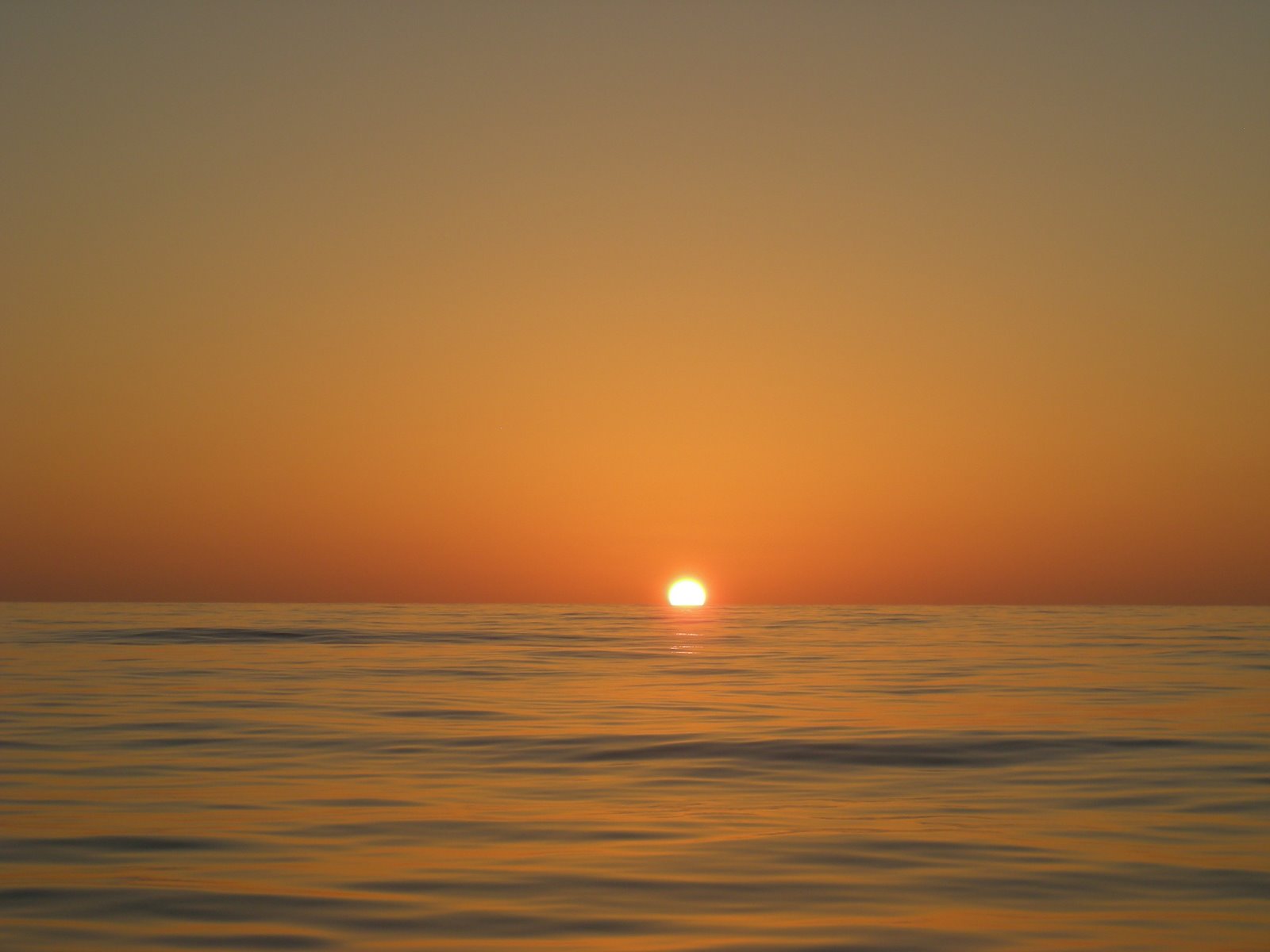
Having passed Cape Guadarfui, we have entered a zone of absolute calm.  For the last 48 hours the sea has been smooth and oily, except where a slight breeze ruffles its surface or covers it with a network of minute wrinkles as regular as the weave of a tapestry.  Upon this mirror flying-fish rise up, glide, and take off again, like swallows skimming the water.  In the middle of this great shoreless lake the evenings take on an exquisite beauty.  Yesterday I could never tire of looking to the east where the sea was uniformly milky and green, with opalescence that was still not transparent, lighter than the background of the sky.  Suddenly on the horizon a thin diffuse cloud became tinged with pink; and then with little oily ripples of the ocean still opal on one side and turning to lilac on the other, the whole sea looked for a few seconds like watered silk.  Then the light was gone and the stars began to be reflected around us as peacefully as in the water of a quiet pool.

– Pierre Teilhard de Chardin, Letters from a Traveller, written somewhere between Egypt and India, 1923.
We have returned to the Pacific Northwest after being gone a few days over a year.  The foreign yet familiar smells of the coast: the salt and seaweed, the rocks and the trees were one of the first things to assail our senses, quickly followed by green.  Despite being in many different and stunningly beautiful far-away places for the last twelve months, this is home and there is a strange beauty to this countryside.  Strolling through the quaint streets of Port Townsend, Washington, I realize how good it is to be home, even though I’m not quite there.  Sailing down the Strait of Juan de Fuca a few days ago was a surreal feeling.  The lights of Victoria offered a glow on the horizon off to port, escorting us along.  Are we really back?  Yes, but no.  There are still ten days left before we sail into Victoria’s Inner Harbour in all our glory.  Ten days to keep living this isolated, simple life that exists on board.  Ten days to continue to enjoy life with this wonderful group of trainees and crew that I’ve spent the last three weeks crossing our final stretch of Pacific Ocean with.  Its been an epic adventure; one full of amazing experiences and valuable lessons and lots of good times.