Sermon for June 5, 2016

Preached at the Church of St John the Divine, Victoria.
Main text: Luke 7:11-17

Referenced: 1 Kings 17:8-24

For the audio recording, please see here.

Jesus is on the move. I mean – every time we hear a story about Jesus, he is somewhere else, talking to someone new, doing something different. He seems to be on the road a lot in this part of Luke’s gospel and its amazing that anyone could keep track of him, let alone follow what he was up to or know who he was in a time before texting, Facebook, or twitter.

The best bet seems to be to keep close, to follow Jesus wherever he goes to see what he might do next. And in our gospel reading this morning, they’re following him pretty closely – Jesus walked 35 kilometres down the road into the town of Nain with his disciples, we read, and a really committed “large crowd went with him”

The large crowd jostling around, pushing each other to try and get closer to Jesus…, kicking up dust from the road…, kids running in and out of legs…

Who is this man? We aren’t quite sure, but he is doing some neat things, so lets follow him… Maybe we’ll be able to find out!

But as we approach the town of Nain, Jesus comes to a stop – and all of us in the crowd have to do so as well… bumping into each other as we all try to look and see why Jesus has stopped.

Our crowd walking into town has met another procession head on, just outside the gates of the city…

Instead of the cheerful chatter and sounds of laughter that have been resonating out of our group, the large crowd we have encountered from town is wailing and crying.

It’s a funeral procession. Death is marching through the town gates and leaving a path of hardship behind.

Someone in our group recognizes the woman at the head of the procession … she is a widow, they say. A single mother with only one son. And this body being carried into the cemetery is that son.

Death. Not only has it robbed the life of a young man but also robbed the life of those who he leaves behind. As many of us know, the social structures at place here meant that with the death of her only son, this widow, this single mother, is now shuffled off to the margins of society where she is like nothing and has nothing.


Not something that we do today, now is it? Or is it?

With the loss of a family member, those left behind struggle to find their place in a world that has undeniably shifted.

With the loss of a job, there is struggle for rediscovery of identity and reformation of relationships – let alone struggle for survival.

With the loss of a home comes shame and blame and guilt and all of the struggles of finding a new place in a hot housing market.

We don’t have to look any further than our parking lot or the once-empty grassy space six blocks down Quadra Street [reference: see this or this, amongst other things] to see what happens to those our society shuffles to the side when they cannot fit within the artificially created social structures that govern things.

It is too easy to think that we have nothing in common with each other: with those who live in tents or with the widow in Nain who has just lost her only son.


Loss. Change. It is all around and can bring us to tears. We wonder where God is in the midst of it all. We might even wonder if we are forgotten.

And then we encounter Jesus on the road out of town to the cemetery. I am not sure that those in the funeral procession knew it was Jesus. Or if they did know him, if they knew who he really was.

But that did not matter – Because Jesus sees them.

He SAW the widow – knew her situation – and was moved with compassion.

I’m not talking the kind of compassion that is tinged with pity or with some sort of patronizing “poor you” sentiment.

I’m talking about the kind of compassion that reaches down into your gut and stirs things up so that it is uncomfortable. The kind of compassion that compels you to do something.

Jesus is stirred so deeply by the brokenness of this widow and her unjust banishment to the sidelines of society that he moves towards her to act on his compassion.


As he moves towards the funeral procession and stretches his hand out towards the bier that the body lay on, I wonder if those in either of the crowds recollected a story they’d heard before about the prophet of God who’d lived generations earlier. The prophet of God we heard about this morning who brought a boy, the only son of a widow, back to life by laying on him three times and breathing the life-giving breath of God back into the boy’s lungs.

I wonder if they remembered that story and looked with hope at Jesus.

If they were expecting to see something similar where Jesus stopped the procession and laid himself out overtop of the dead boy, then I’m sure that they were disappointed.

All Jesus did was reach out and touch the funeral bier and spoke to the young man.


A simple action: reaching out and acknowledging him and the situation of those around him.

And with Jesus’ simple action, the young man’s breath, his life, came back into him and he sat up.

No, if the crowds were looking for fireworks and the supernatural like they had seen with Elijah, then I am sure they were disappointed. However if they were looking for resurrection, they experienced it.

Yes there was the resurrection of the boy, the only son of the widow, that that was in and of itself a spectacular event.

But there was also another, perhaps more subtle resurrection.

If resurrection is revitalization, bringing life back into something, or causing something that had been sidelined and forgotten to exist again, then surely the widow was resurrected as well.

With Jesus’ action and acknowledgement, she was restored into community – brought back from the margins and given new life. And perhaps the community was resurrected as well as they saw the injustice of their structures challenged and they found a model for how they ought to react: seeing, being moved by compassion, and acting.


Perhaps that is the biggest miracle here: that God is alive and active in and through us. God has compassion for each and every one of us and is the one who is moving in the world around us. God is living and God is active.

Because resurrection is not some one-time event that happened on Easter Sunday some two thousand years ago for us to commemorate each year. It is not a means of escape whereby we can leave this world behind and go some place where it is all sorted out.

Resurrection is ongoing in our lives as God is abiding in and through us. We are invited to practice and bring resurrection into each corner of our lives through following the model of Jesus: seeing, being moved by compassion, and acting.

And it is an ongoing practice because, in reality, it is a lot easier to deny the resurrection than it is to affirm it.

Every time I participate in systems of injustice, I am denying the resurrection.

Every time I walk by a person on the street who is experiencing homelessness and ignore their humanity, I am denying the resurrection.

Every time I let my white privilege get me one step ahead of everyone else, I am denying the resurrection.

Once and awhile I actually affirm the resurrection by living it.

By actually seeing the people that God brings across my path.

By allowing myself to see and feel and be moved with compassion.

By loving those around me and acting out of my compassion.


And so I’m not asking you to believe or not believe in people rising from the dead – I am asking you to believe and live the greater miracle: the life-giving resurrection power of God. I am asking you to consider whether wholeness is being restored around and through us, whether resurrection is affirmed, and whether Jesus is proclaimed.

Wholeness is restored, resurrection is affirmed, and Jesus is proclaimed.

Let it be, amen.
Ordination

I have no words to describe last weekend. Instead, I will direct you to my Dad and his photos of our ordination.

This week we each had our first full days of work at the church. I have an office and keys and have begun to find my way around the parish. I am preaching this Sunday, my first Sunday in the parish, and I don’t know whether to tell people to come or to stay away!

God has called us on a marvellous adventure and day-by-day we seek to discover how we serve God and God’s people

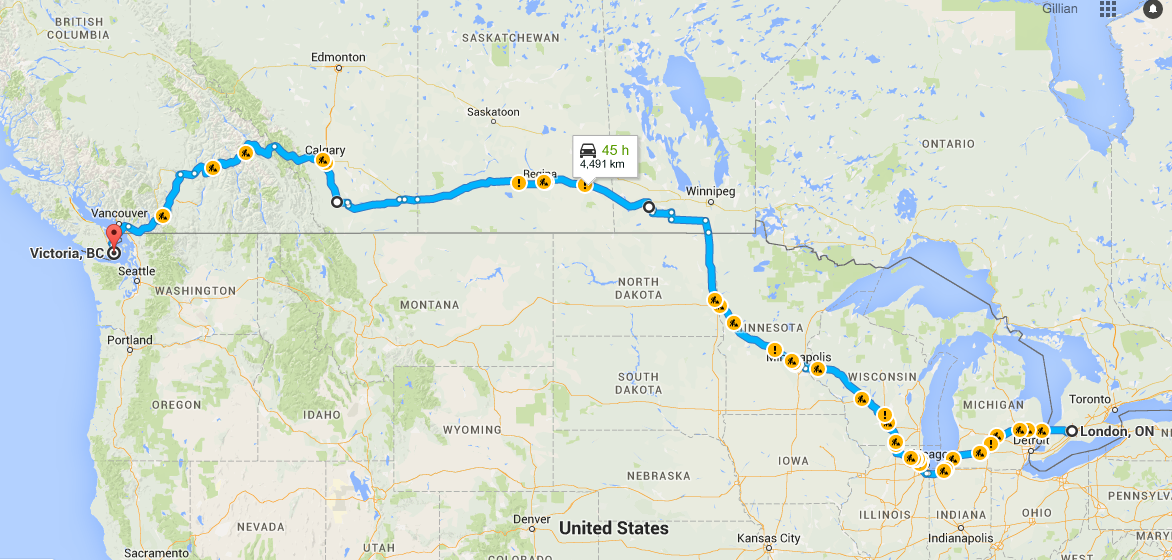
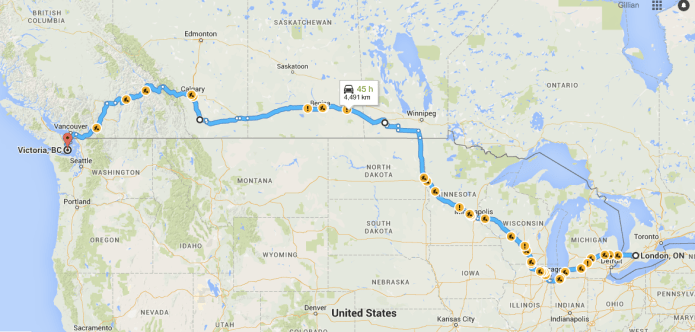
A to B in 4500km

Apparently it is May.

In the last month, Matthew and I have: completed our Master of Divinity degrees, finished up my work with CMHA, said goodbye to family and friends in London and surrounding cities, packed up our house and overseen it being loaded onto a moving truck, and packed up the corolla and driven through six states and five provinces with ourselves and a cat.

Screen shot 2016-05-07 at 11.39.55 AM

After 4500km, we are in Victoria!

13091910_10101404984637131_5467908939173001290_nIt is a bit surreal. A month ago, we were both finishing up our last week of classes and looking at spending the next couple of weeks writing papers. It is hard to believe that three years (2.5 for Matthew) are over and done already. In so many ways, it feels like just yesterday that I was packing up everything in Victoria to move to London. And now it is all in boxes again…

The boxes remain on the moving truck and we are eagerly awaiting their arrival sometime in the next week or so. Meanwhile, we drove ourselves across the country, stopping in Minneapolis, Brandon, Lethbridge, and Sorrento before heading over to the Island.

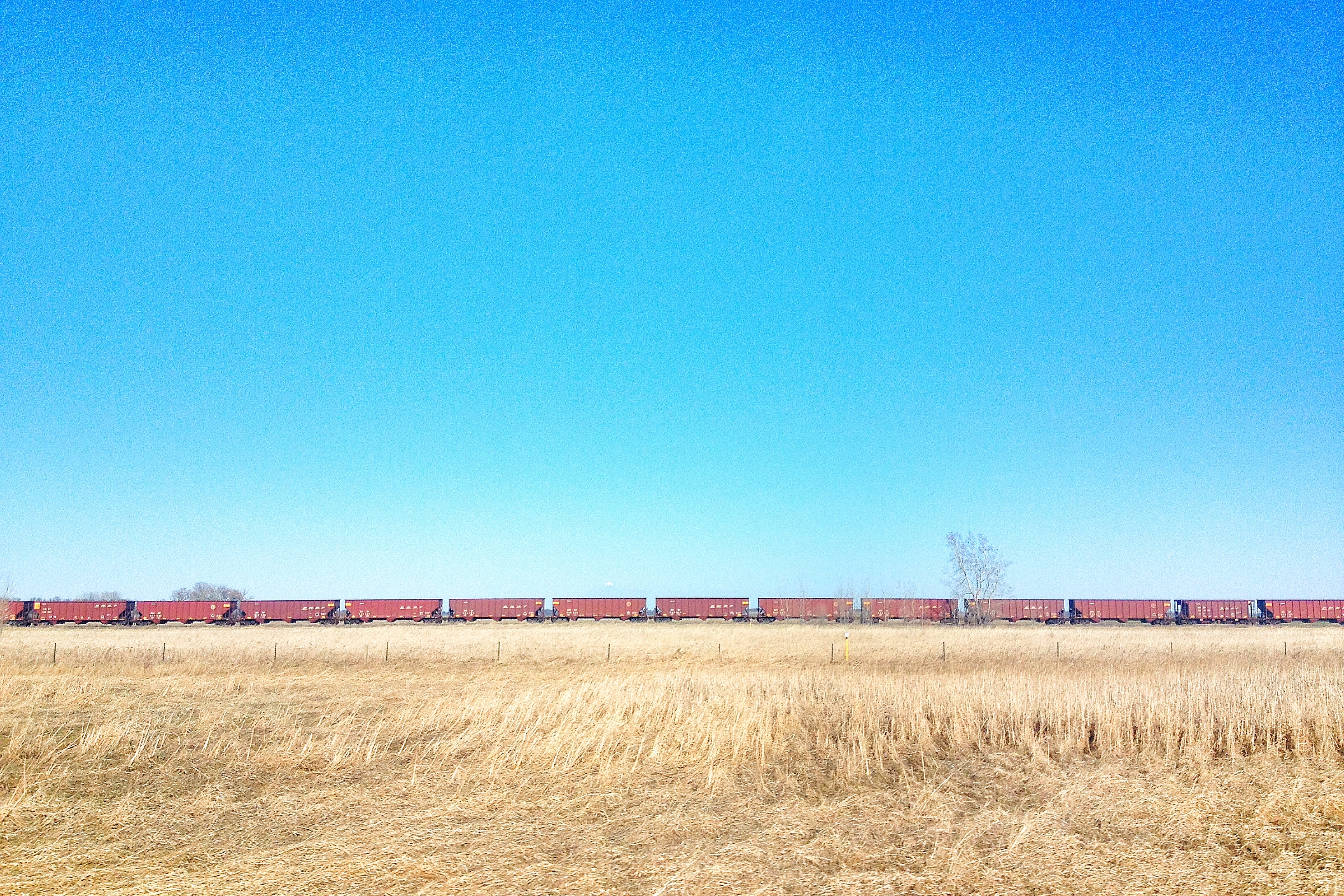
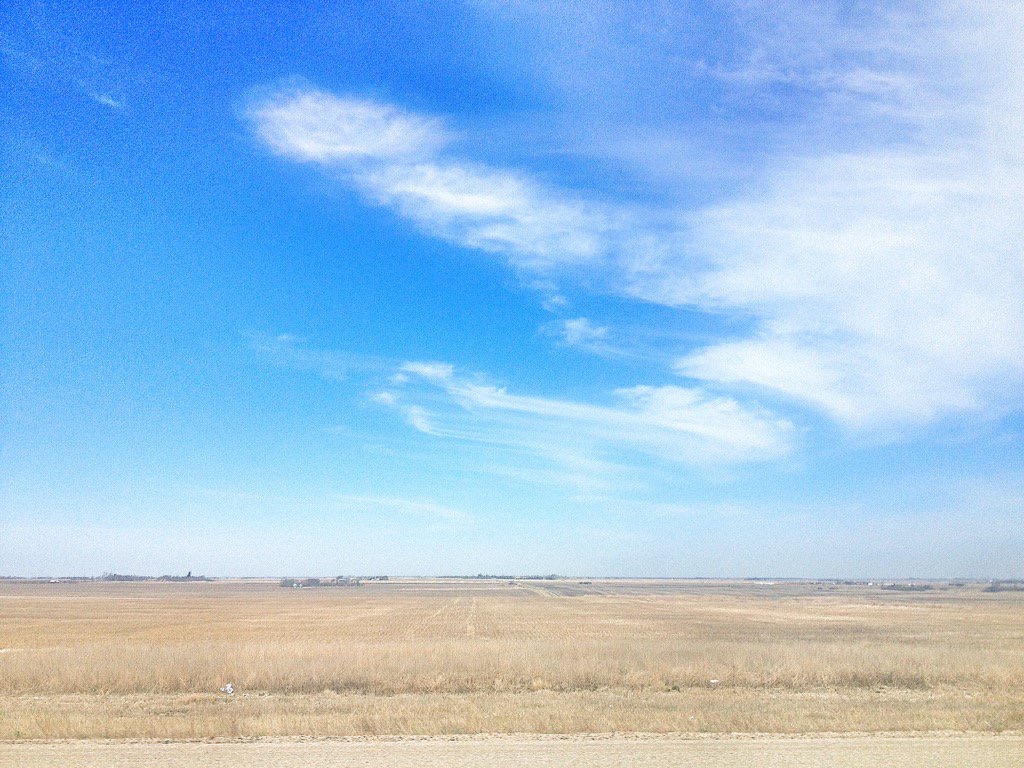
For Matthew, most of the drive was new. For me, the entire route south of the Great Lakes was a new adventure and the cross prairie trek was a lovely reminder of the beauty of our country, as it has been 20 years since my family made our first major move from Belleville to Lethbridge.Attachment-1 IMG_7009 IMG_7011We crossed Manitoba and Saskatchewan in nearly one day, flying along the prairie Trans-Canada highway. Matthew marvelled at the flat flat flat of the land, attempting to see the horizon at every turn (who am I kidding: there were no turns in the road) but continuing to remark instead: “Nope, it’s still very flat!”

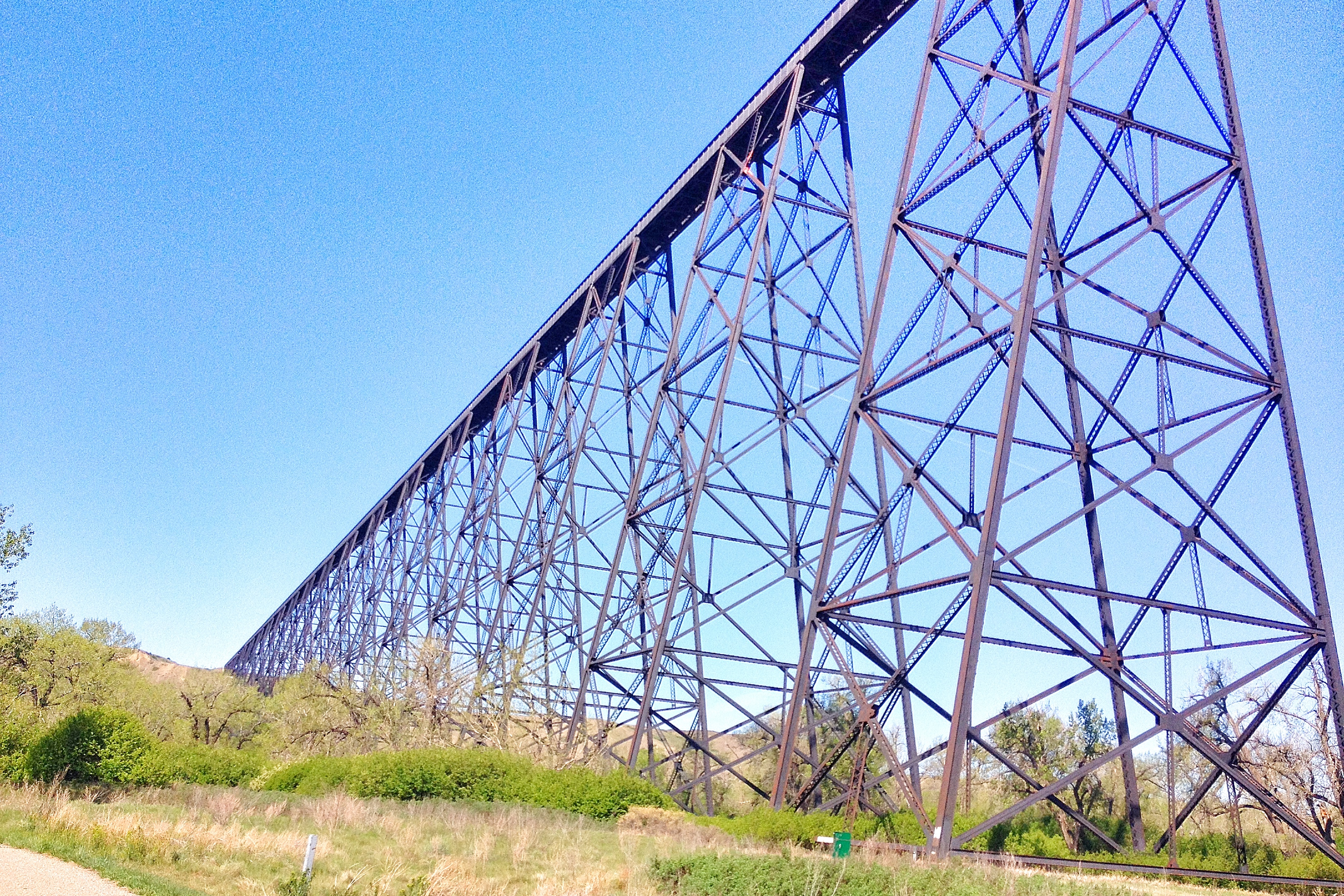
I drove from Swift Current to Lethbridge. Once we turned onto Highway 3 from the Trans-Canada, it was remarkable how familiar things began to look. I learned to drive in Lethbridge and it showed. I was still able to navigate the city quite well, taking Matthew by my old home, down to the Oldman River Valley to see the famous high level bridge, and around by my old high school.

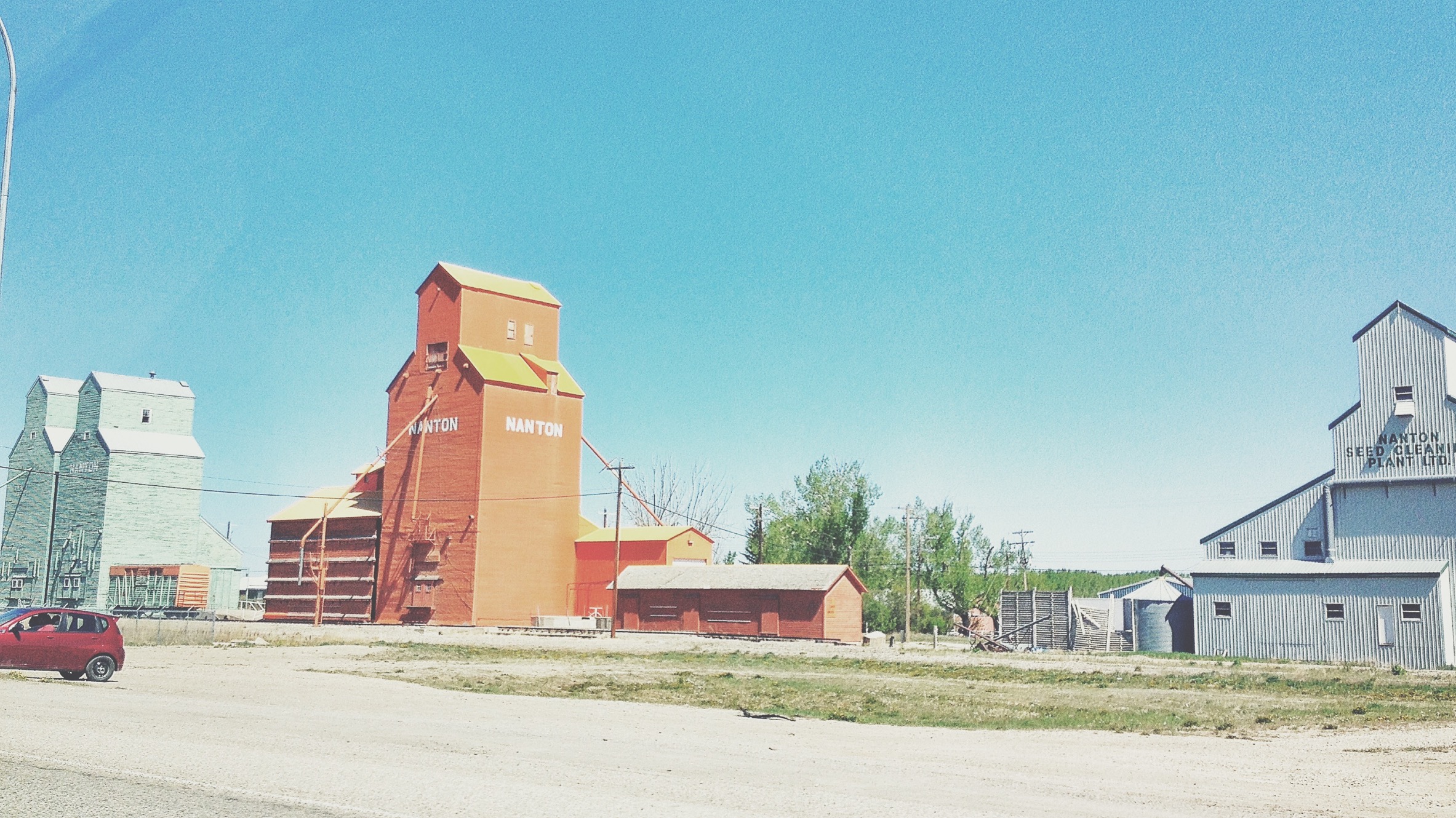
bridgeThen it was off north through more prairie to foothills, through Calgary to the mountains. We could see the mountains from Lethbridge, but it never ceases to amaze me how one can drive all day and not seem to get any closer. Three hours from Lethbridge, however we finally entered the Rockies.IMG_7017

Their majestic peaks were still topped by snow and there were some valleys thick with snow alongside rushing streams as we wound through the mountain passes. Then we were out, into the Interior.

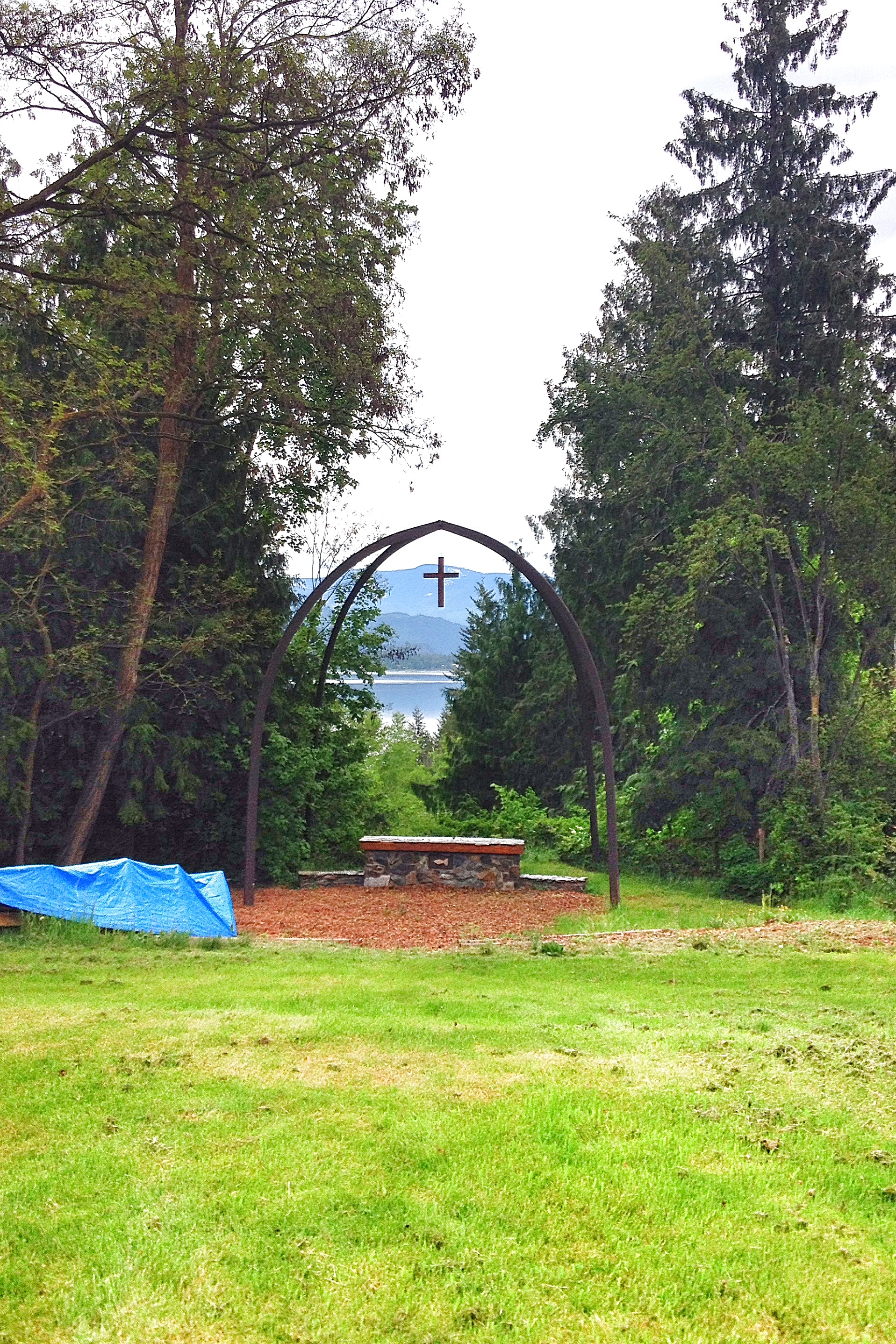
We stopped the night in Sorrento, BC, about an hour outside of Kamloops. The Anglican Church has a retreat centre there and a good friend works there full time. The last time I was at Sorrento was exactly three years ago, when I attended “ACPO” – the Advisory Committee on Postulants for Ordination and was recommended for theological training in advance of pursuing ordination in the Anglican Church of Canada. Talk about full-circle. It is a beautiful haven on the Shushwap Lakes with amazing programming all summer long.Attachment-1 (1)

From Sorrento we drove down the Coquihalla, through Vancouver (waving at Dad and Colleen as we travelled the new South Fraser Perimeter Road to the ferry terminal. After a one-sailing wait, it was onto the Spirit of Vancouver Island and over to Victoria.

We are blessed to have wonderful friends and colleagues in Victoria with whom we are staying while we wait to be able to get into our new suite. It has been an adventure and we are looking forward to what comes next!

Sermon for April 10, 2016

A sermon preached at Grace United Church, Sarnia, Ontario

Text: John 21:1-19 


Two weeks later, here we are, back at the seashore… Simon Peter, Thomas, Nathanael, James, John, and two others have returned to the Sea. Here they are, all together sitting around a fire on the seaside. They’re just hanging out. Ever the impetuous one of the group, Peter suddenly looks up: “Guys, I’m going fishing.” One by one they join him and soon all of the boats are back out on the water.

Follow me, said Jesus, and I will make you fish for people. But now our fishermen have returned to their fish.

***

Easter. Two weeks ago we celebrated Jesus’ resurrection from the dead with what was likely a lot more faith and hope than did Mary, Simon Peter, and the other disciple when they encountered the empty tomb early that morning. It was empty of Jesus’ body and, in the words of Mary when she unknowingly encountered Jesus in the garden, “they have taken away my Lord and I do not know where they have laid him.”

The inclination that something had happened doesn’t seem to have fully sunk in, however. The evening of the day Jesus rose, the disciples were hiding away behind a locked door. A locked door?! So much for believing in the power of the resurrection!

To their surprise, and very likely ours had we been in their shoes, Jesus appeared among them, speaking to them before breathing his spirit upon them as he sent them out.

But… one week later, there we are, still in the same room with the same locked door, clearly not entirely sure of what has happened. Jesus appears again in our midst and we are able to see and touch him.

Another week passes and the disciples are no longer locked up in the room. Simon Peter, Thomas, Nathanial, James, John, and two others have walked some 170 kilometres north of Jerusalem to the Sea of Tiberias – the Sea of Galilee. That’s not too far off the distance between here and, say, Kitchener. First century roads, however, are far cry from our highways and it took them a little longer to plod the dusty tracks of Israel than the couple of hours it might take us to drive that distance today.

It is a familiar road.

I wonder if they were recalling the last time they had all walked it: on the way to Jerusalem and the way to Jesus’ death on the cross, though they did not know it at the time.

This time, though, we’re headed north instead of south. Perhaps they feel as we sometimes do when travelling: the return road seems to pass by faster than the leaving did. Despite the hills and the dust as we walk along, maybe our pace begins to pick up as we get closer to the Sea.

They’re going home.

Did the painful and confusing memories of the previous few weeks in Jerusalem begin to fade as they put some distance between themselves and the city? Were they talking about what had happened? Were they trying to forget? Or were they still struggling to make sense of what had happened?

Despite having seen Jesus, seen him twice for some of those in our travelling group, there seems to be some confusion about what to do now. Jesus sent them out, but maybe they don’t know what that means.

So we are gathered together beside the Sea, their familiar place, the place where they had fished every day up until Jesus called each one, one-by-one.

Two weeks after the resurrection and that first Easter morning, two weeks after Jesus’ appearance to the disciples and his sending them out… Three years of hearing Jesus’ teachings day-in-day-out and seeing his miraculous actions, and we are back where we started: at the sea, fishing.

I don’t know about you, but Easter Sunday wasn’t even over before I was back to my regular routine: papers to write, textbooks to read…

We have work to do. Activities to plan. People to see. Daily life catches up with us and it is easy to forget.


The writer of the gospel of John doesn’t tell us the motives behind Peter’s return to fishing fish, so we are left to fill in some of those blanks. Thinking about human nature, though, I think that I get it: Life has been pretty uncertain for awhile. They haven’t had a stable place to stay for anything more than a few nights at a time. Their leader has just died and then strangely reappeared.


The economy is uncertain. Unemployment has been dragging on and on. Too many good people have died for what seems like no reason. Food prices keep fluctuating.

It is pretty natural to want to stay in the security and certainty of things that are known, even if it does mean going back.


But can we go back? Can we remain unchanged?


Easter has happened and is happening whether we feel certain about it or not.

Today we call the third Sunday of Easter – so our feet are still firmly planted in the season of Easter.

With the cross and resurrection, time shifted and what was then is now. Rather than Easter being that day we look forward to once a year, it is every single day.

The sun rises every morning and we are reminded that early in the morning today, yesterday, and tomorrow, Jesus rose.


So it is for the disciples, whether they knew it or not: the things they witnessed and participated in over the previous three years have changed them irrevocably. There really is no going back for any of us.


As if as a reminder of that, Jesus suddenly appears to us for the third time since he rose.

But, we don’t know it is him at first. We’re still out fishing – well, trying to fish. It has been a bad night and we have caught nothing.

Maybe they had been about to give up anyway. Thomas, leaning over to Peter, reminding him that he had thought this was a bad idea in the first place: they hadn’t fished in three years! What made us think we could just pick it back up?

And a figure appears on the beach, shouting out: Have you caught anything?

I’m not much of a fisherman. Two summers on the lake with my husband and his family haven’t increased my skill at all, so I have some understanding of what it feels like to have to respond to that question with a sigh and a Nope. Still haven’t even caught one fish

But I have enough of an understanding of how fishing works to realize that when you’re out in the middle of the sea, throwing your net or your rod over the other side of a small boat isn’t going to make a huge difference.

Believe me, I’ve tried everything.


But that is what Jesus tells them to do: Cast the net to the right side of the boat, and you will find some.

So they do it and have an epic haul of fish. The gospel writer tells us that there were so many fish that they were not able to haul in the net, fearful that it might break.


Such abundance.

Such abundant grace from Jesus: these people he had invested so much time and energy into over the last three years seem to have abandoned everything to go back to how life was before they met him. Rather than pout or get angry, Jesus extends so much grace that it strains our capacity.

It overflows.

Because that is what grace does.

When you least expect it. When all hope is gone. When you wonder what you are doing. When there are no fish. When you think there is no future.

There is overflowing abundant grace.

Not blame for having failed. Not guilt for feeling like there is no hope. Not shame for feeling lost.

Only overflowing abundant grace.

My grace is sufficient for you, for my power is made perfect in your weakness, in your doubt, in your confusion…


And then, as if to settle it, Jesus invites them to share a meal.

They came, Jesus took bread, broke it, and passed it to his disciples.

Then he did the same thing with the fish.

Eat with me, he said.

Remember what happens when we eat?

Where two or three are gathered,

Whenever you break bread and eat, you do this in memory of me.

Food.

It is so simple, isn’t it?

In the midst of our doubts, in the midst of our uncertainties, Jesus shows up on the shore and invites them to share a meal once again. We sit down together and eat: whether it be around the Table of the Lord on a Sunday morning as the church community breaks bread together, around the kitchen table at home with the familiar laughter of family or friends, or around tables in a church hall smelling and tasting rich and fragrant soup prepared by your church family, Jesus is with us on the shore this morning, inviting us to share life and eat with him.

The Last Supper and resurrection meals fold into one with the changing of time and we find community and fellowship with each other.

Not only that, but we remember that today is Easter. And tomorrow when we wake up and eat breakfast, it is still Easter. And the next day, and the day after that.

Shortly after Jesus rose, two disciples, in their fear and uncertainty, went for a walk and found themselves at the table, eating with Jesus.

As the bread was broken and shared, their eyes were opened and they realized that Jesus had been amongst them the entire time, overflowing with such grace that their hearts had been burning with the joy of his presence.

May it be for us as it was for them: as we eat, as we drink, may we find and know the abundance of God’s grace in our lives and in our lives together.

Amen.

Green

This Sunday is Palm Sunday. We read through and studied the gospel reading for this Sunday in class this week. From the gospel of Luke (19:28-40), we read the story of the procession into Jerusalem:

After Jesus had said this, he went on ahead, going up to Jerusalem. When he had come near Bethphage and Bethany, at the place called the Mount of Olives, he sent two of the disciples, saying, “Go into the village ahead of you, and as you enter it you will find tied there a colt that has never been ridden. Untie it and bring it here. If anyone asks you, ‘Why are you untying it?’ just say this, ‘The Lord needs it.’” So those who were sent departed and found it as he had told them. As they were untying the colt, its owners asked them, “Why are you untying the colt?” They said, “The Lord needs it.” Then they brought it to Jesus; and after throwing their cloaks on the colt, they set Jesus on it. As he rode along, people kept spreading their cloaks on the road. As he was now approaching the path down from the Mount of Olives, the whole multitude of the disciples began to praise God joyfully with a loud voice for all the deeds of power that they had seen, saying, “Blessed is the king who comes in the name of the Lord! Peace in heaven, and glory in the highest heaven!” Some of the Pharisees in the crowd said to him, “Teacher, order your disciples to stop.” he answered, “I tell you, if these were silent, the stones would shout out.”

One of my classmates asked us to draw an image that came to us from this passage, one that speaks to where this passage is going. I have always been captivated by the closing line spoken by Jesus, “I tell you, if these [people] were silent, the stones would shout out.” It is such a powerful image of creation crying out praises to God even if we human fail to keep it up all the time. So I drew a pile of rocks with a speech bubble and the word LIFE! proclaimed loudly in the speech bubble. Because ultimately that is where the procession of palms ends a week later: rock tombs opening up and shouting life as Jesus is risen.

I don’t know about where you are, but in this little corner of the world we are starting to see spring. It has been raining and the smells of spring are in the air. Green is beginning to sprout and I will not be surprised if trees start to bud soon. Seeing green pop everywhere always brings to mind the song “The Color Green” by Rich Mullins.

And the moon is a sliver of silver
Like a shaving that fell on the floor of a Carpenter’s shop
And every house must have it’s builder
And I awoke in the house of God
Where the windows are mornings and evenings
Stretched from the sun
Across the sky north to south
And on my way to early meeting
I heard the rocks crying out

Be praised for all Your tenderness by these works of Your hands
Suns that rise and rains that fall to bless and bring to life Your land
Look down upon this winter wheat and be glad that You have made
Blue for the sky and the color green that fills these fields with praise

The rocks cry out, the colour green cries out, sun rise and rain fall bless the name of God.

We’re headed to the celebration of Palm Sunday and then on to Holy Week and the great Tridiuum services. But at the end of the day, the rocks cry out along with us: Blessed is the king who comes in the name of the Lord! Life!

diakonos – Some Huron University College History

Sometimes in my role as Co-President and Secretary for the Bishop Hallam Theological Society Council at Huron I get to do some really neat things.

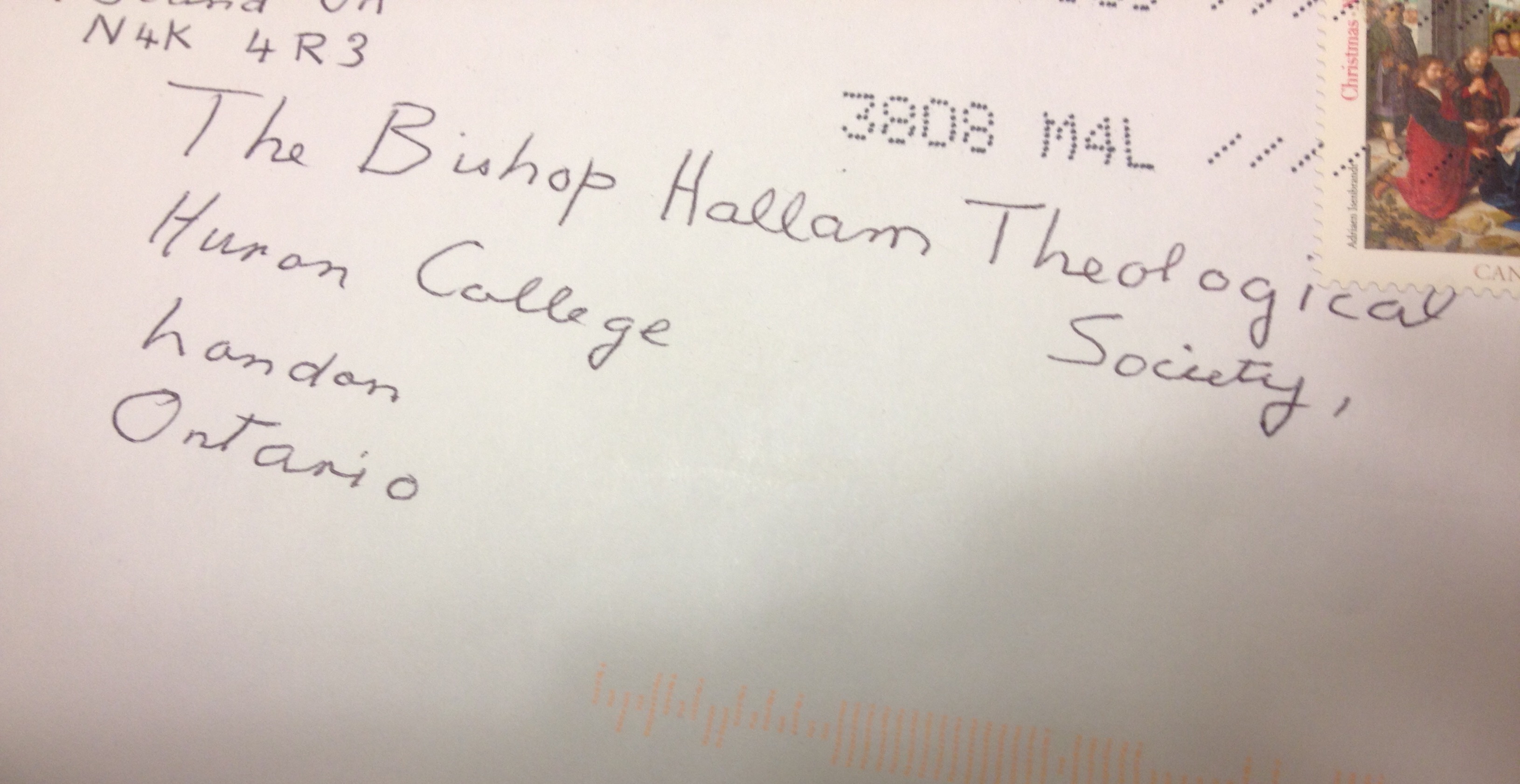
envelopeOne of my tasks is checking the Society’s mail. I usually check every few days, more or less frequently if there are things I am expecting or if school is not in session. Last week, a small envelope appeared in our mailbox. The address was written with shaky-looking writing and there was no street address or postal code: just “The Bishop Hallam Theological Society, Huron College, London Ontario. The postmark suggested that it had been mailed in December meaning it took two months to find us – but that Canada Post still managed to get it to the right building! (Small miracles!)

Two small pieces of paper torn from a spiral ring notebook were inside, with a return address from a retirement home in Owen Sound, Ontario. It read:

To the Bishop Hallam Theological Society Huron College London Ontario.

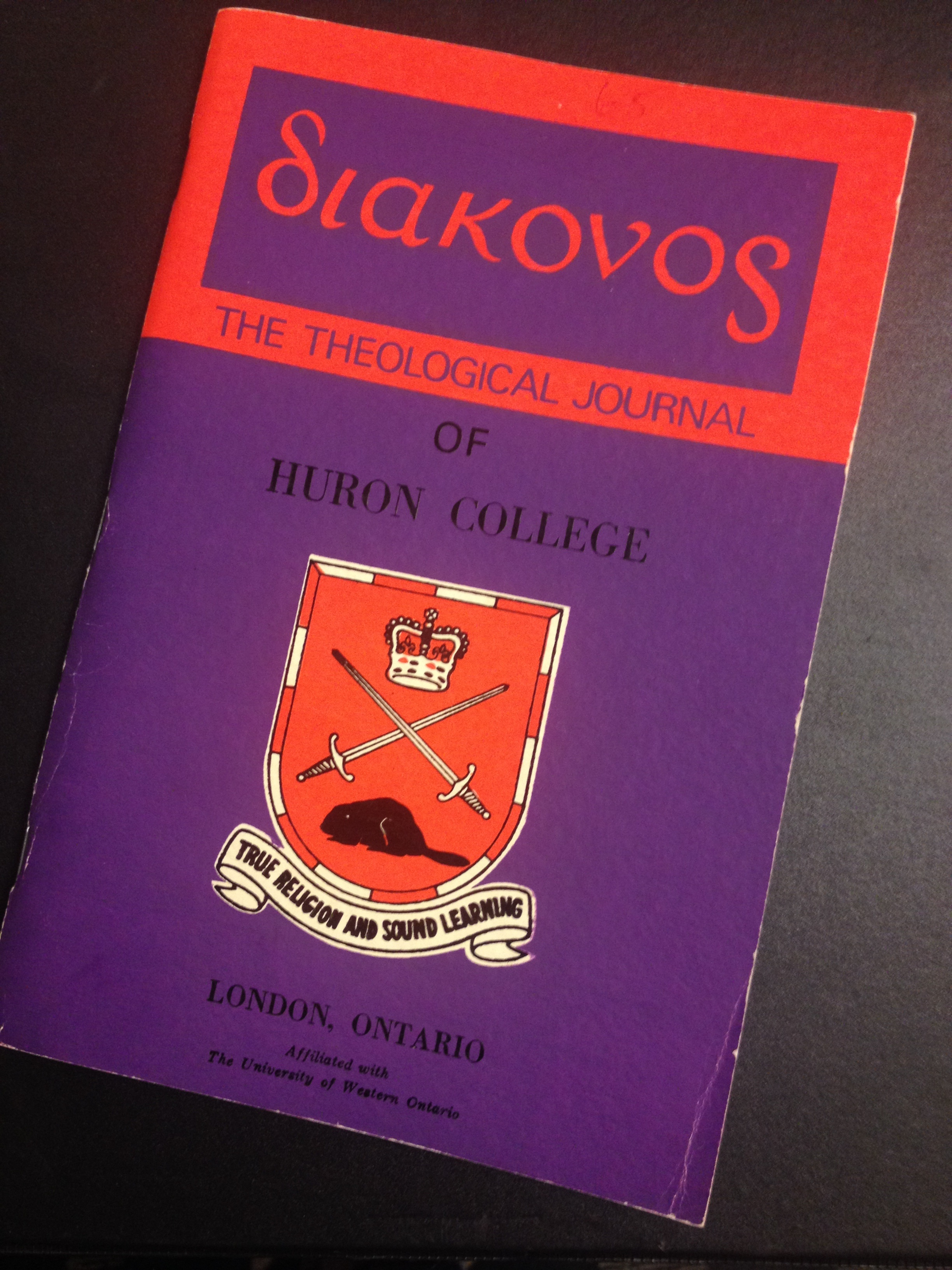
Is it possible to obtain copies of diakonos, the theological journal of Huron College London Ontario published by the Bishop Hallam Theological Society Huron College London 1965? My husband was the editor of this journal and we lived in a cottage next door to Huron College.

Would it be possible to obtain copies of this Journal? as I would very much like to be able to give a copy to each of my 3 children.

Your sincerely,

———-

I had no idea what she was talking about. The BHTS no longer publishes a journal – in fact I hadn’t even known we had in the past! Fortunately I happened to be near the Dean’s office when I opened and read the envelope and he and the Assistant to the Dean, both of whom have a long memory of things at the school, were in their offices. When I inquired about the journal, they both knew exactly what our letter writer was talking about!

It turns out that the BHTS did publish a journal, roughly from 1964 to 1967 or 68 from diakonoswhat I can tell. Copies are hard to come by now, for obvious reasons. There is a copy of each issue in the archives and the Dean has a copy of each issue in his office. Coincidentally, fortuitously, or providentially, he had a second copy of the 1965 edition which he was happy to give me. Yes, the surname of the editor is the same as the surname of our letter-writer.

Happily, I have been able to respond to our letter-writer with a note, thanking her for writing and for allowing us to reconnect with a piece of our history and to reconnect with the hundreds of faithful people educated at this seminary before us. I was sorry that I did not have three to send to her, one for each of her children, but so thankful that there “just happened” to be an extra copy of the one her husband was the editor of. I hope that she enjoys reading it as much as we have enjoyed being reconnected with a piece of our history that we had lost.


The Holy Innocents

Now after the wise men had left, an angel of the Lord appeared to Joseph in a dream and said, “Get up, take the child and his mother, and flee to Egypt, and remain there until I tell you; for Herod is about to search for the child, to destroy him.”

Then Joseph got up, took the child and his mother by night, and went to Egypt, and remained there until the death of Herod. This was to fulfil what had been spoken by the Lord through the prophet, “Out of Egypt I have called my son.”

When Herod saw that he had been tricked by the wise men, he was infuriated, and he sent and killed all the children in and around Bethlehem who were two years old or under, according to the time that he had learned from the wise men. Then was fulfilled what had been spoken through the prophet Jeremiah:

“A voice was heard in Ramah,
wailing and loud lamentation,

 Rachel weeping for her children; she refused to be consoled, because they are no more.”

Matthew 2:13-18


The largest massacre of the conflict in El Salvador happened in El Mozote on December 11, 1981. Reports vary, but anywhere from 750-1000 civilians were killed by the Salvadoran army that day.

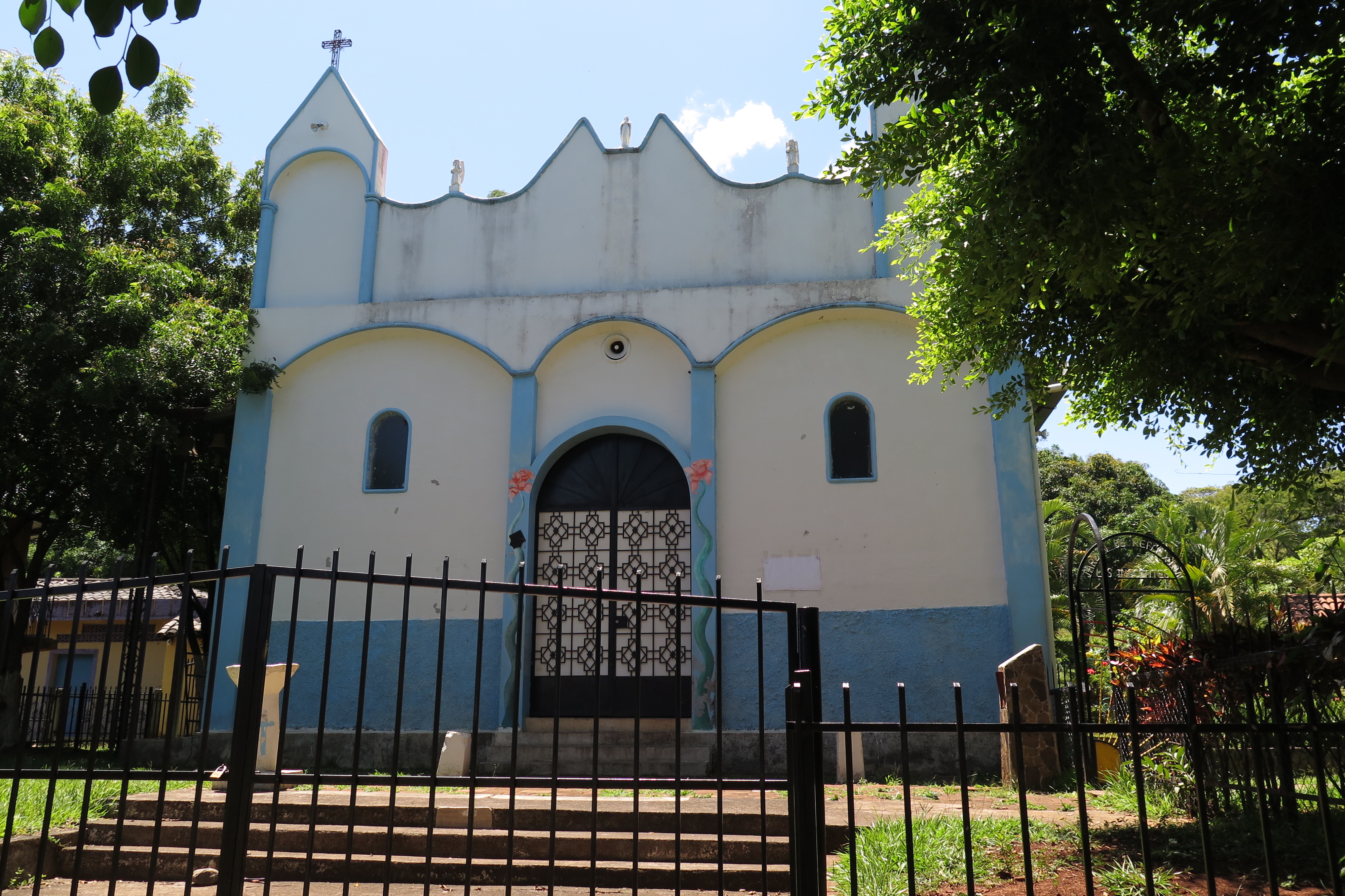
IMG_2676El Mozote is a small town near the border with Honduras. There are a few homes around a square, a small store, a big tree with the open-air market, and a church on a small rise at the base of one of the surrounding hills. The church is simple – whitewashed with blue trim. There is no steeple or tower, just two small crosses on the outside corners. Whether or not the church looked like this 35 years ago, I do not know. But there has always been a church.

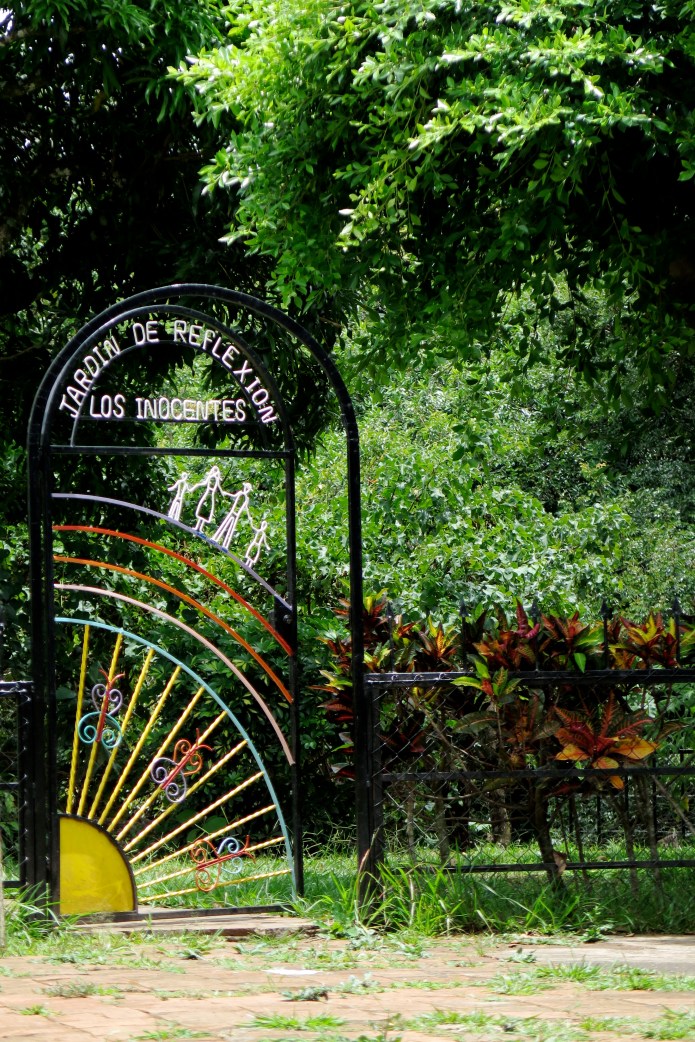
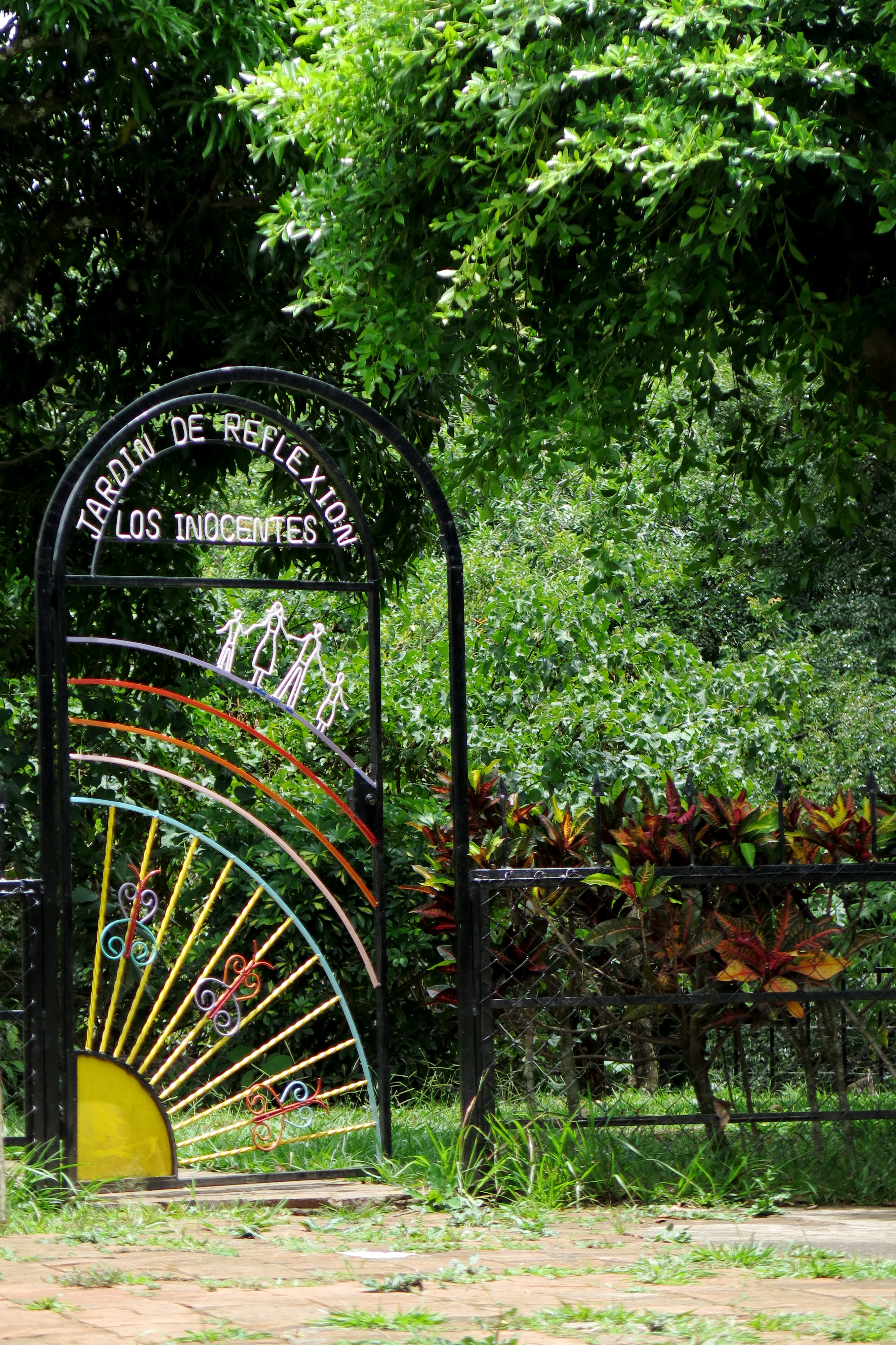
The church is surrounded by a concrete retaining wall and a short iron fence. While the gate is closed today, I can see another gate, made of iron in the shape and colour of a sun with rays and rainbow, leading into the garden beside the church. Over this image is the words, “Jardin de reflexion los inocentes” – The Garden of Reflection of the Innocents.

IMG_2691

Immediately what springs to mind is the Feast of the Holy Innocents, which we are commemorating today in the chapel at Huron. This is the feast where we remember those children massacred by King Herod when he was hoping to kill the child Jesus. But that isn’t entirely what this garden is commemorating, though it may be a reference. This garden is commemorating the massacre in El Mozote.

No one outside of the immediate department in El Salvador really believed that there had been a massacre of civilians of this scope in El Mozote. The army took great pains to hide it from everyone. Yet years later when they finally began to excavate the site, they found the bones of approximately 150 children buried in this space beside the church. One hundred and fifty innocent children massacred in one place.

IMG_2686With tears in his eyes, the brother of the lone survivor, Tomas, told us of how his sister Rufina was carrying her eight-month old baby and had her other children by her side that morning when the army rounded everyone into the square. First the men were brought into the church, interrogated, and killed. Then the young girls were taken into the hills, raped, and buried. Rufina’s baby was knocked from her hands by the soldiers who then picked it up, tossed it into the air, and “caught” it on the end of their bayonets.
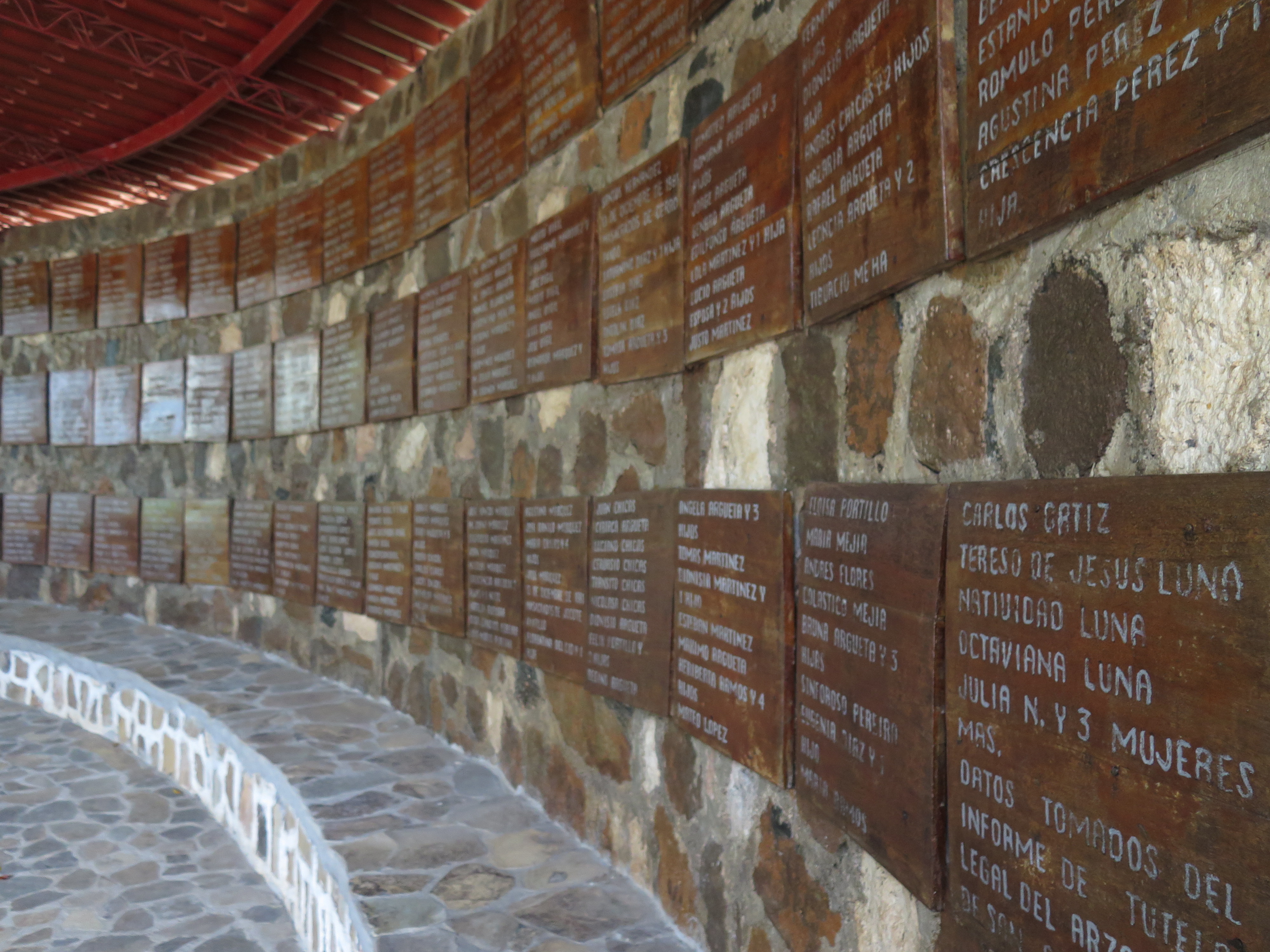
Slaughter of the innocents.

Entire families were wiped out in this massacre. Lives changed – and taken – in an instant. Soldiers set fire to all of the buildings in the village, with the bodies piled inside, hoping to remove all evidence of what they had done.

IMG_2678

IMG_2688

I asked if justice had ever been served. They said no: those who ordered the massacres are still serving in the Legislative Assembly and until they are no longer around to block the process, they cannot seek justice.

[For an extensive report of El Mozote: here.]

It is hard to have hope, witnessing something like that. These massacres seem to have been going on for far too long. Who knows what will someday be uncovered about our history? Perhaps the only hope we can offer is that in the second reading for today:

Then I saw a new heaven and a new earth; for the first heaven and the first earth had passed away, and the sea was no more. And I saw the holy city, the new Jerusalem, coming down out of heaven from God, prepared as a bride adorned for her husband. And I heard a loud voice from the throne saying,

“See, the home of God is among mortals.
He will dwell with them;
they will be his peoples,
and God himself will be with them;
he will wipe every tear from their eyes.
Death will be no more;
mourning and crying and pain will be no more,
for the first things have passed away.”

Revelation 21:1-4

God is here and is making all things new. We are participating in that renewal of the earth. Awful things are still going to happen, unfortunately, until the new heaven and new earth becomes reality. Until then, we continue to hope and pray and work to make it our reality.

Cricket

IMG_2174

Hello world! I’m Cricket!

Meet Cricket!

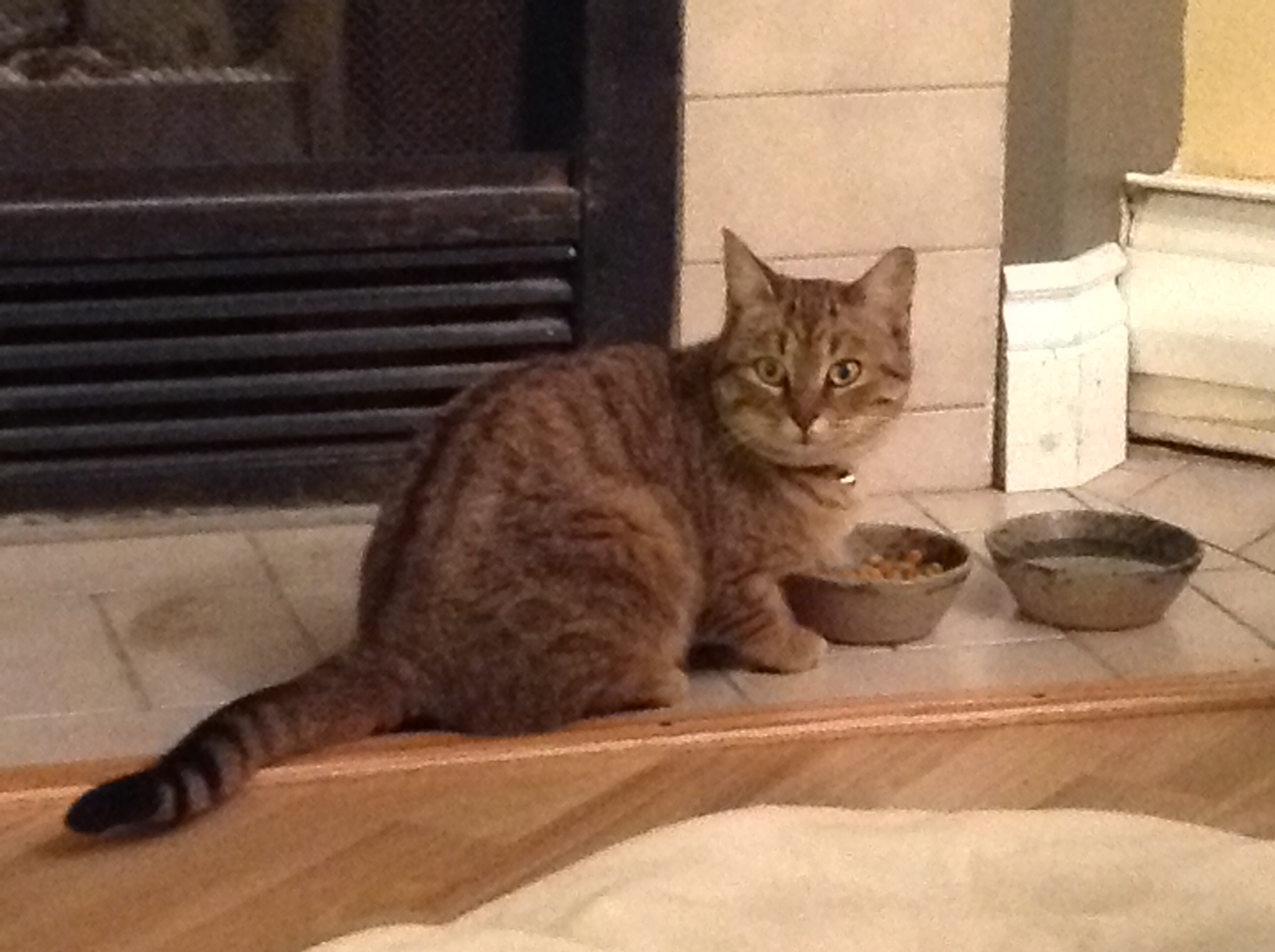
Matthew and I adopted an 8-9 month old kitten on Friday. She is a rescue cat who came to us by way of the parents of a friend.

She is still getting used to us, and is a little skittish, but is quickly warming up. After spending her first day entirely under our bed, she is gradually taking over the house. This morning I woke up and discovered her on the kitchen counter. She then discovered the gap between the fridge and wall and proceeded to fight with my apron which hangs there. While still easily startled by quick movements, she has just started to climb over me to get places, pausing for a chin rub on the way. Her meow is not much more than a little squeak but she has a loud purr box! She is quickly becoming a big part of our little family!


Sermon for the Reign of Christ, November 22, 2015

Preached at St Mark’s by-the-Lake, Tecumseh Ontario, November 22, 2015.

Text: [Revelation 1:4b-8], John 18:33-37

I was invited to preach at St Mark’s because I was awarded the St Mark’s by-the-Lake award for Christian Leadership last year and they have a tradition of inviting those who receive the award to preach in the church and meet the community. I had a wonderful morning with St Mark’s and was able to speak with many people in the community over coffee (post-8am) and soup (post-10:30). They are a warm and welcoming community just outside of Windsor. Many thanks to Rev. Robert Lemon and his congregation for the invitation.

I would like to invite you to take a walk with me if you will.

It might not be an easy walk. The streets are crowded. Its that Holiday rush – the tight pack of people all headed in the same direction with far too little space to accommodate them all. And yet the crowd is growing – where they are all coming from and how many more will fit is anyone’s guess.

The air is full of voices – but there are so many voices that it is hard to pick out what anyone is saying. From the tone, there are some who are overcome with excitement for the Holiday. And there are others who are muttering about this inconvenience or that annoyance.

The sounds and smells of animals – horses, donkeys, sheep – provide that smellscape that you sometimes get when the petting zoo or live nativity scene sets up in the town centre. But that isn’t too surprising: we are headed towards the Temple. It is Passover. We are in Jerusalem.

You look around, taking in the sights, and start to notice that there are soldiers strategically placed along the roadside and even more around the Roman government building up ahead. An extra show of force – and security? – at Holiday time. They are instructed to keep the peace at all costs.

The crowd begins to shift, bunching in closer together and you start to hear the clinking of armour. Looking back, you can just see through the mass of people a group of fully armed soldiers pushing through the crowd. You can tell they are soldiers because of the sun glinting off of their drawn weapons. No wonder the crowd is surging away to give them space. And the soldiers have with them a group of men wearing the long robes of religious leaders and a man who looks like he is their prisoner.

They are heading towards the headquarters of the Roman Governor in Jerusalem, a brutal man who would have only have come to the city if he anticipated civil unrest and the need for soldiers to squash it.

The Roman Empire. A vast empire won and held by force.

There is no way that anyone can take over most of the known world without some sort of violence: violence of the sword, of executing political prisoners by crucifixion, of brutal suppression of dissent.

Or, perhaps there are other ways of taking over or spreading dis-ease that are more familiar to us sitting here in our pews today: The violence of systems that enslave people and keep them in poverty. The violence that strips culture by stifling the speaking of native languages or religious expression. The violence of having to work long hours in a sweatshop for only pennies a day to produce clothing you can’t afford to wear. The violence when children are removed from loving families. The violence that forces families to flee from their homes and risk everything in small boats on an open sea to get to safety. The violence of intolerance and hate.

If the Reign of Christ, Jesus’ kingdom, if Jesus and his followers – if he and they were of this world, then they and we would use the primary tool of this world for establishing and keeping power: violence.

Pilate turns to Jesus and asks him, Are you the King?

My kingdom is not from this world. Responds Jesus. If my kingdom were from this world, my followers would be fighting to keep me from being handed over to you … But my kingdom is not from here …

Imagine an alternate reality with me, and let us think back to last night, when we were gathered with Jesus in the Garden of Gethsemane, praying. Suddenly soldiers appeared with lanterns and weapons – maybe even the same soldiers we saw earlier today pushing him through the crowd.

These soldiers want to arrest Jesus and take him away! But Peter, that faithful follower, will have none of that. Before anyone else can even wrap their head around what is going on, Peter has pulled his sword out and cut off someone’s ear. The next thing we know, everyone is pulling out swords and fighting the soldiers off. Then it is a run down the hill into the city to catch them unawares – fighting into the palace and installing Jesus as King.

For the next few decades, people like Paul will sail around the Mediterranean spreading the good news of a kingdom of violence to the world.

While we know this is not what actually happened with Jesus and his followers, it is what eventually happened with the Crusades, with the colonization of North America, Africa, and many other parts of the world, and is what happens today when good people spread of messages of hate and intolerance in places like Facebook…

This is what happens when kingdoms are spread through the ways this world knows.

But My kingdom is not from this world. Said Jesus.

My kingdom is not a kingdom of violence. Put your sword back into its place, Peter. For all who take the sword will perish by the sword.

We can imagine Jesus saying, Those who live for violence – for hate, intolerance, distrust – will only bring more of the same into their lives.

Jesus is not of this world and so Jesus will not defend himself by violence, nor will he establish his claim by violence. Jesus doesn’t usher in God’s kingdom using violence. And Jesus will not make any followers by violence.

Nevertheless, Pilate asks, So you are a king?

Jesus answers; You say that I am a king. For this I was born, and for this I came into the world, to testify to the truth. Everyone who belongs to the truth listens to my voice.

Instead of coming to establish his reign through violence, Jesus has come to witness to the truth. The truth that God is love and that God so loved the world that God sent God’s only son to the world. The truth of the Word becoming flesh and dwelling amongst us so that we might see his glory, his glory full of grace and truth.

But, as the writer of the gospel of John reminds us, the world did not recognize him. Because no one has ever seen God. (John 1)

Because we have not seen God, we have a hard time imagining God. And when we try to imagine things we have not seen or known, our imagination becomes dominated by our experience. Rather than imagining a God of love, often we imagine God to be angry or violent because we live in a world of violence. The headlines we read, the images we see, and the sounds we hear daily on the news and in social media are frequently ones of violence.

Rather than recognizing the cross as a symbol of sacrificial love, we assume that it is the legal ways of punishing Jesus in our place – because we have way too much experience with punitive relationships.

Rather than believing that God’s grace and acceptance and love are entirely unconditional, we assume that God offers love, power, and status only on the condition that we fear, obey, and praise God – and despise those who do not – because so much of our life is about “tit for tat.”

But Jesus is not of this world. And so his followers do not fight to bring about his reign because to use violence is to violate the very principles of his kingdom and will only cause its destruction.

No, the way to bring about the Reign of Christ is through love.

That radical love that, in the words of our baptismal covenant, calls us to seek and serve Christ in all persons, loving our neighbours as ourselves.

Because while the Reign of Christ on one hand reveals Christ in his glory, coming in with the clouds so that every eye might see him, the Reign of Christ is also about the glory of Christ hidden beneath rags so that when we see him, we might love him by giving him clothing,

or find Christ thirsty that we might lovingly hand him something to drink,

or discover Christ the stranger or refugee who we might welcome into our homes or communities.

The Reign of Christ – the reign of the Christ who is calling us to transform the unjust structures of society that cause people to have to flee from their homes,

or that force people to work in dehumanizing conditions for insufficient funds,

or that calls us as a national Anglican church to grapple with a legacy of violence stemming from systematic abuse in Residential Schools –

The Reign of Christ is here on earth so that we might challenge violence of every kind to pursue peace and reconciliation.

Because here is another difference between the kingdom that Pilate was looking for and Jesus’ kingdom that is not from here: Jesus’ kingdom is not limited to a particular place or time like the Roman empire was or like the empires of today are.

Jesus’ kingdom is a state of being. A way of life. A commitment to view the world through Jesus’ eyes of love and to love fiercely even in the face of these violences in the world we see all around us every day.

In a few moments we will gather together around a table. A table where we proclaim the power of the sacrificial love of Christ. And then together we will pray, praying with believers all around the world, “Your kingdom come on earth as it is in heaven.”

Today we proclaim that the Reign of Christ is here on earth. That Christ is among us, enthroned in glory and leading a kingdom not spread through the means of this world, but spread through love.

Welcome to the Reign of Christ, to the Reign of God’s love.

Amen.

Twelve

IMG_2103I am currently in Toronto for the board meeting of the Primate’s World Relief and Development Fund. This morning our Executive Director led us in a theological reflection that included, in part, a reflection on the life that can come out of death.

Twelve years ago this morning we lost mum. One month ago this weekend, I was given her wedding band and a promise. Out of death has come new life. Amen.