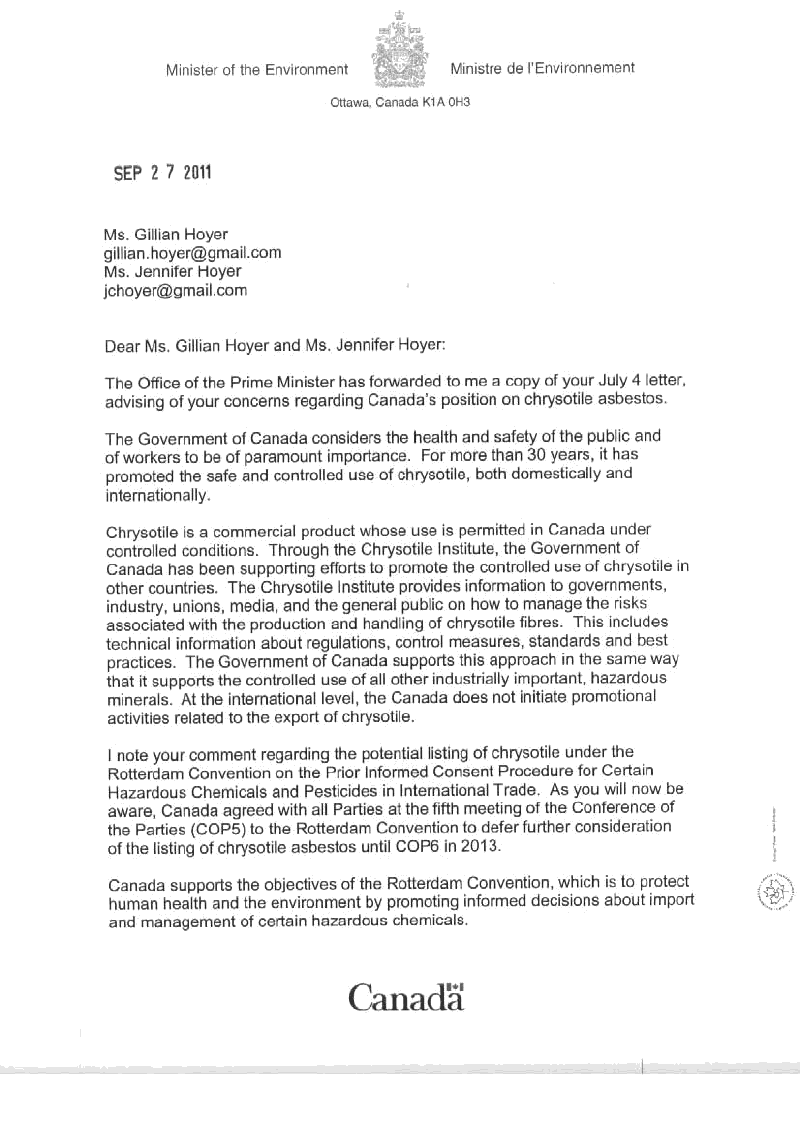
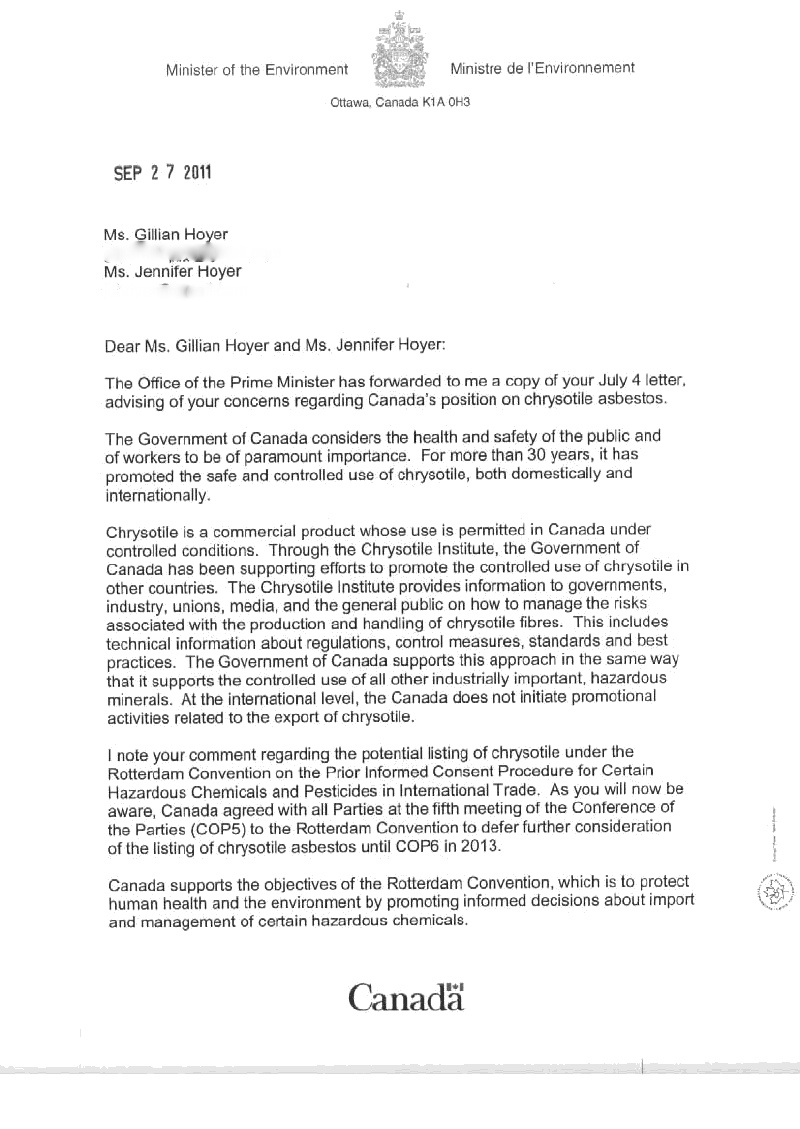
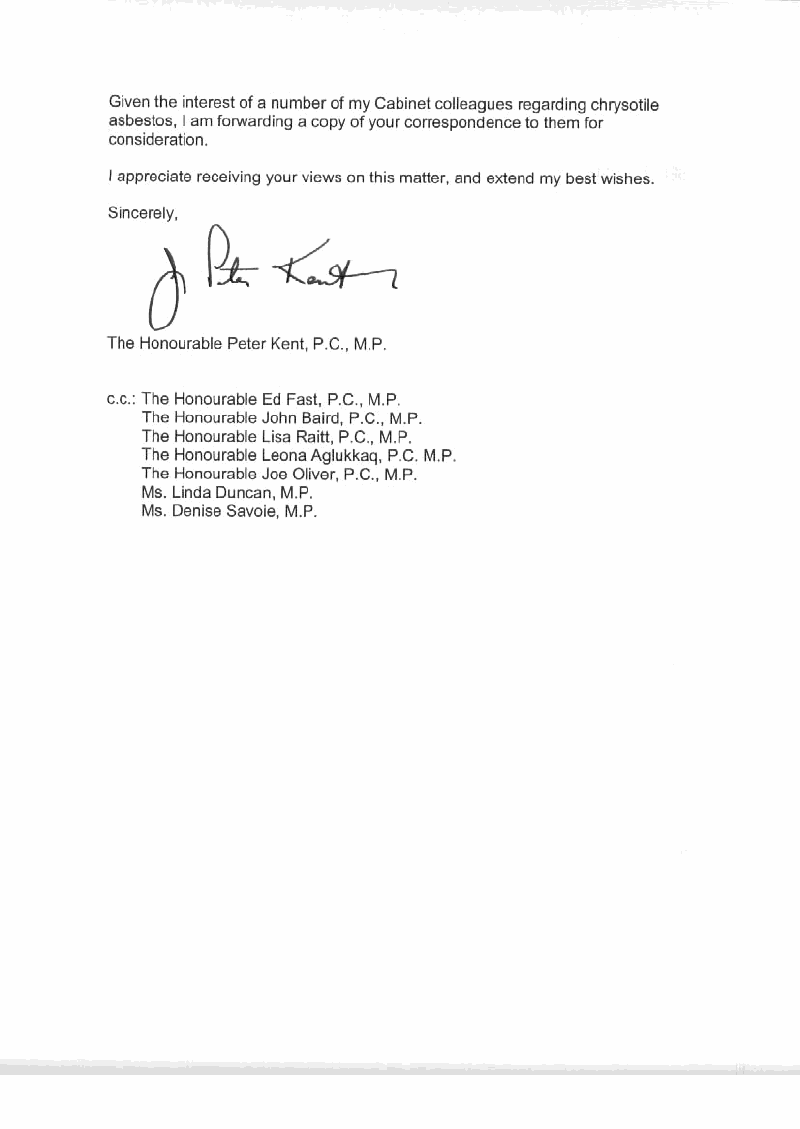
UPDATE 09/27: A second letter from the Minister of the Environment!
This is a long one… if you don’t read everything in the Government’s letter (and it is all a load of crap), at least scan to the end for my editorializing…!
Back in July, asbestos was in the news a lot. Canada, a leading exporter of the stuff, was getting in hot water internationally for exporting it and not ensuring it was used safely overseas when it is something banned in this country. I got a little miffed about that, given my family history with asbestos, and made some comments on Facebook. Those comments turned into a series of long debates with friends which my sister, Jen, proposed that we incorporate into a letter to the Prime Minister. Since I had just done something similar a couple months earlier, I was definitely game to hate mail our government once again.
July 4, 2011
Dear Mr. Prime Minister,
As you may have noticed, your efforts at the recent Rotterdam Convention to keep chrysotile asbestos off the Annex 3 list of hazardous chemicals have garnered some attention. We are writing you to voice our own concerns about Canada’s continuing role in exporting asbestos. We are sisters; Gillian is 29 and Jennifer is 26.
Our relationship with asbestos began fairly personally. Our grandfather worked for an oil company at their refineries for his entire career. As a manager, he brought his family to live in onsite housing when his children were young. This is likely how the family received most of their exposure to asbestos. When our grandfather died of cancer in 2003 he was also suffering from asbestosis. When our mother was diagnosed with mesothelioma in the fall of 2000, doctors were shocked to see the disease in a patient so young. She fought it for three long years, far beyond the maximum 8 months she was originally given, and died a few months shy of her 50th birthday. Jennifer was 18 and Gillian was 21. Asbestos touches real people.
We are also concerned about Canada’s place in the global village. If we ban a substance in our own country but continue to sell it to others, what does that make us? Profiteers at the expense and certain harm to others? Would we expect the federal government to prop up the manufacture of drugs so that we can ship them to other countries? Opiates have a use in the health care industry, as does marijuana, but in reality we get upset at countries that don’t crack down on the manufacture and export of drugs that are illegal in Canada.
Canada should agree to let chrysotile asbestos be listed as a hazardous material and also provide the training necessary for its proper use. Unfortunately, developed countries have a tendency to sell resources to developing countries with no regard for safety, often exposing them to risks that would never be acceptable here. If we are a global village, we need to act like neighbours who actually care about each other more than making a dollar.
We worry about possibly watching our mother’s three siblings deal with asbestos-related diseases. We worry about other children losing their parents. We worry about Canada’s tarnished reputation on the world stage because of the government’s stance on this issue, and we are ashamed.
Sincerely,
Gillian and Jennifer
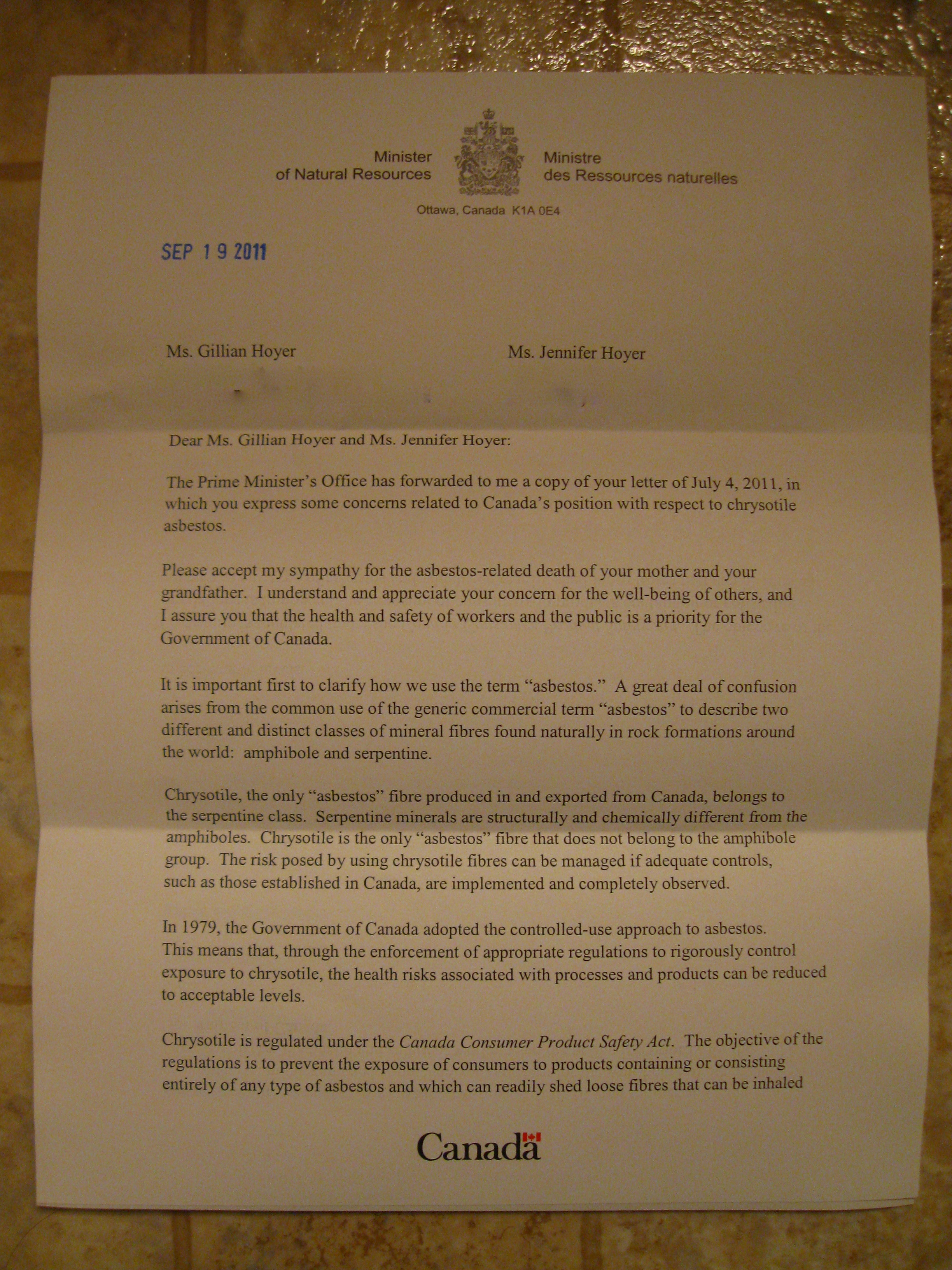
I didn’t receive a response to the first letter that I sent (though, unlike this one, I only sent it to the PM and not my MP) and so, that was the last I thought of it. Until today. I arrived home this afternoon to a letter in my mailbox from the Ministry of Natural Resources. Ministry of Natural Resources? It wasn’t until I was halfway down the driveway with the closed letter in my hand that I realized what it must be. Inside, I received a two-page lecture from the Hon. Minister Joe Oliver… (text follows) (Sorry for the bad lighting in the first image. Not sure what happened. It was the same time/place… I should get a scanner.)
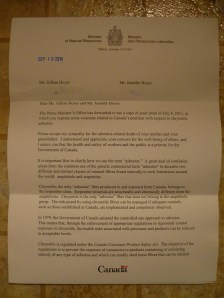

Dear Ms Gillian and Ms Jennifer:
The Prime Minister’s Office has forwarded to me a copy of your letter of July, 4, 2011, in which you express some concerns related to Canada’s position with respect to chrysotile asbestos.
Please accept my sympathy for the asbestos-related death of your mother and your grandfather. I understand and appreciate your concern for the well-being of others, and assure you that the health and safety of workers and the public is a priority for the Government of Canada.
It is important first to clarify how we use the term “asbestos.” A great deal of confusion arises from the common use of the generic commercial term “asbestos” to describe two different and distinct classes of mineral fibres found naturally in rock formations around the world: amphibole and serpentine.
Chrysotile, the only “asbestos” fibre produced in and exported from Canada, belongs to the serpentine class. Serpentine minerals are structurally and chemically different from the amphiboles. Chrysotile is the only “asbestos” fibre that does not belong to the amphibole group. The risk posed by using chrysotile fibres can be managed if adequate controls, such as those established in Canada, are implemented and completely observed.
In 1979, the Government of Canada adopted the controlled-use approach to asbestos. This means that, through the enforcement of appropriate regulations to rigorously control exposure to chrysotile, the health risks associated with processes and products can be reduced to acceptable levels.
Chrysotile is regulated under the Canada Consumer Product Safety Act. The objective of the regulations is to prevent the exposure of consumers to products containing or consisting entirely of any type of asbestos and which can readily shed loose fibres that can be inhaled and cause adverse health effects. Canada does not ban naturally-occurring substances. Canada manages the risks of products and practices derived from these substances where and when required and applicable.
The illnesses we are currently seeing in countries that have intensively used “asbestos” fibres are linked to past high-level exposures and inappropriate uses. These uses have been prohibited or discontinued in Canada since the late 1970s. A total ban on chrysotile is neither necessary nor appropriate. Implementing a ban would not protect workers or the public against past uses that have been prohibited for many years.
More than 93 percent of the world production of chrysotile is used in chryso-cement-manufactured products in the form of pipes, sheets and shingles. Five percent is used for friction materials such as brake pads and linings. Canadian-manufactured products include brake pads, gaskets and specialty products. Fibres are encapsulated in a matrix in those products, thus preventing the release of fibres and allowing their use.
We all share the objective of protecting human health. Since 1979, Canada has promoted the controlled-use approach, both domestically and internationally. Canada continues to work with other countries on matters related to the safe use of chrysotile through the Chrysotile Institute.
The Chrysotile Institute, a not-for-profit organization established in 1984 by the governments of Canada and Quebec, labour and industry, has the mandate to promote the controlled use of chrysotile both domestically and internationally. The Chrysotile Institute provides information to governments, industry, unions, media and the general public on how to safely manage the risks associated with the handling of chrysotile fibres. This information includes technical regulations, control measures, standards and best practices. Over the years, the Chrysotile Institute has assisted knowledge and technology transfer in more than 60 countries.
Thank you for writing.
Yours sincerely,
The Honourable Joe Oliver, P.C., M.P.
Did anyone else notice the excessive use of quotation marks around “asbestos”?
I find it interesting how, in the same breath, asbestos use in Canada is both condoned as safe and labelled as risky. Please, make up your mind. And then instead of giving me a history lesson and lecture, trying to placate me with lots of information and overwhelm me to silence, actually address my concerns. While I appreciate that the government actually replied to my letter (First time that the Conservatives have ever replied to anything I have written. Though I would also like to take this opportunity to state that my wonderful NDP MP has responded to every letter I have ever written her.), I feel a little patronized and completely unsatisfied by this response. Basically, it is another rehashing of this government’s position: “I am right, you are wrong. Shut up, get out of our way while we screw this country over.”
 Instead of a strict public engagement talk, a talk about how promotional placemats introduced me to the Primate’s Fund, I ended up talking about “placemats and a passionate person.” Because more than the placemats, there was a key member of the church I grew up in who, with her husband, pushed social justice and and international relief and development like very few people I know. Apparently she is still doing it today (centre back of the table as I remember her in 1995) at 90+ years of age and has now been honoured with an honorary memorship to PWRDF.








 gillian's island