On the off chance that some young-ish Anglicans find themselves reading this occasionally, you should apply to 50 Leaders.
All of the people in this video are awesome and, as of about 5 weeks ago, are good friends.
On the off chance that some young-ish Anglicans find themselves reading this occasionally, you should apply to 50 Leaders.
All of the people in this video are awesome and, as of about 5 weeks ago, are good friends.
You may have already seen this, because it has popped up in a few places for me today.
I’m pretty sure I’m really going to like this book.
After a day of listening and learning, sharing and discussing change and church and all the variations found therein, I came back to St David of Wales tonight to take part in the for the Eucharist for Haiti. In the minutes leading up to the service, I found some wifi and checked in on the happenings of school and facebook friends, and then began to read through some of the blogs on my rss feed. Mike, who I’ve now met in person at the Brian McLaren conference a of couple weeks ago though I’ve followed his blog for about a year, had posted this today. I was immediately struck by its application to our setting and the discussions that had been going on and are continuing to go on throughout the conference here.
“Incremental change is usually limited in scope and is often reversible. If the change does not work out, we can always return to the old way. Incremental change usually does not disrupt our past patterns–it is an extension of the past. Most important, during incremental change, we feel we are in control…
Deep change differs from incremental change in that it requires new ways of thinking and behaving. It is change that is major in scope, discontinuous with the past, and generally irreversible. The deep change effort distorts existing patterns of action and involves taking risks. Deep change means surrendering control.”
Robert E. Quinn, Deep Change (p. 3)
That being said, something one of the people who shared yesterday, Dwight Friesen (lectures at Mars Hill Divinity School in Seattle) also grabbed me: “People don’t fear change, we love change! People fear loss.”
Either way, the consensus seems to be that we need to take risks. Try something new – sometimes it will work, sometimes it won’t. Either way, you won’t know until you’ve tried.
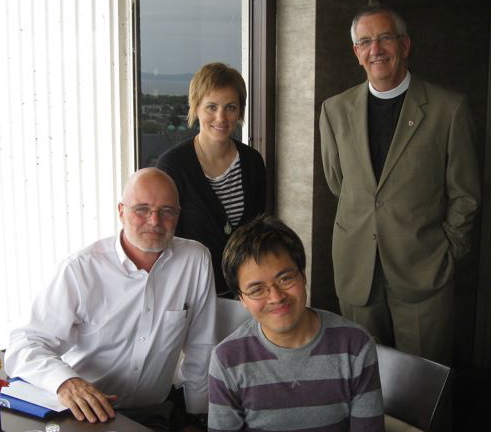 My head is still spinning from this past weekend [possibly also spinning because I had a paper due hours after the conference ended and I’ve been going non-stop on writing since then…]. It is a blur of good times with good friends, late night conversations, stimulating presentations at the conference, uplifting music, new friends, inspiring discussions, new connections, and so much more. I hope that the discussions that began during the conference will continue now that the excitement and immediacy of the event has died down.
While there was nothing newly revolutionary to my thought processes, the challenge of safe space was renewed for me. As Brian said, “Create a safe space to learn and grown and suddenly it is safe for others to join because they are joining a conversation not a denomination.” This is what we were trying to accomplish with our Modern Retelling of the Stations of the Cross over this past Lent. It is the hope of our monthly Theology Pub events. It is my approach to church as well. I love the denomination that I currently go to – I grew up in the Anglican church and returned to it three years ago. However, I’m not going to introduce a friend to the Anglican Church. I am going to introduce them to Jesus and where they go from there is up to them. Yes, filling up emptying pews is a good thing… for our financial overhead… but it isn’t my primary motivation. I would much rather people join into the conversation than get involved in an institution.
The other thing Brian said that stood out to me was,
Liberating people from what keeps them apart from relationship with God and others.
I feel like this is what what my job is [going to be] as a counsellor. It is what I want my job description to be as a counsellor: Creating safe spaces for people to discover who they really are and grow in their relationships.
For full, comprehensive notes, check out the blog of a priest in the diocese who attended. He’s summarized things far better than I can/will:
Also, I read a story about Steve Bell, who did the music for the conference as well as a concert on the last night. Not only do I think what Steve did absolutely wonderful, I am proud of whoever at the Cathedral relaxed enough to let the shopping cart come in.
I recently stumbled upon something – a letter about a part of the Creed – I wrote in January 2007. I liked it and thought to share it:
I believe in the Holy Spirit,
The holy, catholic church,
The communion of saints,
The forgiveness of sins,
The resurrection of the body,
And the life everlasting. Amen
I believe in the Holy Spirit…
Why does Jesus get so many lines in the creed and the Holy Spirit just one?
The Holy Spirit always seems to get the short end of the stick in discussions involving the Trinity. The academic part of me knows this may be because Jesus was the “hot topic” of the day when the creed was written; with all the heresies abounding to claim him as one thing or another there was a need for a unifying statement of faith. But the other part of me thinks that surely the Holy Spirit deserves more than just an “I believe in the Holy Spirit”. Is not the Holy Spirit one of the more real aspects of the Trinity for us today? We can’t see God the Father or Jesus directly (although I suppose we don’t actually see the Holy Spirit either), but in terms of the Holy Spirit, we often speak of experiencing him in a real way in our daily lives. Jesus told his disciples when he left that he would send his Holy Spirit to them, and, by extension, to us. So if the Holy Spirit is with us on a daily basis, it should merit much more in the way of discussion than just a single line!
Frequently the Holy Spirit misses out in discussions and the like because we don’t really understand him. However, do we understand God either? Or Jesus? I suppose if faith depended on understanding, I would be out of luck. I do know, however, that we would be lost but for the presence of the Holy Spirit.
The holy, catholic church
One of the things I have loved when travelling is visiting other churches. I love the catholic-ness, the worldwide-ness of the church and family of God; I love how the same God may be encountered worldwide by people of different nationalities and traditions. It was this catholic-ness of the church that really opened my Chinese language partner’s eyes this summer when she realised that Christianity was not exclusively a Western religion, but was and is worldwide. It is this catholic-ness that I experienced this year when I was communing in a multinational missionary church service in Xining, China; a Danish service in Copenhagen; a German service in Wolfsburg; a Dutch service in Amsterdam; an English-German service in Freiburg; an English service in London; a French service in Montreal; and the fellowship of my own part of the body in Victoria. Wow! We were all reading from the same Bible and speaking of the same God – sometimes even singing the same songs tho in different languages. This is truly The Communion of saints in a world-wide manner. The ideal, which, sadly, is often not realised, is a worldwide church; not divided or segregated from itself but set apart for God as holy.
The forgiveness of sins
Where would I be if this was not so?!? I do not want to contemplate.
The resurrection of the body, And the life everlasting.
I look forward to it.
I have been rereading one of my favourite trilogies this week and it has been like sitting down with an old friend. It is one that belonged to my mum and that is probably part of the value of it to me – her notes are on many of the pages and reading it is a glimpse into her thoughts which I don’t otherwise get anymore. In it, the author talks of our oneness, not as a group of people, but as a self. The oneness of ourself and our being. What she speaks of is what I look forward to at the resurrection of the
body.
The burning bush: somehow I visualize it as much like one of these blueberry bushes. The bush burned, was alive with flame and was not consumed. Why? Isn’t it because, as a bush, it was perfect? It was exactly as a bush is meant to be. A bush doesn’t have the opportunity for prideful and selfish choices, for self-destruction, that we human beings do. It is. It is a pure example of ontolgy. Ecology — ontology — the words fascinate me. Ontology is one of my son-in-law’s favourite words, and I’m apt to get drunk on words, to go on jags; ontology is my jag for this summer, and I’m grateful to Alan for it — as for so much else. Ontology: the word about the essence of things; the word about being.
I go into the brook because I get out of being, out of the essential. So I’m not like the bush, then. I put all my prickliness, selfishness, in-turnness, onto my isness; we all tend to, and when we burn, this part of us is consumed. When I go past the tallest blueberry bush, where my twine is tied to one of the branches, I think that the part of us that has to be burned away is something like the deadwood on the bush; it has to go, to be burned in the terrible fire of reality, until there is nothing left but our ontological selves; what we are meant to be. (A Circle of Quiet by Madeleine L’Engle)
Nothing left but our ontological selves. What we are meant to be.
Amen. So be it.
Grace and peace,
Gillian
Continuing with what I wrote yesterday on Celtic Christianity and the power of nature, from Restoring the Woven Cord by Michael Mitton:
Psalm 29:
The voice of the Lord is over the waters;
the God of glory thunders,
the Lord over mighty waters.
The voice of the Lord is powerful;
the voice of the Lord is full of majesty.
Such biblical passages as these appealed very much to the Celts, whose previous Druid-let pagan religion also had a very high regard for nature. Ian Finlay writes; “The Celtic church grew among people who were not builders, who were not tempted to follow a tradition of containing their gods in temples, but felt closer to them where they felt the wind buffeting their faces and saw the flash of white wings against the sky, and smelled the sun-warmed bark of trees.”
The Christian community saw nothing wrong with this respect for nature and they found it very easy to incorporate it into their Christian life and witness. In fact, their Christian faith enhanced their love for creation, and many Celtic communities were formed in wild and remote places, for it was here that they could feel the power of the wind and the strength of the sea. Anyone who has been to Lindisfarne or Iona during bad weather will know all about this. The first time I visited Lindisfarne the rain fell continuously and most of the time horizontally carried by the north-easterly gale. I clearly remember walking round the coast of the island in these conditions, getting soaked and buffeted, and feeling so aware of the power and glory of God. How sad that we have got into the mentality of thinking that storms are something to shelter from! In our Western society where we do all we can to protect ourselves from cold wind and wet, we miss something of this closeness to creation that those early Celtic communities experienced. This protectiveness has been partly to blame for our lack of concern for creation and ecological issues. It also contributes to our lack of any sense of adventure. David Adam, in his book Borderlands, speaks about the need for us to experience the borderlands;
Today we are very much in danger of producing ‘midlander’ mentality and emotions: those safe people who have never been at sea or experienced the ‘cliffs of fall’ (as the poet Gerard Hopkins described the mind’s mountains of grief). We avoid being frontiersmen and women in case we are shot at by our own side if we dare to cross boundaries. Yet in reality, life is ever taking us to the edge of things. Borders may be hard to set or define, but we forever cross into new lands. Frontiers are still exciting places and everyone should be encouraged to explore them: the borderlands are there for us all to enjoy.
If we have never spent time in natural borderlands such as where the land meets the ocean or where day becomes night, then we will find the borderlands of human experience harder to face and understand.
“Today I am giving you a choice of life or death: choose life.”
I just listened to a fantastic talk by the Archbishop of Canterbury, Rowan Williams. Brian McLaren said about the talk that he “gets it right… on life. An amazing article and speech on the ecological crisis and more. In this address, Archbishop Rowan Williams exemplifies the kind of theological mind and heart that I believe are central to ‘a new kind of Christianity.'”
The talk is available to listen to or read here. If you’re short on time, save it for later: the whole thing runs about an hour.
Something he said at the end resonated with some of the reading I’ve been doing on Celtic  Christianity and reminded me of some epic storms on Offshore. He talked about restoring a sense of association with our environment and nature so as not to be so disconnected with it and loose any sense of responsibility for it and to do this by going for a walk in the rain and wander through gardens and parks. It is like the poem by St Columba:
Delightful it is to stand on the peak of a rock, in the bosom of the isle, gazing on the face of the sea.
I hear the heaving waves chanting a tune to God in heaven; I see their glittering surf.
I see the golden beaches, their sands sparkling; I hear the joyous shrieks of the swooping gulls.
I hear the waves breaking, crashing on rocks, like thunder in heaven. I see the mighty whales.
I watch the ebb and flow of the ocean tide; it holds my secret, my mournful flight from Eire.
Contrition fills my heart as I hear the see; it chants my sins, sins too numerous to confess.
Let me bless the almighty God, whose power extends over sea and land, whose angels watch over all.
Let me study sacred books to calm my soul; I pray for peace, kneeling at heaven’s gates.
Let me do my daily work, gathering seaweed, catching fish, giving food to the poor.
Let me say my daily prayers, sometimes chanting, sometimes quiet, always thanking God.
Delightful it is to live on a peaceful isle, in a quiet cell, serving the King of kings.
Taken from Peter Rollins’ blog. Read what he has to say about these 2 videos here. (He mentions Banksy, which should be enough to get anyone to watch/read.)
may the god who is community
be with us as we seek to be a community
may god bless our dreams
and may god shatter our dreams
may god help us to be real
and to find depth in weakness and brokenness
may god help us to face and grow through conflict
rather than pretend by being nice
may we look at each other through soft eyes
and truly respect each other as human beings
may god help us let go of control
and the need to fix one another
may god help us discover we are needy in our own souls
and give attention to our own hearts
may god grant us the gift of an extraordinary love that flows from the heart of god
that covers a multitude of wrongs
by jonnybaker.
 gillian's island