Moments

I had a ‘Oh, I can’t wait to go home and call mum and tell her’ moment this evening.  I found out tonight that the Kit I sing alto with in choir, the Kit who looked vaguely familiar, is in fact Kit Pearson, the Canadian children’s writer.   Someone said to me, in front of her “Did you know that we have a famous author in our midst?”  I replied that no, I didn’t.  As soon as they told me who she was, however, I exclaimed “Oh, I’ve read all your books!”  Her response was that she now felt old… whoops.  I loved her books as a kid, especially A Handful of Time and the trilogy about some English kids who come and live in Toronto during WWII.  Actually, I re-read the trilogy last year…  Mum introduced me to them when she bought them for the BDCS school library in Belleville.  I’m pretty sure she would have been excited to hear I’ve met the author.

So, because I was excited, I came home and told my roommate who didn’t know what I was talking about. Then I emailed my sister, and she validated my excitement.  And now I share with you.

Lest We Forget VII: Hiroshima

Saturday, I went to see Doctor Atomic, the opera by John Adams about Oppenheimer, the man in charge of the Manhatten Project which was responsible for the development of the world’s first atomic bomb.  It was an interesting opera that focussed less on the events (though they were evident) than on the people behind them.  It showed, very well, the internal conflicts many of the main characters experienced while working on the bomb.  At one point, Oppenheimer quotes the Bhagavad Gita: “If the radiance of a thousand suns were to burst at once into the sky, that would be like the splendor of the mighty one.  Now I am become Death, the destroyer of worlds.”

For me, and the friend I went to see it with, it had added meaning because we were in Hiroshima in March (for the original visit blog, see here) and saw first hand the rebuilt city and the memorials that have been set up on the site.  Thousands of people died when the bomb exploded over Hiroshima in August of 1945.  Thousands more died in the days, weeks, and years that followed as a result of various radiation sickness.  Visiting the Peace Memorial was an incredible experience that moved me to tears at a number of points.
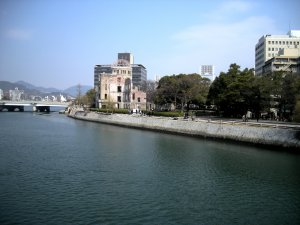
This is the A-Bomb Dome.  It was a large, stone, bank-like building only a few hundred metres away from where the bomb exploded.  Surprisingly, parts of the walls were left standing: one of the only buildings in the area.  The building has now been reinforced and is a monument to the destruction of the atomic bomb.  It was the first site we saw getting off of the tram.
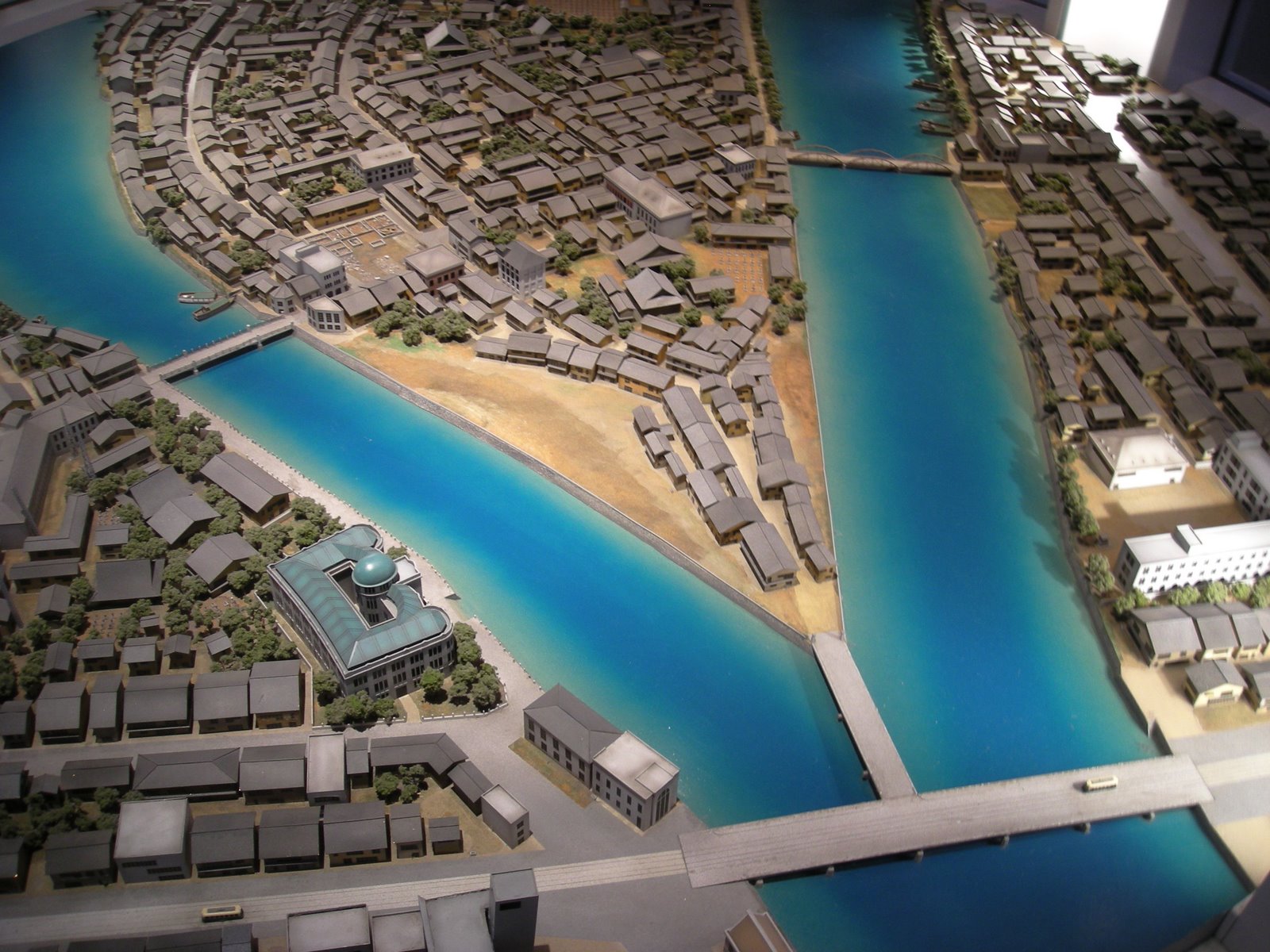
This is a model of Hiroshima prior to the bomb blast.  You can see the above building in the bottom left (green roof).  The target of the bomb was the T-shaped bridge at the bottom.  It was deemed to be the best place to kill off transportation in the city as the purpose of the bomb was to be psychological as well as destructive.  

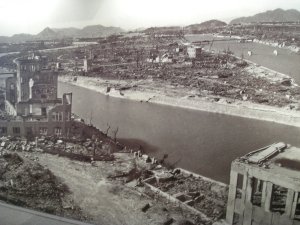
The city post-bomb.  The T-bridge is still there because the bomb actually exploded about 600m SE of where they wanted it too and up in the air.  The A-Bomb Dome is still bottom left.  The destruction of the bomb was immediate and ultimate.  There was no living thing left within the inner circle of the bomb.

This is a photo of the city post-bomb.  This photo was on the wall in the Peace Museum and took up an entire wall, almost as if one was looking out the window at the sight.  

In the models you can see an area between two rivers.  Now, that has been entirely turned over the Peace Memorial Park.  Inside the park, there are dozens of monuments, small and large, to different groups who suffered when the bomb was detonated.  One of them was to a young girl named Sadako. When I was in elementary school, we read a book called Sadako and the Thousand Paper Cranes, the story of a young girl who got leukemia and eventually died as a result.  She hoped that if she could fold a thousand paper cranes her wish to be healed would come true.  She died before that happened.
This is a monument to her.
All over the Peace Park, there are strings upon strings of paper cranes people have folded and left there in memory of her and of the desire for peace.
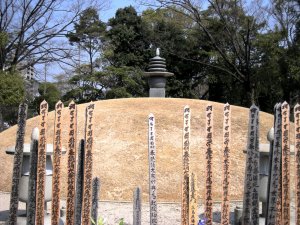
In another place in the park was this mound.  Inside are the ashes of the people who died and could not be identified.  A large number of children died from the bomb because they were at work that day moving things in the centre of town, where the bomb exploded.

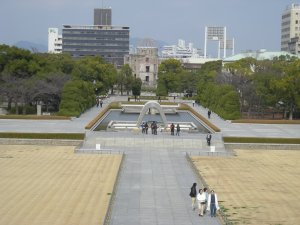
Looking back over the memorial towards the A-Bomb Dome across the river.


It was inside this room in the Memorial Museum that I was moved to tears.  Inside there were parts of clothing and shoes that had literally melted off of people.  This is a wall.  The streaks are the radioactive materials in the rain dripping down.

Now, the city of Hiroshima is thriving again.  Rather than put the past behind it after rebuilding, it has become a proponent of peace and the danger of nuclear armament.  In fact, every time a nuclear test is done anywhere in the world, the mayor of Hiroshima sends a telegram to the head of that state urging them to reconsider and to stop.  These are all posted over several walls in the museum.  The sad thing is that they still continue: entire rows are dated within months of each other to the same country.

Lest We Forget VI: Japan

Yes, Japan was an aggressor during the war.  However, that did not stop them from suffering horrific tragedies (more on that tomorrow).  While in Kyoto, I visited a great number of temples.  At one, a Buddhist temple with a massive (several stories high) statue of the Buddha sitting on the roof, there was a small shrine off to the side.  Inside, I was surprised and delighted to see a WWII memorial.

Above the file cabinets it reads “Individual Names of Allied Personnel who Perished in Territory under Japanese Jurisdiction during World War II.”

Thank you, Japan, for that rememberance.

Lest We Forget V: Australia and Midway.

Australia has a special place in my heart.  So it (nearly) gets its own section.  Many people don’t realize that Australia was actually bombed during WWII.  In fact, Darwin was bombed over 60 times and nearly 300 people died.  The major hits went to the wharf, where many boats were destroyed, and the oil reserves which, well, exploded.

Not only did Darwin suffer huge hits, but Australia was a training ground for many of the Allied troops that served in the South Pacific.  There was (is? Its existence is fairly secretive) a major training camp somewhere in the Northern Territory.  Australian troops were some of the most courageous in the South Pacific, many enduring horrible conditions as POWs under the Japanese.  Many Aussie civilians were instrumental behind-the-lines spies for the Allies in an underground organization called the Coastwatchers.  There is a monument to them in Madang, PNG.
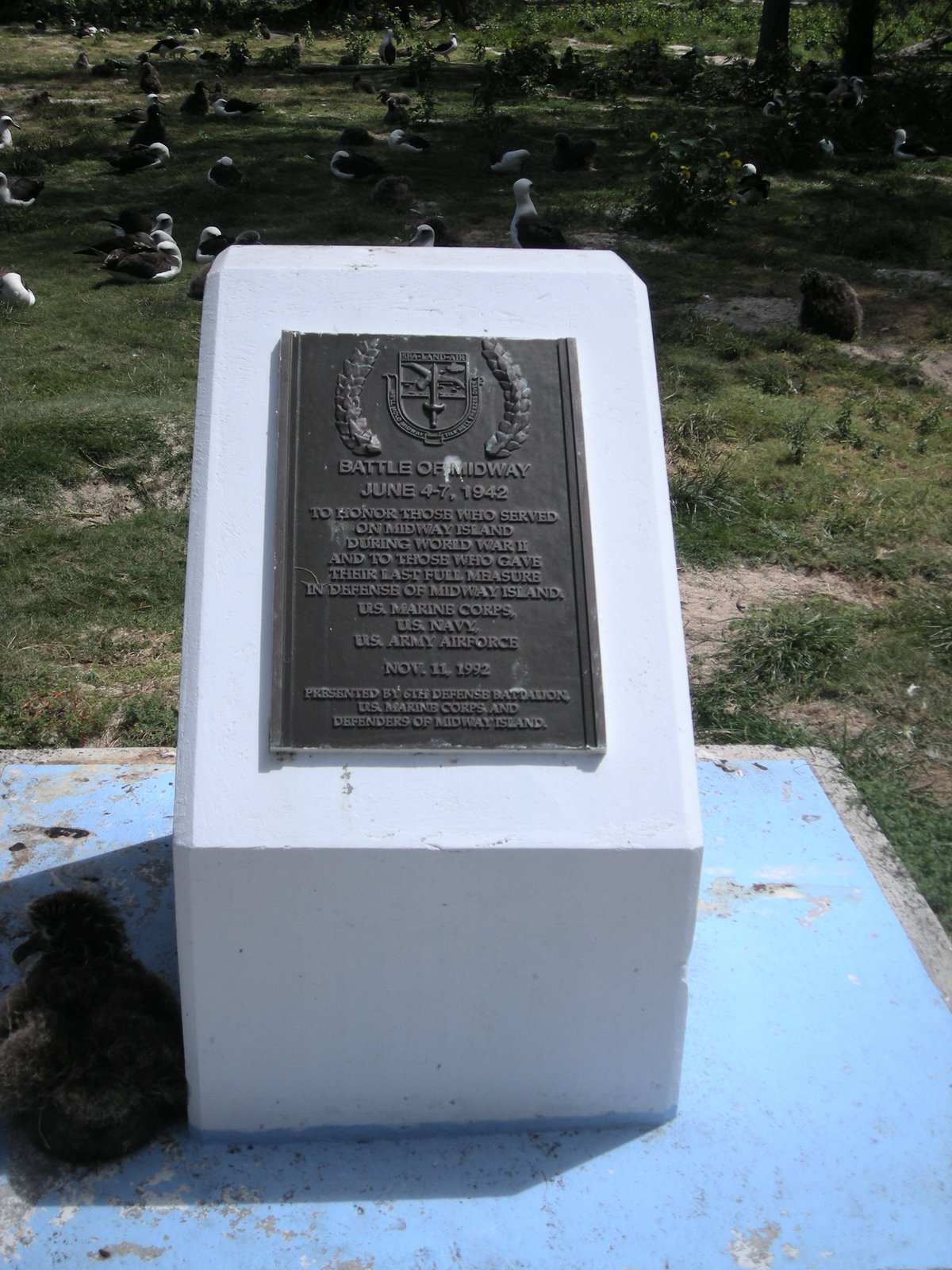
After leaving Japan on the way home on Offshore, we ran out of fuel.  Consequently, we stopped in at a small island in the Hawaiian chain that is aptly named: Midway.  Midway is considered by many to be the turning point of the War in the Pacific.  Pretty much, the Japanese got screwed here.  
To make a long story short:
Americans crack Japanese code but Japanese don’t know.  Americans learn Japanese planning attack on one of a couple places.  Americans send out phony messages, Japanese fall for bait and presto, Americans know where Japanese are going to hit next.  Japanese don’t know what is waiting for them.
The battle was long, the battle was hard, but in the end, the Americans won and the Japanese suffered huge losses and began to lose the rest of the battle.  They’d essentially tried to pincer the Pacific from the north and from the south and had now lost the north decisively.  You can still see the remnants of the war on Midway whether it be in monuments, in old buildings (like the old airplane hangar that was all shot up during the war), gun mounts, or even the guns themselves.  And there are lots of albatross on the island, 2 million and counting, but they are not from the war.

Now, Midway is run by the National Park Service and is a Wildlife Reserve.  There are about 60 people who live on the Island all of whom are either scientists, park employees, or Thai workers.  There are no kids, so they were delighted to see us.  The island is slowly returning to its natural state as the wildlife has free reign and comes first (even at the expense of your golf cart trip across the island or your evening volleyball game).  There is a push to retain some of the war sites like buildings so the past can still be remembered.

Lest We Forget IV: The War in the Pacific

Over the course of our time in the South Pacific, we essentially followed, in reverse, the Japanese advance through the region.  It was hard to believe that some of the beautiful, picturesque sites that we sailed (well, motored) through were once major battle grounds.  Like, for example, Gizo in the Solomon Islands, below.
The first major encounter with the war we had was in Luganville, Vanuatu.  Luganville is entirely quonset huts leftover from the war.  Its major tourist attraction is the wreck of the SS Calvin Coolidge, a ship that was used for transport by the Americans during WWII.  Upon entering the harbour, it struck a (friendly) mine.  The captain, knowing that he couldn’t save the ship, decided to run it ashore so as to save as much as possible.  En route, he it another mine and the boat sunk.  It is a long ship with the bow in only a few feet of water and the stern a long ways down.  It is quite divable and you can even go inside to check out some of the cargo of airplanes, jeeps, and weapons down there.
From Luganville, it kept getting more and more frequent that we ran into these types of sites.  Next stop was Honiara, the capital of the Solomon Islands.  If Honiara doesn’t ring a bell as a major battle in WWII, the name of the island it is on will: Guadalcanal.  The Allies and the Japanese fought a major battle for the island, one considered a turning point in the War in the Pacific.  At stake: the South Pacific.  Guadalcanal was along the major supply route for the Japanese.  If the passageway could be cut off, the Japanese advance through the South Pacific could be slowed if not halted.  The channel between Guadalcanal and its neighbouring island is often called Iron-bottom Sound in reference to the number of boats that were sunk in it during the war.
Now: Honiara is dirty, there are strange red patches all over the sidewalk from the betel nut that nearly everyone chews, its not the safest place I’ve ever been, especially for white women (I was fine, Dad), and there are lots of rats.  In fact, Houdini Sylvester, our [un]beloved rat joined us on board in Honiara.

From Honiara we continued north and west towards Papua New Guinea.  But first, there was a trip through Diamond Narrows (still in the Solomons) where we snorkeled a sunken supply ship (I swam up through the funnel, it was weird) to Gizo.  Just outside of Gizo is a small island that a very famous person swam to with the crew of his boat (PT-109) after being shipwrecked by a Japanese ship in the middle of the night.  There they survived for several days before getting word via the network of locals on the Allied side to American troops that they were alive.  This person’s identity is actually a Trivial Pursuit question, at least in the edition we had on board:
“During WWII, which former American President got malaria and suffered a herniated disk after being shipwrecked in the South Pacific?”  Answer will follow…  
This is the island:

Gizo is still home to a lot of quonset huts as well as a decent fresh produce market, some very friendly people at the biggest grocery store, and a rocking night club, the PT-109.  If you haven’t guessed it by now, the boat PT-109 was captained by non other than JFK.  He swam from the middle of the channel to the island dragging a crew-mate in a lifejacket with his teeth while the rest of his crew kicked their way over on a small part of the wreck.  I guess there wasn’t room for all of them.

From the Solomons, it was off to Rabaul, the centre of the Japanese world in the South Pacific.  Admiral Yamamoto had his hide-out high in the volcanic hills around the city and the hills are still littered with kilometers of Japanese tunnels.  We met a man who was actually born in one during the war.  Rabaul has a huge, incredible natural harbour.  It actually is a caldera, which accounts for its amazing shape.  The harbour is bordered by several active volcanoes, one of which was smoking profusely while we were there.  That is also the one I climbed to the top of.  No worries though, it last erupted about 10 years ago and completely destroyed the city.


After leaving PNG, we began our trek north.  First call was Chuuk/Truk Lagoon in the Federated States of Micronesia.  On the bottom of the lagoon is an entire Japanese fleet, sunk by the Americans during the war.  

After Chuuk, Guam.  There still remains a major US base on Guam, in fact, Guam was a huge culture shock: it was almost like being in Hawaii, complete with duty free shopping and Japanese tourists.  They even had stores that were open past 4pm and never ran out of eggs!  Just north of Guam, in the same island group is the island of Saipan.  We didn’t visit here because of unfavourable winds, but it was from Saipan that the airplane carrying atomic bombs bound for Hiroshima and Nagasaki left.

Lest We Forget III: The Holocaust

By all accounts, the Holocaust was one of the worst tragedies in human history.  The fact that similar things have happened since and, indeed, still happen, should not and does not lessen its tragedy.  It makes a person wonder if mankind will ever learn from our mistakes.
In Berlin, this monument covers nearly a city block.  While uniformly level at the top, some of the blocks are probably 8ft high.  It is possible to walk down the corridors between them.  It is an unusual monument and if it were not for Natalie, my friend and Euro-travel buddy, telling me it what it was, I likely would not have known.  There are no inscriptions on the blocks, as far as I could see.  Just large blocks of concrete.  Yet it is a memorial to the Holocaust.  Perhaps in memory of the thousands of nameless people who were killed.
One of the things I wanted to do in Europe was visit a concentration camp.  It is something, given the opportunity, that everyone should do at some point in their life.  Perhaps if we experience it, the reality becomes more impressed upon our souls and conscience and we are more likely to speak out in the future?  One can only hope.
I visited Sachsenhausen Concentration Camp, just a short train ride north of Berlin.  It was the model upon which other camps were based.  Sachsenhausen was a model of killing perfection.  It was set up so one guard in the tower with a machine gun could scan all rows between barracks and mow down everyone he saw.


The inscription on the gate says “Work will set you free.”  Literally, I suppose that meant that by death in the camp, you were free of the horrors of being there.


After the Germans left the camp, the Soviets actually took over operation and continued using it for similar purposes with their own prisoners.  This monument was a Soviet era piece.

The wall around the camp had a “Neutrale Zone” where you were killed upon entering (hence the skull and crossbones).  If that didn’t happen in time, the electric fence would probably stop you.


The Jewish prisoners had their own separate barracks.  A few years before I was there, some neo-nazis set fire to the Jewish section.  I guess they thought it sent a message of some kind.  Instead, there were a lot of people who funded the restoration of it.  These bunks remind me of Schindler’s List.

While I usually don’t go in for crazy stories of the supernatural etc., I did find it interesting that throughout my time in the camp, I had a headache that kept on getting worse and worse… until I stepped out of the gate to leave.  It totally disappeared.

Lest We Forget II: Pearl Harbor

Some consider the bombing of Pearl Harbor, Honolulu on December 7, 1941 to be a major turning point in the war because it brought the Americans into World War II. That FDR, the then President, had been maneuvering for a few years to get the American public to agree to go to war is often overlooked. At any rate, the attack on Pearl Harbor was devastating in the number of lives that were lost.

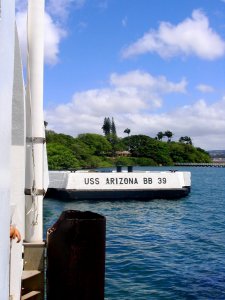
Japanese planes came, without much advance warning, and devastated the American fleet stationed in Pearl Harbor.  Many lives were lost including over a thousand on the USS Arizona.  When in Honolulu on Offshore, I took time to visit the Arizona Memorial at Pearl Harbor (along with hundreds of others that day – there were long line ups to get in).  It was a moving, if not slightly America-centred, experience.
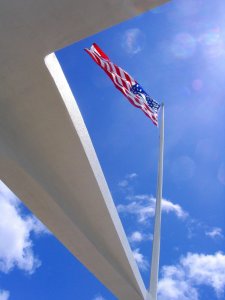
A bridge-like structure has been built over the wreck of the USS Arizona for visitors to walk on.  It is quiet inside, almost eerily, given that nearly 200 people are inside at any given time.  At one end is a list of all the names of those who perished when the Arizona went down.  It is slightly strange to look down at the wreck – the entire thing is just sitting on the bottom of the harbor as it fell – knowing that it is a tomb to so many young men (over 1000 were on board when it went down).

All around the edge of the harbor where the battleships were tied up, are these white markers.  They were, in fact, what each ship was tied to.  The name of each is written on it, two boats per marker.  All that remains of some of these boats is this name.


Sometimes called the tears of the Arizona, oil still floats away from the wreck on a daily basis.  Often, as is the case here, accompanied by the petals of flowers a rememberer has tossed into the water.

Lest We Forget I: Normandy

Over the last number of years, I’ve been had the honour of visiting various sites around the world with significance in World Wars I and II. Today is a week until November 11th, Remembrance or Armistice Day. In the lead up, I want to highlight some of those sites and the events that happened there.

To begin, the end of the war in Europe.  Bayeux is a small town in Normandy.  All the streets are stone and very narrow.  In fact, this is what saved the medieval town from destruction during the war: the tanks could not fit through the streets and so the liberating armies went around it.  Bayeux is perhaps the closest town to the D-Day beaches in Normandy, and the first town the armies would have encountered after leaving the beaches (it is also the town William the Conqueror left from on his conquest of England in 1066).  It was the base for my explorations of Normandy two years ago (original post here).
Bayeux is a small town but is home to a mammoth cathedral.  My aunt’s father was a medical officer with the Canadian Army in 1944 and came through here.  Strangely enough, when I was showing some of my photos to my aunt, she found one nearly identical of the cathedral that her father had taken 60 years earlier. 
Inside the cathedral are memorials to the members of the various armies who liberated Bayeux.
Arromanches Beach was first taken by the British and then used as a supply base.  Some of the floats used to create a breakwater around the beach can still be seen.
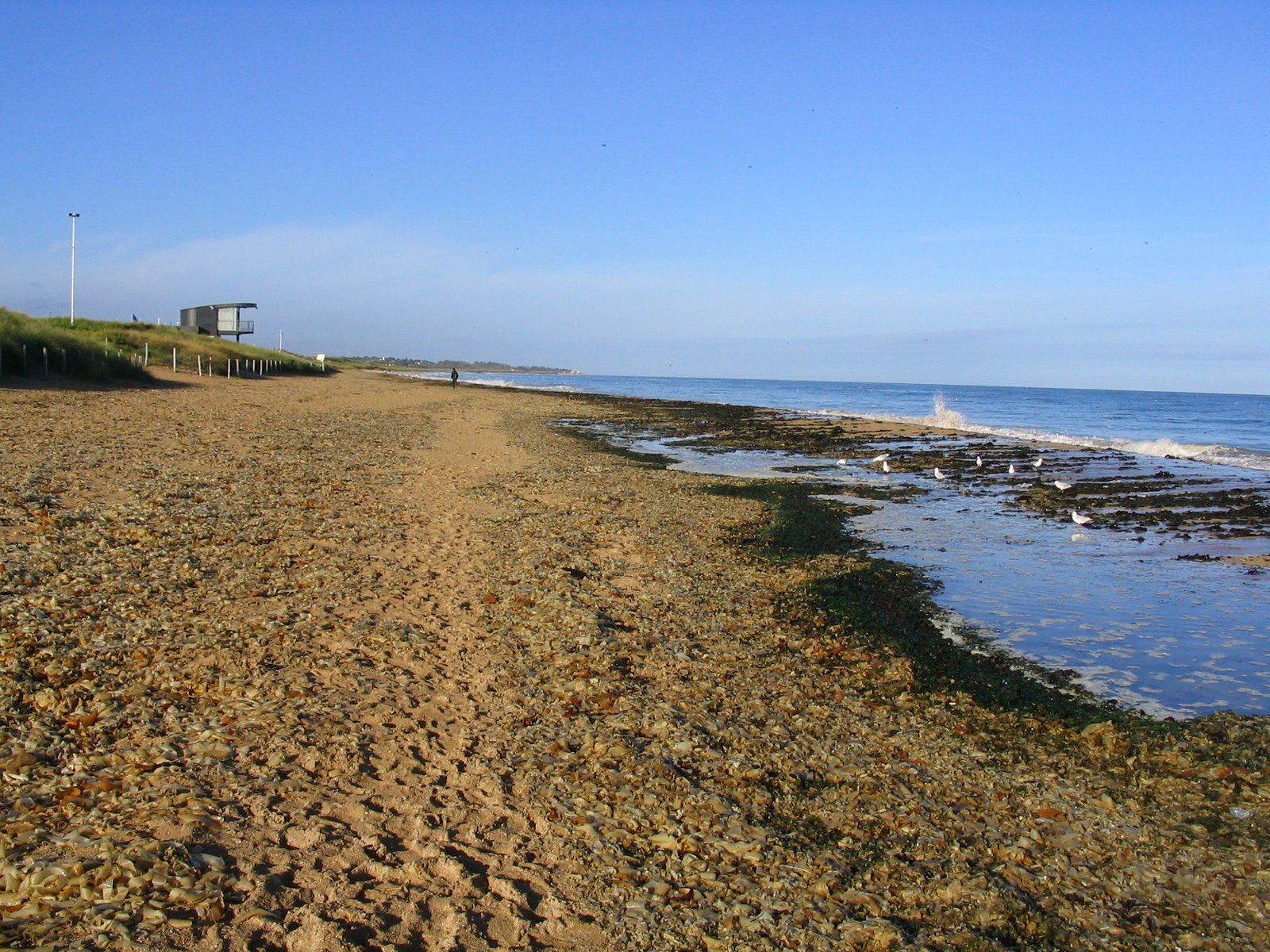
Juno Beach, where the Canadian Army landed.  On the 50th anniversary of D-Day, some good friends from Ontario (my “adopted” grandparents) came back with a group of veterans to visit this beach.  They brought me home a rock.  Cheesy as it sounds, when I visited Juno beach in 2006, the 62nd anniversary and 12 years after my friends did, I picked up another.  Its hard to imagine scores of boats and tanks once lined the beach here.  Perhaps some are still visible, but the tide was up.  All that remains are a few battered bunkers that presumably the German army returned fire from.
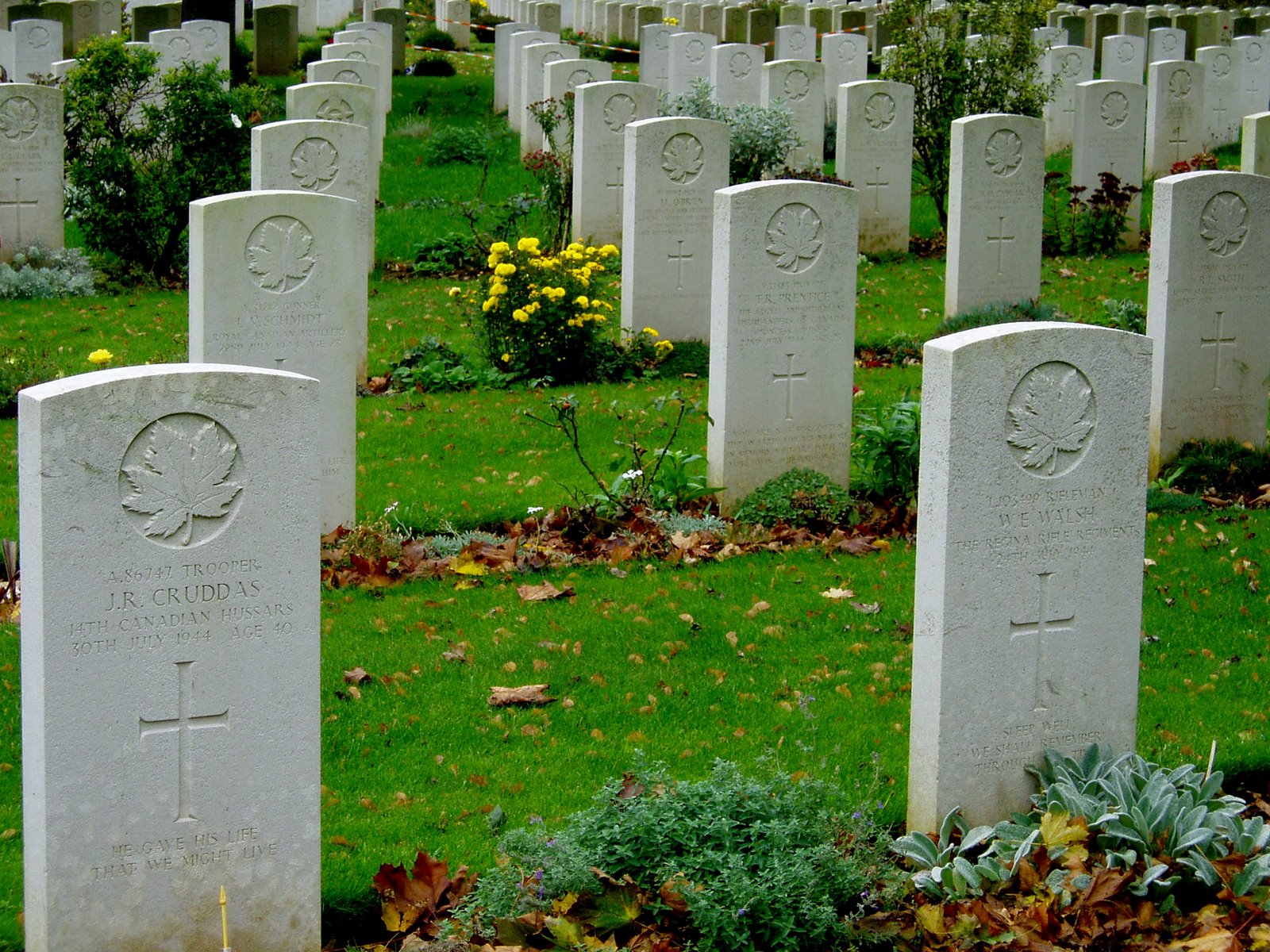
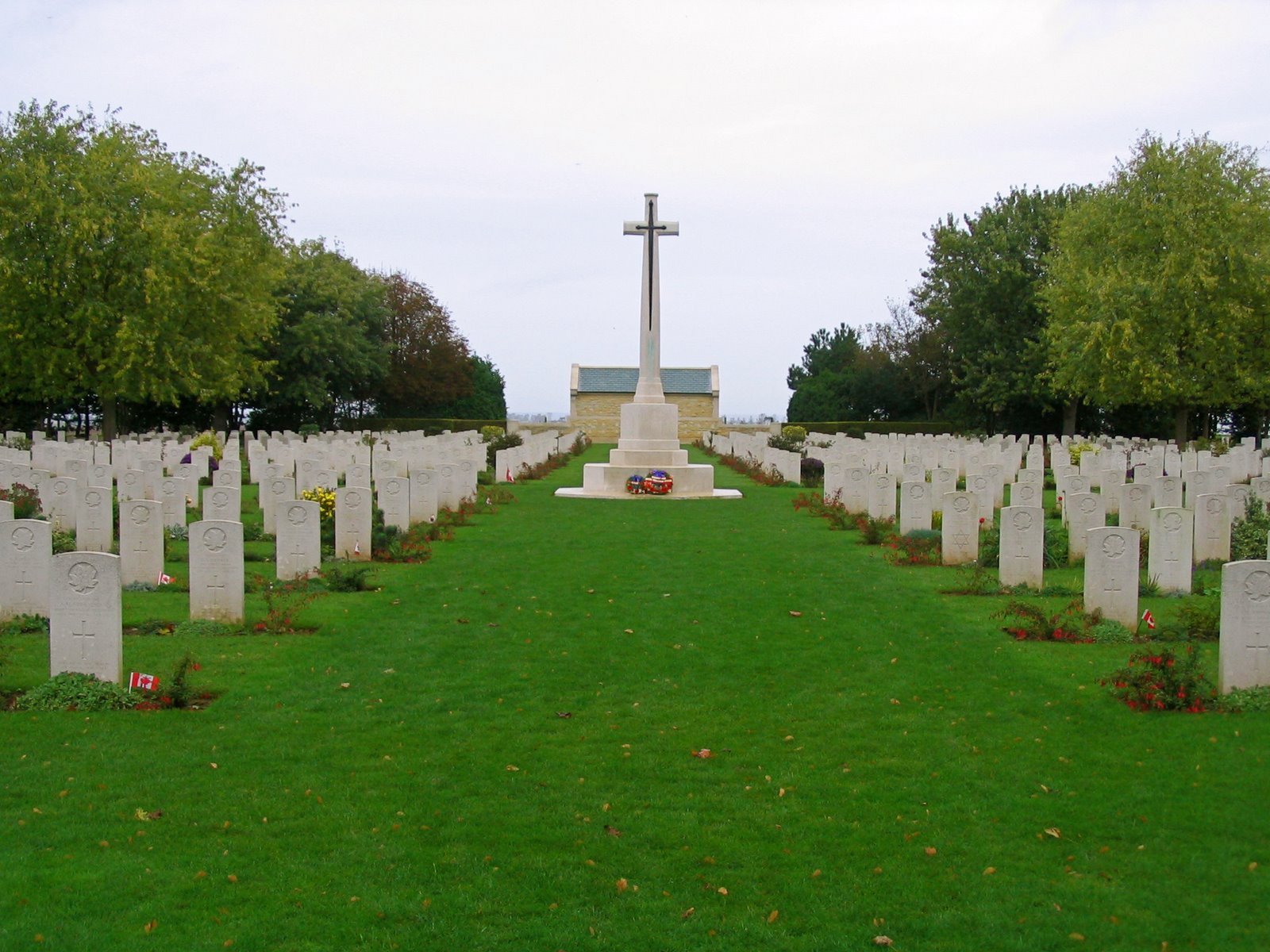
The Canadian cemetery in Normandy.  It is in the middle of farmer’s fields and can see the ocean.  Its not too big, but big enough considering what it contains.  It is always moving to visit war cemeteries overseas and see the love and care that locals give to maintaining them.